Takaichi Bows to the Taegeukgi Before the Korea-Japan Summit
Shifts from Hardline Conservative Image to Conciliatory Gestures
At the Korea-Japan summit venue, Japanese Prime Minister Sanae Takaichi was seen bowing her head in respect before the Taegeukgi, drawing significant attention. While it is not uncommon to pay respects to the flag of another nation during a welcoming ceremony or honor guard inspection, it is considered "highly unusual" for a leader to bow to the flag of the counterpart country inside the summit venue itself. The act has attracted even more interest because Prime Minister Takaichi, often categorized as a 'hardline conservative,' has previously made numerous 'hawkish' remarks toward Korea on historical and territorial issues.
Bows to the Taegeukgi Upon Entering the Summit Venue
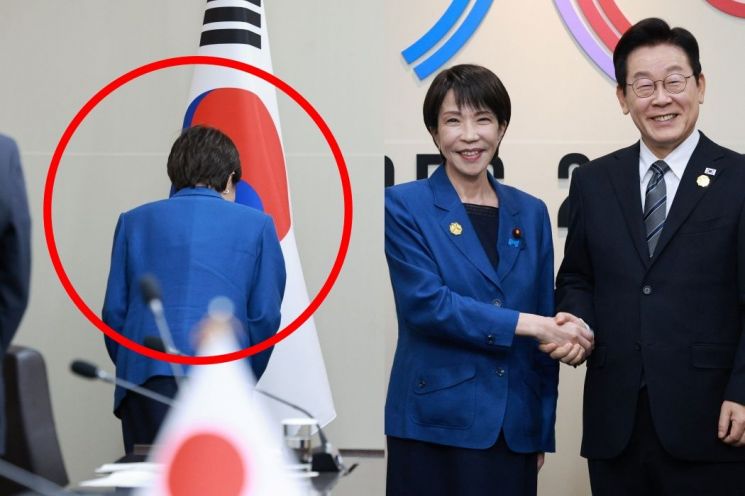 Sanae Takaichi, Prime Minister of Japan (red circle), is paying respect to the Taegeukgi before heading to her seat after a commemorative photo session with President Lee Jae-myung at the APEC Summit venue in Gyeongju, Gyeongbuk, on the 30th. Photo by Presidential Office Press Photographers Group Yonhap News
On the 30th, upon entering the Korea-Japan summit venue at the Gyeongju HwaBaek Convention Center, Prime Minister Takaichi shook hands with President Lee Jae-myung and took commemorative photos. On her way to her seat, she bowed her head toward the Taegeukgi, which was positioned on the left side of the venue.
Prime Minister Takaichi is widely regarded as an ultra-right-wing figure both domestically and internationally, which has further amplified interest in her actions. Takaichi is a politician who rose to prominence with the support of former Prime Minister Shinzo Abe, known for his 'historical revisionism.' Even as a cabinet minister, she consistently visited the Yasukuni Shrine, where Class A war criminals from the Pacific War are enshrined, thereby securing support from conservative circles. She is also seen as having inherited much of former Prime Minister Abe’s political line, frequently referencing a 'strong Japan.'
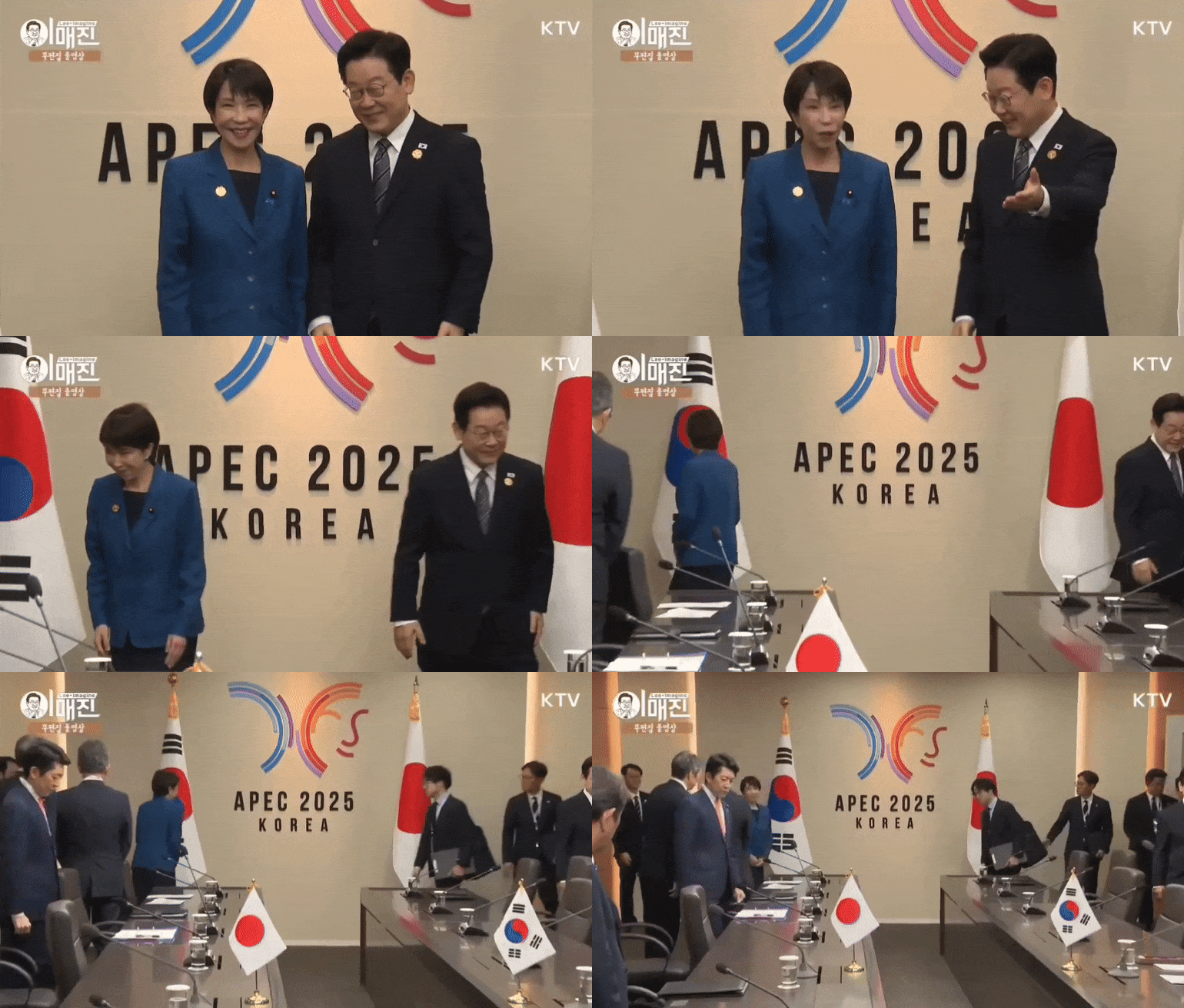 Sanae Takaichi, Prime Minister of Japan, pays respect to the Taegeukgi before heading to her seat after a commemorative photo session with President Lee Jae-myung at the APEC Summit venue in Gyeongju, Gyeongbuk on the 30th. Photo by KTV Imagine YouTube
"Korea Is Getting Uppity"... The 'Female Abe's' Harsh Rhetoric
At a symposium hosted by the far-right group 'Association for the Reverence of Yasukuni Shrine' in Tokyo in February 2022, Takaichi used the derogatory expression "getting uppity" to belittle Korea. Targeting the backlash from neighboring countries such as Korea and China over visits to Yasukuni Shrine, she said, "When we make ambiguous gestures, like stopping our visits to Yasukuni Shrine midway, the other side gets uppity (tsukeagaru)." The Japanese term 'tsukeagaru' means to take advantage of someone’s kindness or leniency and act in a disrespectful manner, which is often translated as "getting uppity" in English.
Takaichi also stated, "As a representative of a sovereign nation, it is only natural to have feelings of respect and reverence for the virtuous and to express sincere gratitude." She continued, "If we continue to do what is natural, the surrounding countries (such as Korea) will eventually look foolish and stop complaining," expressing an optimistic view through her controversial remarks. Regarding the term 'comfort women,' she denied the Japanese military's responsibility for forced sexual slavery, saying, "There were people called comfort women, but the term 'military comfort women' does not exist."
She is also known for having challenged former Prime Minister Tomiichi Murayama (1924-2025), who in 1994 expressed apology and remorse for Japan’s war of aggression and colonial rule, by asking, "Does the current prime minister have the right to declare a government decision made 50 years ago as wrong?" and "It is problematic to apologize on behalf of Japan without national consensus."
Adopts a Conciliatory Stance and Emphasizes Pragmatic Diplomacy
However, more recently, Takaichi has been issuing conciliatory messages one after another. At her inauguration press conference on the 21st, she expressed her willingness to improve Korea-Japan relations by saying, "I like Korean seaweed, cosmetics, and dramas." During the autumn festival at Yasukuni Shrine, she exceptionally refrained from visiting, leading to interpretations in Japan that she may be shifting toward pragmatic diplomacy.
In the summit that day, Prime Minister Takaichi stated, "Japan and Korea are important neighboring countries to each other," and emphasized, "Given the current strategic environment, the importance of Korea-Japan relations and cooperation between our two countries is increasing." She added, "This year marks the 60th anniversary of the normalization of diplomatic relations between Korea and Japan, a significant milestone. I am convinced that developing our bilateral relationship in a future-oriented and stable manner, based on the foundation we have built so far, will be beneficial for both countries."
© The Asia Business Daily(www.asiae.co.kr). All rights reserved.
![Clutching a Stolen Dior Bag, Saying "I Hate Being Poor but Real"... The Grotesque Con of a "Human Knockoff" [Slate]](https://cwcontent.asiae.co.kr/asiaresize/183/2026021902243444107_1771435474.jpg)
















