Amid ongoing comprehensive tariff pressure from U.S. President Donald Trump, China and Canada, whose relationship had been strained for some time, held their first official summit in eight years and expressed their willingness to restore ties. This official summit is the first since 2017, during the tenure of former Prime Minister Justin Trudeau.
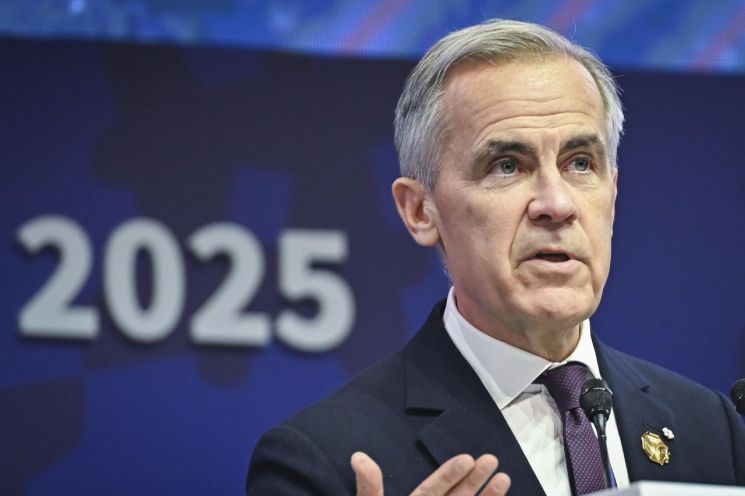 Mark Carney, Prime Minister of Canada, is delivering a speech at the 2025 Asia-Pacific Economic Cooperation (APEC) CEO Summit held at the Gyeongju Arts Center in Gyeongbuk on the 31st. Photo by Yonhap News
According to AFP and Bloomberg, on the 31st, Chinese President Xi Jinping met with Canadian Prime Minister Mark Carney on the sidelines of the Asia-Pacific Economic Cooperation (APEC) summit in Gyeongju and stated, "Thanks to the recent joint efforts of both sides, China-Canada relations are showing signs of recovery." He added, "China wishes to cooperate with Canada to put bilateral relations back on the right track."
President Xi invited Prime Minister Carney to visit China, and Carney accepted the invitation, responding, "I look forward to constructive and practical dialogue."
Previously, on the 27th, Prime Minister Carney emphasized a pragmatic approach to China, stating, "China is our second-largest trading partner and the world's second-largest economy."
The bilateral relationship froze in 2018 during the first U.S.-China trade war, when Canada, at the request of the United States, arrested Meng Wanzhou, Vice Chair of Huawei, China's largest telecommunications equipment company. In retaliation, China detained two Canadians on espionage charges.
In 2023, when allegations surfaced that China had surveilled a Canadian politician of Chinese descent, the two countries escalated tensions by expelling each other's diplomats.
Amid further allegations that China interfered in the 2021 Canadian general election, Canada imposed a 100% tariff on Chinese electric vehicles and a 25% tariff on steel and aluminum in August last year. In response, China imposed retaliatory tariffs of 25% to 100% on Canadian agricultural and livestock products, including canola oil, this March.
President Xi also expressed displeasure over the fact that his conversation with then-Prime Minister Trudeau at the Group of 20 (G20) summit in November 2022 was made public by the media.
Although Canada has reached out to China to protect its economic interests, some predict that results will not come easily due to the complexity of trade issues. China wants Canada to lower tariffs on electric vehicles, but Canada faces a dilemma of whether to protect its farmers' interests at the expense of its automotive industry. Additionally, given that Canada must continue negotiations with the United States, many analysts believe it will be difficult for Canada to strike a major deal with China without considering U.S. interests.
© The Asia Business Daily(www.asiae.co.kr). All rights reserved.
![Clutching a Stolen Dior Bag, Saying "I Hate Being Poor but Real"... The Grotesque Con of a "Human Knockoff" [Slate]](https://cwcontent.asiae.co.kr/asiaresize/183/2026021902243444107_1771435474.jpg)
















