50 Days in Office: Minister Won Minkyoung Embarks on Full-Scale Gender Equality Initiatives
"We Will Listen to Young Voices and Reflect Them in Policy"
The Ministry of Gender Equality and Family has officially begun its efforts to promote "gender equality policies." The ministry, which has changed its name from the former "Ministry of Gender Equality and Family Affairs" and decided to strengthen its functions and authority related to gender equality, plans to open public forums to help men and women perceive each other as "partners" rather than "competitors," and to take a leading role in closing gender perception gaps. The first step was the "Gender Equality Talk Concert." This initiative stems from Minister Won Minkyoung's belief that "accurate diagnosis must come before policy is established." The ministry plans to hold a total of five on-site meetings to identify the issues surrounding gender perception gaps among young people and reflect these findings in future policies.
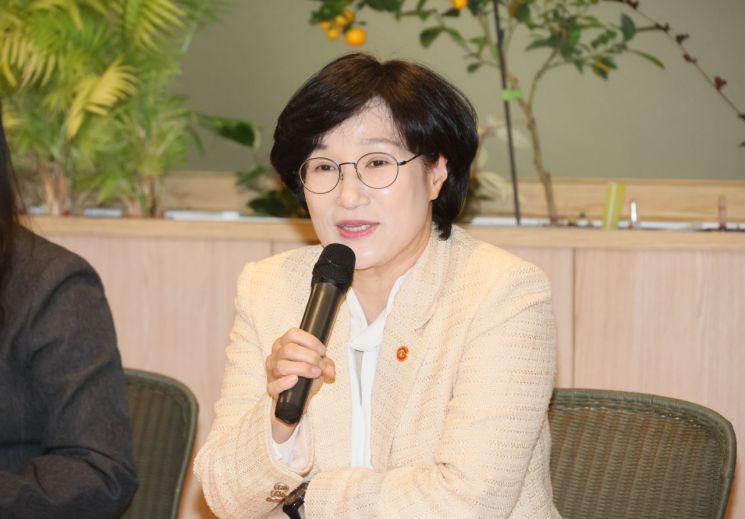 Won Minkyoung, Minister of Gender Equality and Family, held the 1st Gender Equality Talk Concert "Soda Pop" on the 29th at KT&G Sangsang Planet, discussing the diagnosis and solutions for gender perception gaps with young participants. Ministry of Gender Equality and Family
"When male colleagues go to the field, I am assigned phone work just because I am a woman" vs "Men are given all the tough tasks just because they are men"
On the evening of the 29th, marking her 50th day in office, Minister Won held the "1st Gender Equality Talk Concert" at KT&G Sangsang Planet in Seongdong-gu, Seoul. Twenty-one men and women in their 20s and 30s from various fields-including social welfare, IT, finance, culture and arts, aviation, and academia-participated in the event, engaging in a two-hour discussion on topics such as the women's additional points system, workplace discrimination, online conflicts, and safety awareness.
A woman in her 30s, Ms. Kim, said, "I joined the IT sector, but while my male colleagues who passed the same exam were sent to the field, I was assigned phone and desk work simply because I am a woman. People say men are being discriminated against, but women are still discriminated against in certain fields." She pointed out that gender, rather than job function, determines one's role. On the other hand, a man in his 20s, Mr. Lim, said, "In fields with many women, men are often assigned tough tasks such as long business trips. There are also situations where men are excluded from welfare benefits or support systems." He emphasized, "We need to make sure that gender equality policies do not invisibly marginalize anyone."
In particular, participants engaged in a heated debate over the women's additional points system. A man in his 30s, Mr. Kim, said, "In the film industry, if the writer or director is a woman, or if the main character is a woman, they receive significant additional points. I question whether such a system truly contributes to gender equality." Conversely, a woman in her 30s, Ms. Lee, argued, "In films dominated by male directors, the way women are portrayed is often too violent. I hope that by giving additional points, more films led by women will be produced." Another man in his 30s, Mr. Seok, also supported maintaining the system, stating, "Thanks to the additional points system, we are seeing more films from a female perspective."
Gender conflict online was also identified as a common issue. A man in his 20s, Mr. Lee, said, "Because of algorithms, people only see what they want to see and only talk among themselves. The younger generation, who are more exposed to the internet, seem to experience even greater gaps." He also noted that in school class president elections, there is now a tendency for "boys to vote only for boys, and girls only for girls."
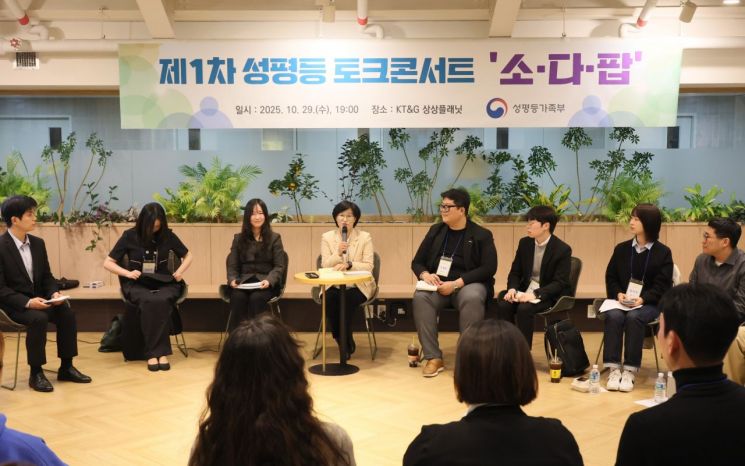 Won Minkyoung, Minister of Gender Equality and Family, held the 1st Gender Equality Talk Concert "Soda Pop" on the 29th at KT&G Sangsang Planet, discussing the diagnosis and solutions for gender perception gaps with young participants. Ministry of Gender Equality and Family
Gender perception gap stems from 'low growth, communication breakdown, and disconnect from reality'... Won Minkyoung: "We must understand and empathize with each other"
Why has the gender perception gap widened so much? During the meeting, participants also offered diagnoses of the causes. Baek Wonjong, an official from the Gender Equality Planning Division, identified "low economic growth, abnormal and disconnected communication online, and the gap between the values of gender equality and reality" as factors that have widened the gender perception gap.
According to the Bank of Korea's "National Accounts" data, South Korea's economic growth rate has hovered between 1% and 5% since 2006. This means that those born in 1986, who entered university around that time, began to face fierce competition in a chronically low-growth society. As the number of quality jobs decreased and competition intensified, perceptions of inequality regarding conflict increased. A 2022 analysis by the Ministry of Gender Equality and Family and the Bank of Korea on the "economic factors of youth gender conflict" found that in groups facing high competitive pressure, the proportion of respondents who felt their gender was treated unfairly was 3.61. Baek explained, "In a low-growth structure, people are more sensitive to issues of conflict and imbalance, and gender issues are highlighted for the same reasons."
Communication problems in online spaces are also cited as a cause of the gender perception gap. According to the National Integration Committee's "Status and Analysis of Youth Gender Conflict," the top reason for intensified gender conflict was "an online environment where productive communication is difficult, such as communities divided by gender."
Additionally, the disconnect between gender equality values taught in schools and their application in real life is seen as a factor that widens the perception gap. While gender equality education has accumulated, fixed gender roles still exist in areas such as hiring and caregiving, leading to conflict. Baek noted, "Both men and women feel that their own group is more discriminated against, but there are survey results showing that both agree on the need to resolve gender conflict." He emphasized, "We need to start social dialogue with agendas that can realistically reach consensus."
Minister Won said, "I planned this event in the hope that it would help shape future policies. Today is not about drawing conclusions, but about listening to each other's thoughts. We can only move forward by understanding and empathizing with one another." The ministry plans to hold four more meetings by the end of the year, aiming to close the perception gap between men and women.
© The Asia Business Daily(www.asiae.co.kr). All rights reserved.
![Clutching a Stolen Dior Bag, Saying "I Hate Being Poor but Real"... The Grotesque Con of a "Human Knockoff" [Slate]](https://cwcontent.asiae.co.kr/asiaresize/183/2026021902243444107_1771435474.jpg)
















