Dong-A Transportation Second Trial Recognizes Regular Bonuses as Ordinary Wages
Union: "Strike Possible Next Month If Good-Faith Negotiations Do Not Occur"
Overdue Wages Must Be Paid Separately from Collective Bargaining, Including Interest
A court has ruled that regular bonuses for bus drivers are to be included as ordinary wages. This decision is expected to impact ongoing negotiations between labor and management of Seoul city buses, who have been in conflict over issues related to ordinary wages.
According to the Seoul City Bus Labor Union on October 30, the Seoul High Court ruled the previous day, in the second trial of a lawsuit filed by Dong-A Transportation workers, that regular bonuses should be considered part of ordinary wages. The first trial had determined that bonuses did not qualify as ordinary wages, but this decision overturns that ruling. In December of last year, the Supreme Court's Grand Bench expanded the scope of ordinary wages by recognizing regular bonuses as such.
The court stated, "The bonuses in question appear to have been paid as compensation for work performed during the calculation period. It is difficult to say that they were paid to all employees regardless of the actual work provided, simply because they were employed at a certain point in time." The court further explained, "It is reasonable to view these bonuses as regular and uniform compensation for prescribed work." The court clarified that the legal principles established by the Supreme Court's Grand Bench regarding ordinary wages apply in this case.
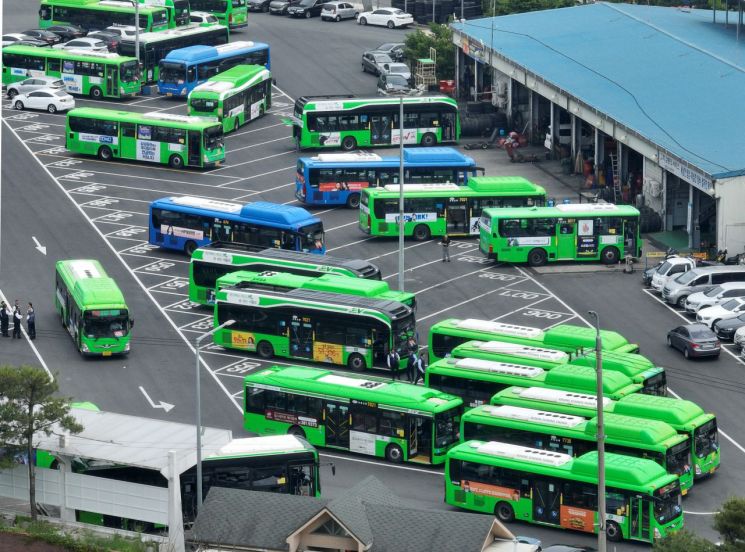
The issue of ordinary wages is at the core of the ongoing conflict between labor and management in Seoul's city bus sector this year. The management, represented by the Seoul City Bus Transport Business Association and the Seoul Metropolitan Government, maintains that, given the expanded scope of ordinary wages and the resulting sharp increase in labor costs, the wage system should be restructured by incorporating bonuses into base pay. The union, on the other hand, argues that since the Supreme Court has ruled that bonuses must be included in ordinary wages, this issue should not be subject to collective bargaining negotiations and must be paid as a matter of course.
On this day, the union warned, "If the business association and the Seoul Metropolitan Government continue to ignore the union's demands for improved working conditions and fail to engage in sincere negotiations following this ruling, a complete suspension of all Seoul city bus services, including general and converted buses, could occur starting from November 12." On October 27, four companies that converted their licenses from village buses to city buses completed mediation applications with the Seoul Regional Labor Relations Commission. Once the mediation period expires at midnight on November 11, strikes and other labor actions will become possible. The 61 city bus companies affiliated with the union have already secured the right to strike following a breakdown in mediation in April.
Additionally, the union called on management to pay all overdue wages in accordance with the Supreme Court's recognition of ordinary wages, separate from the ongoing collective bargaining negotiations. The union stated, "The issue of overdue wages arising from this year's collective bargaining and the recognition of ordinary wages are separate matters," and added, "We have officially notified each Seoul city bus company that not only unpaid wages since last year's Supreme Court ruling, but also claims for damages due to delayed interest, punitive damages claims effective since the 23rd, and even criminal complaints are now unavoidable."
© The Asia Business Daily(www.asiae.co.kr). All rights reserved.
![Clutching a Stolen Dior Bag, Saying "I Hate Being Poor but Real"... The Grotesque Con of a "Human Knockoff" [Slate]](https://cwcontent.asiae.co.kr/asiaresize/183/2026021902243444107_1771435474.jpg)















