2026 Seoul Budget Announced at 51.5 Trillion Won
15.6 Trillion Won for 'Walking Together with the Vulnerable'... Covering Livelihood to Culture
Mayor Oh: "Disappointed by Criticism That Policy Direction Has Been Compromised"
Proactive Urban
Seoul Mayor Oh Sehoon's core policy initiative, "Walking Together with the Vulnerable," will be expanded. The scope of welfare, which has so far focused on beneficiaries such as low-income households, residents of single-room dwellings, and the elderly, will be broadened to cover all administrative areas of Seoul, including employment, healthcare, housing, and culture. The city has decided to allocate its budget to policies for the "vulnerable." Mayor Oh stated, "The vulnerable are not limited to low-income groups," and added, "The 'Walking Together with the Vulnerable' initiative will continue to evolve and develop."
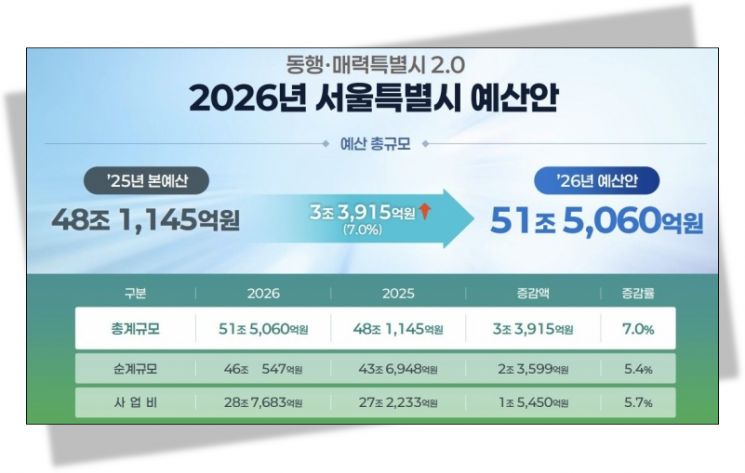
The 2026 budget proposal unveiled by Mayor Oh on the morning of the 30th totals 51.506 trillion won. Of this, 15.6 trillion won will be allocated to the "Walking Together with the Vulnerable" initiative, an increase of 800 billion won compared to this year. Excluding 5.4513 trillion won of overlapping entries due to inter-account transfers and support for the Office of Education and district offices, about half of the actual policy project budget of 28 trillion won will be dedicated to "vulnerable policy."
Despite this, the city's debt will not increase. Even with variables such as the government's livelihood recovery consumption coupons this year, resources were efficiently allocated, and the debt scale did not rise. Next year's debt is expected to remain at the previously projected end-of-2025 level of 11.6518 trillion won.
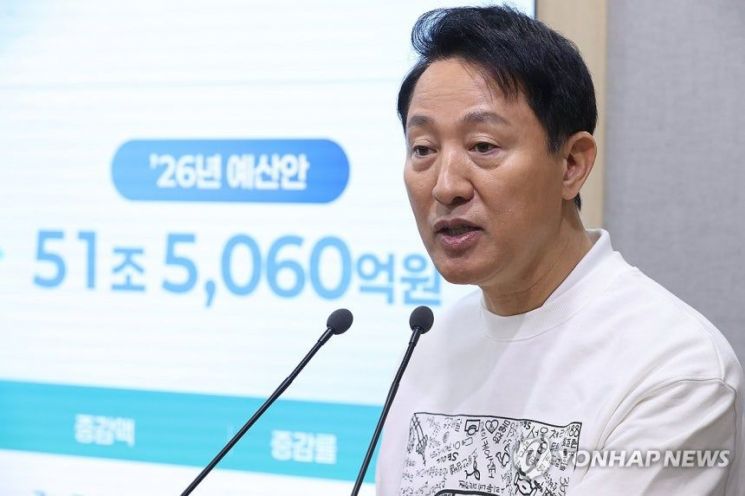 Seoul Mayor Oh Sehoon is holding a press briefing on the 2026 Seoul Metropolitan Government budget proposal at the Seoul City Hall briefing room on the 30th. Photo by Yonhap News
Half of Policy Budget for 'Vulnerable Policy'... 15.6 Trillion Won to Be Invested
The city's core "Walking Together with the Vulnerable" initiative will see an investment of 15.6 trillion won, up 800 billion won from this year, to provide more comprehensive support for vulnerable groups. This is an increase of 2.3937 trillion won compared to the 13.2319 trillion won budget when the initiative was first fully launched in 2023. By major sectors, the allocations are: ▲Livelihood (9.3453 trillion won), ▲Medical and Health (2.7754 trillion won), ▲Housing (2.6157 trillion won), ▲Education and Culture (288.1 billion won), ▲Social Safety Net (539.8 billion won), and ▲Social Integration (61.2 billion won).
In fact, next year's "Walking Together with the Vulnerable" initiative will be expanded to cover a broader range of areas. In addition to support for the four basic allowances (4.7645 trillion won), meal support for low-income groups (80.1 billion won), and the establishment of an integrated care system (6.4 billion won), detailed allocations have been made for small business owners and SMEs (745.2 billion won) and for creating a stable residential environment (1.7016 trillion won).
Notably, the scope of beneficiaries for the initiative has been expanded. A total of 7 trillion won will be allocated to so-called "life-cycle customized support budgets," including: ▲Creation of Seoul-style kids cafes and kids lands (40.8 billion won), ▲Operation of Seoul-style safe postpartum care centers (2.8 billion won), ▲Expansion of additional support for families with multiple children (68.9 billion won), ▲Seoul Learn 3.0 (23.6 billion won), ▲Seoul Young Careers (15.6 billion won), ▲Operation of mid-to-senior employment academies (10 billion won), ▲Creation of leisure spaces for seniors (3 billion won), and ▲Expansion of public silver care and daycare centers (2.6 billion won).
Mayor Oh addressed the reason for the reduction in the budget for existing areas of support under the initiative, saying, "There is always a dilemma with 'Walking Together with the Vulnerable,'" and expressed disappointment at criticism that this deviates from the policy's core. He explained, "The elderly are vulnerable, people with disabilities are vulnerable, and according to such classification criteria, the vulnerable are not limited to low-income groups," adding, "There are always rational criteria when the budget for a particular sector increases or decreases."
Proactive Response to Urban Disasters... Budget Allocated for Mobile Response Vehicles, Han River Buses, and More
A total of 4.3663 trillion won will be invested in the "safety" budget for citizens' daily lives. This is aimed at proactively responding to urban disasters caused by climate change, such as heavy rainfall, ground subsidence, and fires. The city will enhance the durability of overall infrastructure and diversify inspection methods, including maintenance of water and sewage pipelines over 30 years old (447.7 billion won), replacement of old heat transmission pipes (6 billion won), and replacement of aging facilities on subway lines 1 to 8 (92.3 billion won).
Additional support will be provided for the city's flagship "Climate Companion Card" policy. From next year, K-Pass benefits will be expanded to an "unlimited flat-rate pass" similar to the Climate Companion Card, and it is expected that many users will switch to K-Pass. The budget for operating the Climate Companion Card is 148.9 billion won, while the K-Pass operating budget is 377.5 billion won. This is a reversal from this year, when the Climate Companion Card budget (108.9 billion won) was higher than the K-Pass budget (99.6 billion won).
Kim Taemyung, Director of Transportation Planning for Seoul, explained, "As of last month, 700,000 people use the Climate Companion Card and 670,000 use K-Pass. With the expanded benefits, we expect about 350,000 people to switch to K-Pass," adding, "The budget proposal was prepared based on that assessment."
In addition, the city bus and village bus budgets, which have been a source of conflict between Seoul City and the central government regarding financial support, have been set at 350 billion won and 51 billion won, respectively. This represents increases of 30 billion won and 9.4 billion won compared to this year. However, key issues such as the inclusion of bonuses in base pay, which is central to the city bus labor-management dispute, and compensation for transfer losses requested by the village bus association, are not included in this budget. Director Kim stated, "Compensation for transfer losses requires further review because it is a system where surplus operators receive more support," adding, "We plan to coordinate these issues through working-level consultations going forward."
The budget also reflects consideration for the Han River Bus project. Next year, 13.2 billion won will be allocated, double the 6.1 billion won provided this year for safe operation support. The city explained, "This is to enhance convenience and safety for users by linking with other public transportation such as buses, responding to natural disasters, and maintaining docks."
Oh Sehoon Criticizes Government Measures... "Will Propose Adjustment of Mandatory Supply Ratio for Rental Housing in Redevelopment Projects"
On this day, Mayor Oh provided detailed explanations regarding the housing sector budget. In particular, he announced plans to propose to the government a reduction in the mandatory supply ratio for rental housing applied to redevelopment and reconstruction projects to facilitate housing supply.
Mayor Oh stated, "When I recently visited the redevelopment site in Garibong-dong, an association official earnestly asked if we could reduce the rental housing ratio due to economic concerns," adding, "At this morning's meeting, I suggested we respond flexibly." He continued, "In the past, when the economy was strong and real estate prices were stable, the rental housing ratio was different from now," and added, "To reassure citizens, Seoul will do what it can, and for matters that require legal changes or action by the Ministry of Land, Infrastructure and Transport, we will make requests as necessary."
Choi Jinseok, Director of Housing for Seoul, also explained, "By law, the mandatory rental housing ratio is set at 50-70% for redevelopment and 30-50% for reconstruction, and Seoul has long set it at 50% through ordinances." He added, "While factors such as increasing floor area ratio, applying profitability adjustment coefficients, and shortening approval periods are external aspects of support for redevelopment projects, the rental housing ratio is an internal factor," and continued, "Since many developers have requested this, we believe it is worth discussing."
When asked whether the government's October 15 real estate measures, which have reduced the number of real estate transactions in Seoul, would make it difficult to secure local tax revenue, Mayor Oh replied, "Acquisition tax, which forms the backbone of local taxes, will inevitably decrease. It is a concern." However, he added, "Even if transactions decrease by 80%, acquisition tax does not decrease by the same proportion, as there are various forms of ownership changes such as inheritance and gifting, which serve as a buffer," and explained, "It is true that there will be some impact, but it will not decrease drastically, so we have taken a very conservative approach in budgeting."
Mayor Oh reiterated his criticism of the October 15 measures, stating, "They do not promote housing supply but rather make it impossible to buy or sell homes, forcing people into expensive monthly rentals." He added, "Whatever direction the government takes, we will do our best to cooperate, alleviate citizens' concerns, and prioritize stabilizing the real estate market through increased supply."
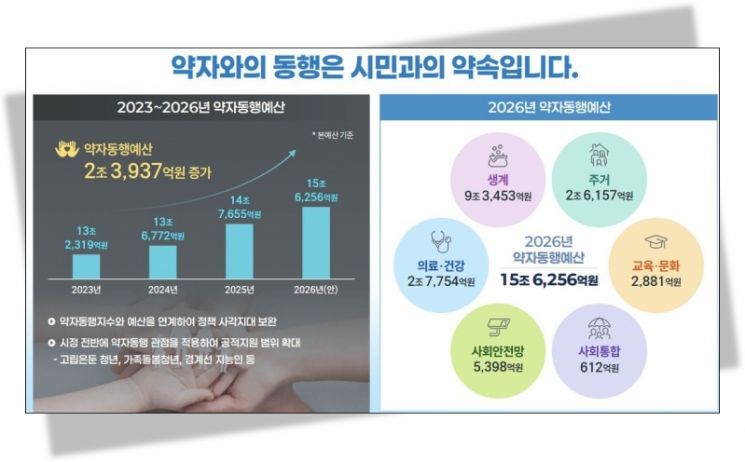 2026 Seoul Metropolitan Government Budget Proposal for 'Walking Together with the Vulnerable'. Seoul Metropolitan Government
© The Asia Business Daily(www.asiae.co.kr). All rights reserved.
![Clutching a Stolen Dior Bag, Saying "I Hate Being Poor but Real"... The Grotesque Con of a "Human Knockoff" [Slate]](https://cwcontent.asiae.co.kr/asiaresize/183/2026021902243444107_1771435474.jpg)


















