Immediate Resumption of Soybean Purchases
Key Technology and Security Issues Excluded
"No Discussion on Nvidia Blackwell"
Leaders Agree on Mutual Visits Next Year and Cooperation on Ukraine
On October 30, U.S. President Donald Trump announced that, following his meeting with Chinese President Xi Jinping, the United States had agreed to reduce tariffs on Chinese products by 10 percentage points. In accordance with the bilateral agreement, China will suspend its export controls on rare earth elements for one year and will immediately resume purchases of American agricultural products such as soybeans. As a result, the conflict between the United States and China, which has shaken the world trade order and heightened economic uncertainty, has been narrowly resolved. However, some point out that fundamental sources of conflict remain, including the competition for technological supremacy, the Taiwan issue, and advanced semiconductor regulations.
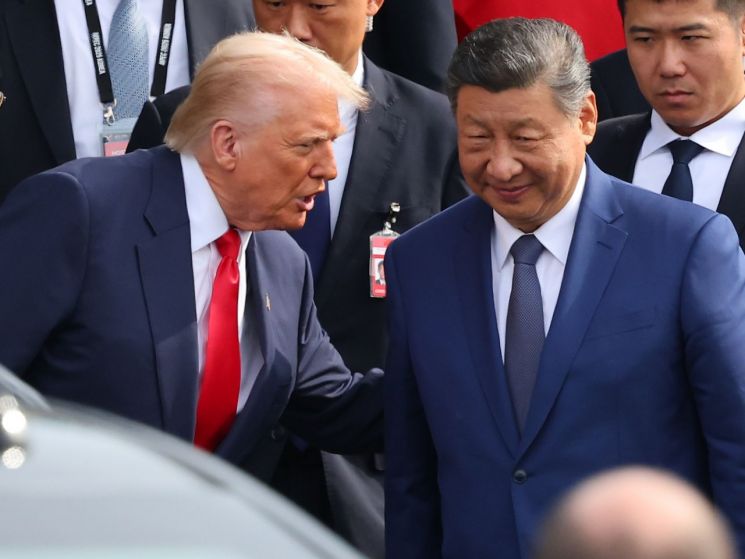
Trump Reduces Tariffs on Chinese Goods... Agreement on Rare Earth Exports and Soybean Purchases
President Trump conveyed this in a brief press conference aboard Air Force One on his way home after meeting with President Xi at Gimhae Air Base in Busan. He explained that the agreement formalized the basic framework prepared by working-level officials from both countries during their meeting in Malaysia on October 25-26.
This summit marked the first direct encounter between President Trump and President Xi in six years. Before the meeting, President Trump predicted it would be a "successful meeting," while President Xi stated that "the United States and China are ready to enter a truce on major issues."
The key agenda item of the trade negotiations-China’s export controls on rare earth elements-was ultimately settled with a one-year suspension. The rare earth agreement will remain in effect for one year, after which both sides will reconvene annually to decide whether to extend it. President Trump expressed optimism, saying, "The rare earth issue has been completely resolved. That obstacle is now gone," and added, "China may further expand its investments in the United States and possibly extend the suspension of its rare earth policies."
Jamison Greer, the United States Trade Representative (USTR) attending the expanded summit, stated, "We focused on China's controls over rare earths, and China has promised to continue supplying them."
President Trump described his meeting with President Xi as "amazing," saying, "On a scale of 0 to 10, this meeting was a 12. The relationship between our two countries is very, very important, and it was truly an excellent meeting."
President Trump also announced that China had pledged to take concrete steps to reduce the influx of fentanyl precursors into the United States. Accordingly, the United States will lower the so-called "fentanyl tariff" on Chinese products from 20% to 10%. After returning to office, President Trump had imposed a punitive 20% tariff, criticizing China for not cooperating in blocking fentanyl shipments.
He said, "I believe President Xi will work very hard to stop 'death (fentanyl)' from coming into the United States."
President Trump further stated that China had agreed to immediately purchase American agricultural products, including soybeans. He also reported an agreement to abolish tariffs and fees in the shipping sector.
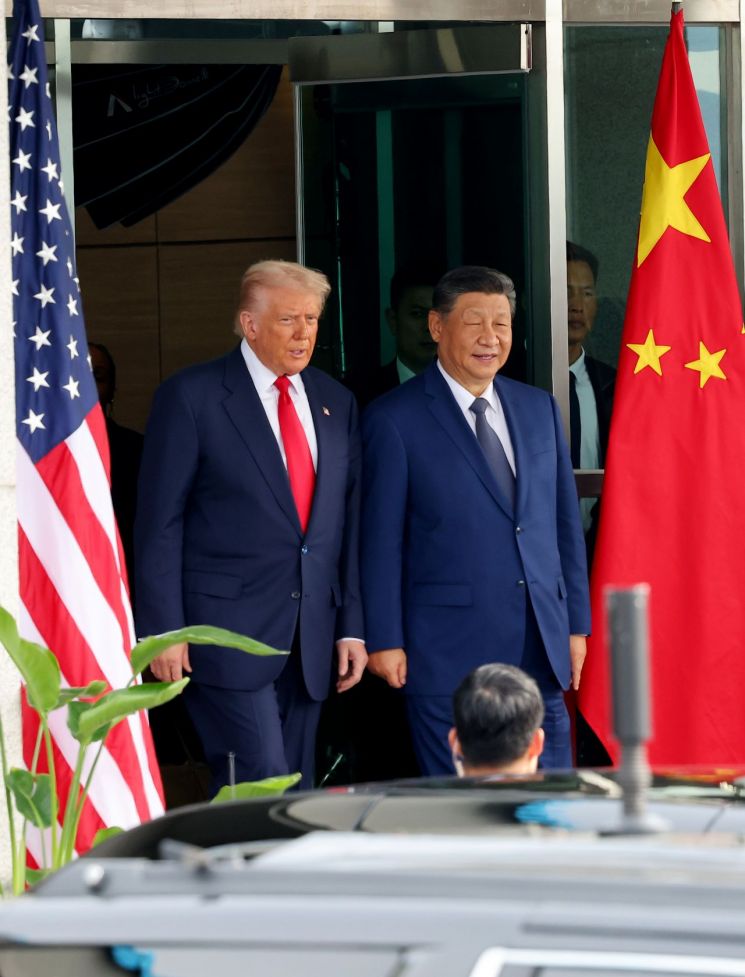
"No Discussion of Nvidia Blackwell"... Taiwan Issue Not Raised
President Trump clarified that the easing of export restrictions on Nvidia's Blackwell chips was not discussed at this summit. He said, "Blackwell, which was just released yesterday, was not discussed," but added that there were talks with Nvidia and other companies regarding chip supplies within China. Previously, while en route to Korea to attend the 2025 Asia-Pacific Economic Cooperation (APEC) summit, President Trump had told reporters that there was a possibility of discussing Nvidia’s latest AI chip, "Blackwell," with President Xi.
The Taiwan issue was also not raised during this summit. Before the talks began, both leaders declined to answer questions related to Taiwan.
President Trump stated that the two countries had agreed to cooperate on the Ukraine issue, saying, "We have discussed this matter for a long time and will work together to find a solution." However, the issue of China’s large-scale imports of Russian crude oil was not specifically addressed.
President Trump said that details of China’s investment plans in the United States would be announced at a later date. He did not address the approval of the sale of TikTok’s U.S. operations or the relaxation of regulations requiring subsidiaries with more than 50% ownership by sanctioned companies to be subject to the same controls-issues that were expected to be included in the agreement. This regulation, which subjects subsidiaries of blacklisted companies to the same export controls, has increased due diligence burdens for American exporters and has been a point of contention for China.
President Trump announced plans to visit China in April next year, and President Xi is also scheduled to visit the United States next year. President Trump added that he was unable to meet with North Korean leader Kim Jong Un during this Asian tour, saying, "We did not meet this time, but we maintain a good relationship and I am open to meeting again in the future."
Experts assessed that the agreement was more of a short-term stabilization measure than a substantive breakthrough. Craig Singleton, a China analyst at the Foundation for Defense of Democracies (FDD), said, "As has been the pattern throughout this year, both sides are packaging short-term easing as 'strategic progress.' They are maintaining only the minimum level of cooperation to avoid crisis."
The Guardian also reported, "With both sides agreeing to ease tariffs and ensure supply stability at this summit, the uncertainty in the global economy is likely to ease in the short term." However, it noted that fundamental conflicts remain, such as the competition for technological supremacy, the Taiwan issue, and advanced semiconductor regulations.
© The Asia Business Daily(www.asiae.co.kr). All rights reserved.


















