First Meeting in 6 Years and 4 Months: Immediate Relief on Tariffs, Rare Earths, and Soybeans
Core Tensions Remain... Expert: "A Short-Term Truce"
Donald Trump, President of the United States, and Xi Jinping, President of China, will meet in Busan on October 30. While this U.S.-China summit is expected to temporarily resolve the intense conflict between the two countries, which had once imposed triple-digit tariffs on each other, it is anticipated that the agreement will face numerous challenges during the actual implementation process.
This face-to-face meeting between President Trump and President Xi is the first since the start of Trump’s second administration, and the first in six years and four months since the Group of 20 (G20) Summit in June 2019.
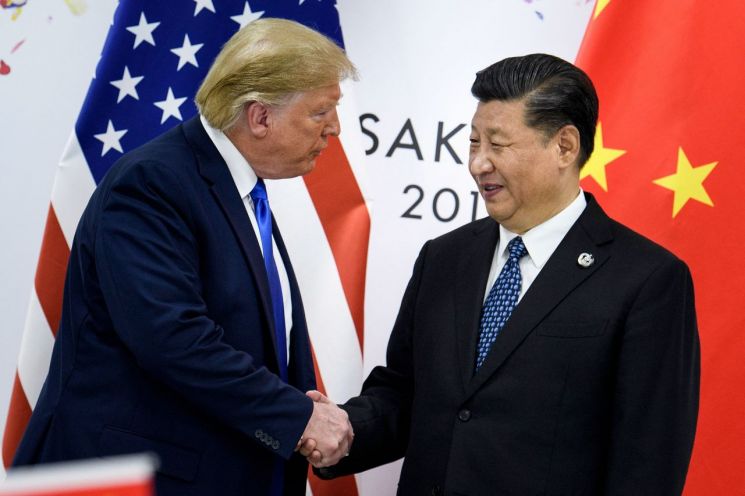 Donald Trump, President of the United States (left), and Xi Jinping, President of China. Photo by AFP Yonhap News
The main focus of this U.S.-China summit is whether President Trump and President Xi will officially begin to end the trade war. Immediately after his second inauguration, President Trump began imposing tariffs on China, citing concerns over fentanyl precursor exports. In response, China imposed retaliatory tariffs, and by April, the U.S. tariff rate on Chinese goods had soared to 145%, while China’s tariff rate on American goods reached 125%, causing global economic uncertainty. The two countries subsequently held five rounds of high-level trade talks in search of common ground.
If the U.S.-China summit brings an end to the tariff war, agreements are also expected on issues such as rare earth elements, soybeans, and TikTok. On October 26 (local time), U.S. Treasury Secretary Scott Besant stated in interviews with American media that the two countries had established a framework for a trade agreement. China will suspend its rare earth export controls for about a year, and the U.S. will not impose the additional 100% tariffs scheduled for next month. In addition, China will resume imports of American soybeans, and the U.S. has agreed to lower tariffs on fentanyl. Secretary Besant also noted progress regarding the sale of TikTok’s U.S. operations. As the leaders of both countries move to resolve their conflict, the global economy is expected to breathe a sigh of relief.
However, even if a trade agreement is reached, fundamental tensions between the two countries remain, meaning the risk of a renewed trade war has not been completely eliminated. The U.S. continues to maintain technology export controls targeting China, and with the rare earth export controls only suspended for a year, China can reintroduce them at any time. As long as China challenges the U.S. as a hegemonic power and seeks to expand its influence in the Indo-Pacific, geopolitical clashes are inevitable. Jack Cooper, Senior Fellow at the American Enterprise Institute (AEI) and a former official in the George W. Bush administration, commented, "This is more of a short-term truce than a long-term solution."
© The Asia Business Daily(www.asiae.co.kr). All rights reserved.
![Clutching a Stolen Dior Bag, Saying "I Hate Being Poor but Real"... The Grotesque Con of a "Human Knockoff" [Slate]](https://cwcontent.asiae.co.kr/asiaresize/183/2026021902243444107_1771435474.jpg)















