Exchange Rate Drops to 1,420 Won as US Investment Uncertainty Eases
After US Rate Cut and "Hawkish Remarks"... Market Focuses on Additional Cut in December
Year-End Range Opened to Mid-to-High 1,300s
"Structural Pressures Must Be Considered in the Mid-to-Long Term"
Following the news of the Korea-US tariff negotiation settlement, the foreign exchange market experienced a temporary sense of relief, causing the won-dollar exchange rate to drop to the 1,420 won level. Despite the US making hawkish (favoring monetary tightening) remarks about the December interest rate overnight, ongoing market expectations for an additional rate cut by the end of the year are also easing exchange rate pressures. Experts noted that while there is room for the won-dollar exchange rate to fall to the mid-to-high 1,300 won range by year-end, structural upward pressures such as a strong dollar and increased domestic demand for dollars must be considered in the mid-to-long term.
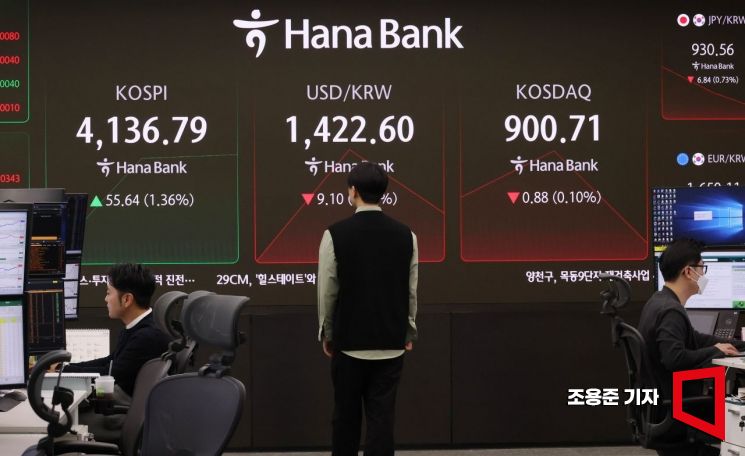 On the 30th, the status board in the dealing room of Hana Bank in Jung-gu, Seoul, displayed the KOSPI and the won-dollar exchange rate.
Governor Lee Changyong: "Negotiations Mitigated Shocks to the FX Market"
On October 30, the won-dollar exchange rate opened at 1,425.0 won in the Seoul foreign exchange market, down 6.7 won from the previous trading day, and fluctuated in the early 1,420 won range at the start of trading. This was due to market relief after the annual cap on cash investments in the US was set at 20 billion dollars out of a total of 200 billion dollars. The government agreed to invest 200 billion dollars in cash out of 350 billion dollars in US investments, with the remaining 150 billion dollars allocated to the "Masga Project" for rebuilding the US shipbuilding industry. Mutual tariffs on Korea and item tariffs on automobiles will be reduced from the current 25% to 15%. Following the announcement of the Korea-US tariff negotiation settlement, the won-dollar exchange rate in the overnight session dropped sharply by 16.7 won from the previous weekly close, ending at 1,421.0 won.
Lee Changyong, Governor of the Bank of Korea, praised the settlement, calling it "an extremely successful negotiation." At the National Assembly's Strategy and Finance Committee's comprehensive audit the previous day, he commented on the annual cap of 20 billion dollars for cash investment, saying, "I think it's fortunate." Governor Lee has previously stated that an annual US investment of 15 to 20 billion dollars would not shock the foreign exchange market. During the audit, he reiterated, "An investment of 15 to 20 billion dollars is an amount that does not require overseas bond issuance," and emphasized, "If the annual investment remains at this level, the impact on the foreign exchange market will be neutral."
On October 29 (local time), the US Federal Open Market Committee (FOMC) cut the policy rate by 0.25 percentage points to 3.75-4.00%. This was in line with market expectations. As a result, the Korea-US interest rate gap, which had widened to 2.00 percentage points since May, narrowed to 1.50 percentage points. Jerome Powell, Chair of the Federal Reserve, held a hawkish press conference, drawing a line that an additional rate cut at the next FOMC meeting in December is not a given, which is limiting further declines in the won-dollar exchange rate. However, the market still places weight on the possibility of an additional cut in December.
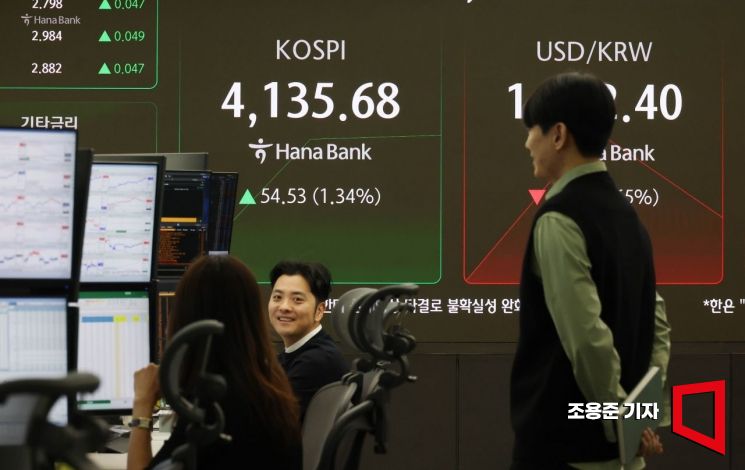 On the 30th, the status board in the dealing room of Hana Bank in Jung-gu, Seoul, displayed the KOSPI and the won-dollar exchange rate.
Year-End Exchange Rate Expected in the Mid-to-High 1,300 Won Range
The market expects that, thanks to the stabilization brought by the Korea-US tariff negotiation settlement, the won-dollar exchange rate could drop to the mid-to-high 1,300 won range by year-end. Park Sanghyun, a researcher at iM Securities, said, "With the uncertainty surrounding the Korea-US tariff negotiations removed, and if the US-China summit proceeds positively, the yuan could strengthen, creating further downward pressure on the won-dollar exchange rate," adding, "The yen is also showing strength, so I expect the exchange rate to be in the mid-to-high 1,300 won range at year-end." Min Kyungwon, an economist at Woori Bank, commented, "With the Korea-US trade negotiations concluded, the supply-demand uncertainty that has weighed on the foreign exchange market has eased," and noted, "The reduction of automobile tariffs to 15% has also alleviated some of the factors weakening the won."
However, some point out that mid-to-long-term upward pressures remain due to structural factors such as the strong dollar and increased overseas investment by Korean residents. Wi Jaehyun, an economist at NH Futures, said, "The recent rise in the won-dollar exchange rate from 1,400 won to 1,420 won reflects concerns about US investments, but the 1,420-1,440 won range has been more influenced by increased overseas investments by Korean residents than by foreign investment in the KOSPI," adding, "To bring the exchange rate below 1,400 won, the supply-demand imbalance must be resolved."
© The Asia Business Daily(www.asiae.co.kr). All rights reserved.
![Clutching a Stolen Dior Bag, Saying "I Hate Being Poor but Real"... The Grotesque Con of a "Human Knockoff" [Slate]](https://cwcontent.asiae.co.kr/asiaresize/183/2026021902243444107_1771435474.jpg)
















