Ministry of Science and ICT Establishes First Global Talent Map
Half of Top Global Researchers Concentrated in the US and China
Surging Industry Demand in the AI Sector
The number of researchers in South Korea specializing in quantum computing ranks 10th globally. In the fields of quantum communication and sensing, the country is positioned around 12th.
On October 30, the Ministry of Science and ICT convened the Special Committee on Future Talent and announced that it had reviewed and approved the following agenda items: the "Global Talent Map Analysis for National Strategic Technologies (Quantum Field)" and the "Analysis of Talent Demand in the AI Industry for National Strategic Technologies." For the first time, a "Global Talent Map" has been established to secure talent in national strategic technologies. The plan is to visualize the distribution of key researchers in the quantum field using data and to conduct a detailed analysis of workforce demand in the artificial intelligence (AI) industry, providing a factual basis for science and technology talent policy.
The Special Committee on Future Talent is an advisory body under the National Science and Technology Advisory Council. This meeting was the first to be presided over by Park Ingyu, Director General of the Science and Technology Innovation Bureau, since his appointment.
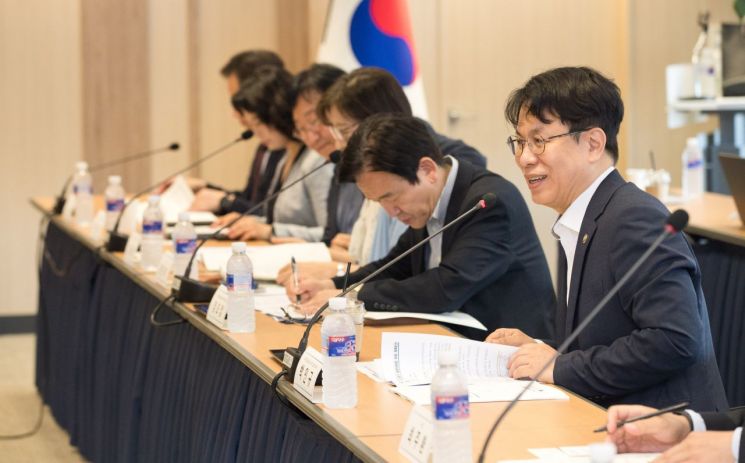 Park Ingyu, Director General of the Science and Technology Innovation Bureau at the Ministry of Science and ICT, is presiding over the "6th National Research and Development Project Evaluation General Committee for 2025" held in August at the National Science and Technology Advisory Council's main conference room in the Kyobo Building, Gwanghwamun, Jongno-gu, Seoul. Photo by Yonhap News
The newly released global talent map for the quantum field is the first attempt to analyze the distribution of key talent and research trends based on worldwide research paper data. According to the analysis, China and the United States have the largest number of researchers in all subfields. Notably, more than half of the top 10% of highly cited researchers are from the United States and China. In the United States, most leading researchers are from industry, such as Google and IBM, while in Europe, academia is predominant. In South Korea, top researchers are mostly concentrated in universities and public research institutes.
An analysis of researcher inflow and outflow by country also showed that China and the United States are net importers of talent in all subfields. South Korea experienced a net inflow of 21 researchers in quantum computing, 10 in quantum communication, and 16 in quantum sensing, with the main source countries being the United States, Singapore, and China. Domestic institutional collaboration and international joint research are also on the rise.
The Ministry of Science and ICT plans to expand the global talent map to cover all national strategic technology fields, starting with quantum technology. In collaboration with the Korean Intellectual Property Office, the ministry also aims to analyze patent inventors, thereby creating a data-driven talent map that encompasses researchers at the application and development stages.
Additionally, the analysis of talent demand in the field of artificial intelligence (AI) revealed that job postings have increased nearly twentyfold since 2017, already surpassing 2,000 between January and August this year. Of these, 42.9% were for "AI application development" roles. Large and mid-sized companies showed high demand for "data design and analysis," while small and medium-sized enterprises focused on "specialized model development."
The proportion of experienced professionals in the AI sector surged from 54% in 2020 to 80.6% this year, and the share of large and mid-sized companies rose from 8.6% to 37.3%. The most in-demand skill was Python, and with the spread of large language models (LLMs), the use of "machine learning operations (MLOps)" technology is rapidly expanding.
Park Ingyu, Director General of the Science and Technology Innovation Bureau, stated, "Securing top talent is synonymous with national competitiveness amid intensifying global technological competition. We will establish science and technology policies that are responsive to on-the-ground needs through data-driven talent analysis."
© The Asia Business Daily(www.asiae.co.kr). All rights reserved.
![Clutching a Stolen Dior Bag, Saying "I Hate Being Poor but Real"... The Grotesque Con of a "Human Knockoff" [Slate]](https://cwcontent.asiae.co.kr/asiaresize/183/2026021902243444107_1771435474.jpg)















