Insurance Research Institute Conducts Survey of Insurance CEOs
33.3% of CEOs Expect "Slight Improvement in Korean Economy Next Year"
"Improvements Needed for Surrender Value Reserve System"
Chief Executive Officers (CEOs) of domestic insurance companies expect the Korean economy to improve slightly next year. They believe that enhancing the competitiveness of the insurance industry will require more efficient financial regulations.
The Insurance Research Institute announced on the 30th that it had conducted a survey over the past month, with responses from 36 out of 42 insurance company CEOs.
Among the insurance company CEOs, 36.1% predicted that the Korean economy would see a "slight improvement" next year. Meanwhile, 33.3% expected the economy to remain similar to this year. Additionally, 27.8% anticipated a "slight deterioration," while 2.8% forecast a "significant deterioration."
By the end of next year, 47.2% of respondents expect long-term interest rates (based on 10-year government bonds) to remain at recent levels (2.5-3%). Another 41.7% anticipate a "slight decline" (2-2.5%).
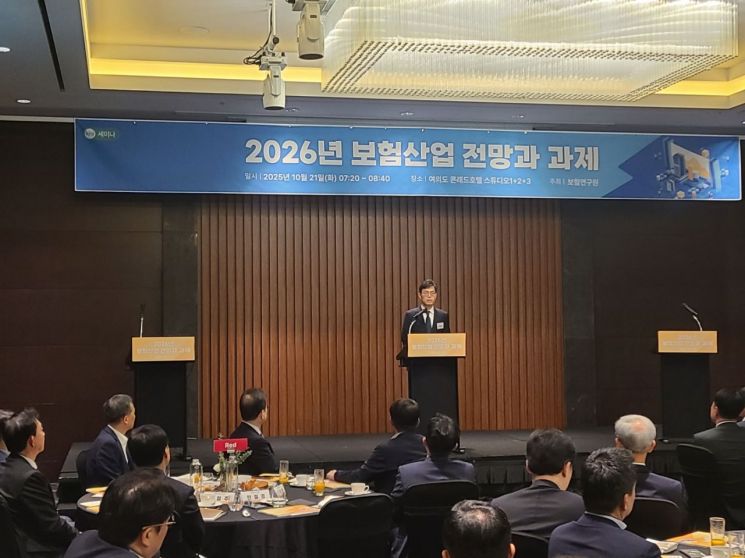 Ahn Chul-kyung, President of the Insurance Research Institute, is speaking at the seminar titled "Outlook and Challenges of the Insurance Industry in 2026" held on the 21st at the Conrad Hotel in Yeouido, Seoul. Photo by Choi Donghyun
Among insurance CEOs, 85.8% expect next year's net profit to increase compared to this year. Specifically, 48.6% forecast an increase of "0-10%," 28.6% expect "10-30%," and 8.6% anticipate growth of more than 30%.
The most urgent task for strengthening the competitiveness of the insurance industry was identified as "reviewing and streamlining the appropriateness of financial regulations" (33.3%). For boosting consumer trust, "establishing a sound sales order" (40.7%) was seen as the top priority.
Regarding tasks related to insurance sales, the most frequently cited were "strengthening seller qualification requirements" (20%) and "revising product brochures and summary terms and conditions" (20%). For solvency-related issues, the most pressing were "improving the discount rate adjustment plan" (29%) and "supplementing the surrender value reserve system" (19.6%).
Insurance CEOs prioritized securing competitive sales channels and developing new products to ensure profitability. In contrast, long-term business model transformation tasks, such as launching new businesses, remained lower in priority. Over the next one to two years, the focus is expected to remain on selling protection-type insurance products, such as health insurance. Among new business areas, interest remains highest in health-related services, including health management and long-term care services.
From an asset management strategy perspective, most respondents chose to reduce risk due to concerns over low growth, low interest rates, and increased financial market volatility. However, a significant number also indicated a willingness to take on more risk to improve investment returns.
Hwang Inchang, Head of the Financial Market Analysis Division at the Insurance Research Institute, stated, "The insurance industry faces heightened concerns about declining profitability due to increased macroeconomic uncertainty, so it is necessary to stabilize the profit base in response. The government should also enhance the competitiveness of the insurance industry by providing policy support and regulatory improvements, thereby promoting economic growth and narrowing the protection gap."
© The Asia Business Daily(www.asiae.co.kr). All rights reserved.
![Clutching a Stolen Dior Bag, Saying "I Hate Being Poor but Real"... The Grotesque Con of a "Human Knockoff" [Slate]](https://cwcontent.asiae.co.kr/asiaresize/183/2026021902243444107_1771435474.jpg)















