Germany Implements Gender Self-Determination Act in November Last Year
Gender Change Now Possible Without Psychiatric Assessment or Court Approval
22,000 People Changed Gender in 9 Months... 45% from Female to Male
Last year, the German government allowed citizens to register their self-identified gender without a court’s approval, resulting in more than 22,000 people changing their gender. On the 29th (local time), Yonhap News, citing the German media outlet Stern, reported that “an analysis of data from the Federal Statistical Office of Germany showed that 7,057 people newly registered their gender in November last year, when the Gender Self-Determination Act went into effect, and the total exceeded 22,000 over the nine months through July this year.” This is more than 30 times the number recorded before the law took effect, with only 596 cases from January to October last year.
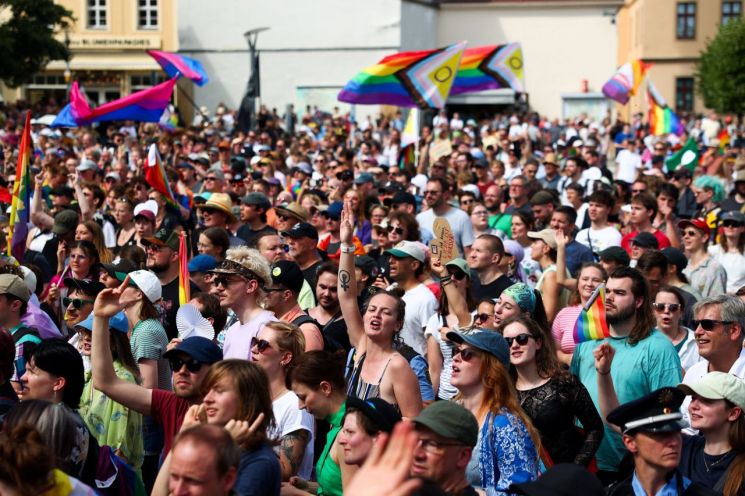 People attending the annual LGBTQ Pride parade held last August in Bautzen, Germany. Photo by Reuters Yonhap News
Germany enacted the Gender Self-Determination Act in response to criticism that the previous gender transition process-including psychological evaluations by two psychiatrists and a court decision-violated the rights of sexual minorities. Under this law, individuals can choose from male, female, diverse, or unspecified as their gender. Those aged 14 to 18 must report the change themselves with the consent of a parent or guardian. According to media reports, during the first two months after the law was implemented, 33% of gender change applications were from male to female, while 45% were from female to male.
The new gender registration system was introduced under the progressive “traffic light” coalition government, led by the Social Democratic Party (SPD) and the Green Party. However, controversy arose when a far-right figure, notorious for anti-LGBTQ remarks, changed his gender to female before being imprisoned, raising questions about whether he should be placed in a women’s prison. The Christian Democratic Union (CDU), a centrist conservative party led by German Chancellor Friedrich Merz, pledged to change the system during the general election earlier this year. However, after forming a coalition with the SPD in May, the CDU softened its stance, agreeing to maintain the law until July next year and review its impact on children, adolescents, and women.
At the time the law was introduced in Germany, similar initiatives were pursued across Europe. Sweden passed a bill lowering the minimum age for legal gender change from 18 to 16. As a result, individuals can now apply to change their gender without a diagnosis of “gender dysphoria” (the feeling that one’s assigned gender at birth does not match their identity). However, those under 18 require approval from a guardian, a doctor, and the National Board of Health and Welfare.
The European Union’s “LGBTIQ Equality Strategy 2020-2025” supports “legal gender recognition based on self-determination and accessible without age restrictions” as a human rights standard for member states. According to Human Rights Watch, several EU countries-including Belgium, Denmark, Ireland, Luxembourg, Malta, Norway, and Portugal-also provide simple legal gender recognition procedures based on self-declaration.
However, as seen in Germany, some countries have raised concerns about potential misuse. According to Le Monde, some Spanish men have posted on social media expressing their desire to change their gender for reasons such as “wanting to take women’s competitive exams to become firefighters or police officers more easily,” “hoping to increase their chances of gaining child custody,” or “wanting to avoid sexual violence charges,” sparking controversy.
© The Asia Business Daily(www.asiae.co.kr). All rights reserved.
![Clutching a Stolen Dior Bag, Saying "I Hate Being Poor but Real"... The Grotesque Con of a "Human Knockoff" [Slate]](https://cwcontent.asiae.co.kr/asiaresize/183/2026021902243444107_1771435474.jpg)















