On October 30, Heungkuk Securities stated, "The United States Federal Reserve (Fed) lowered the benchmark interest rate by 25 basis points (1bp=0.01 percentage points), but took a reserved stance on an additional rate cut in December, leading to a rebound in both short- and long-term interest rates." The firm analyzed, "While the rate-cutting cycle is expected to continue, the timing and pace remain uncertain."
On this day, Kim Jinseong, a researcher at Heungkuk Securities, said, "The Fed decided to cut rates based on the assessment that inflation is stable, excluding the effects of employment slowdown and tariffs."
On the 29th (local time), the October Federal Open Market Committee (FOMC) meeting in the United States lowered the benchmark interest rate by 25 basis points as expected, bringing it down to 3.75-4.00%. There were 10 votes in favor and 2 against. Researcher Kim stated, "Chairman Jerome Powell of the Fed mentioned at the press conference that the Personal Consumption Expenditures (PCE) price index rose 2.8% over the past year, but excluding the impact of tariff increases, it stands at around 2.3-2.4%."
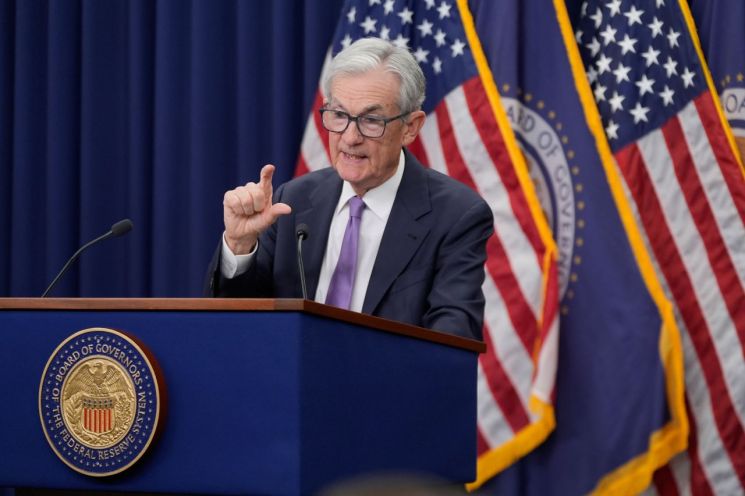 Jerome Powell, Chairman of the United States Federal Reserve (Fed), announced the policy of lowering the benchmark interest rate and signaling the end of quantitative tightening in December during a press conference following the Federal Open Market Committee (FOMC) meeting held in Washington D.C. on the 29th (local time). Photo by AP
The key issue is the December meeting. Researcher Kim explained, "Given the differences in opinion among committee members at the October meeting, Chairman Powell emphasized the need for further judgment based on official economic indicators," adding, "It appears that political considerations were also factored in, with only six months left in his term."
Regarding the Fed's decision to end quantitative tightening (QT) starting in December, he commented, "By reinvesting maturing mortgage-backed securities (MBS) into Treasury bills, the Fed aims to ease short-term liquidity shortages."
Researcher Kim forecasted that the terminal rate at the end of next year would be 3.25% (upper bound). He added, "Although the impact of tariff increases will increasingly be passed on to goods prices, this will be partially offset by a slowdown in service prices, resulting in moderate inflation." He also predicted, "Given the trend of slowing employment, there is a high likelihood that the Fed will maintain its rate-cutting cycle."
© The Asia Business Daily(www.asiae.co.kr). All rights reserved.
![Clutching a Stolen Dior Bag, Saying "I Hate Being Poor but Real"... The Grotesque Con of a "Human Knockoff" [Slate]](https://cwcontent.asiae.co.kr/asiaresize/183/2026021902243444107_1771435474.jpg)















