Fed Cuts Benchmark Rate by 0.25 Percentage Points
Quantitative Tightening to End in December
Two Dissenting Votes on Rate Decision
Powell: "Wide Differences of Opinion Among Policymakers"
Dow and S&P 500 Turn Lower; Treasury Yields Sur
"We should not take a December rate cut as a given. In fact, we are far from that (a December cut)."
Jerome Powell, Chairman of the United States Federal Reserve (Fed), drew a clear line regarding expectations for an additional rate cut in December after lowering the benchmark interest rate by 0.25 percentage points on the 29th (local time). The market, which had anticipated a signal for one more rate cut within the year, was disappointed by Powell's more hawkish (favoring monetary tightening) remarks than expected. As a result, some major indices on the New York Stock Exchange turned downward, and U.S. Treasury yields surged.
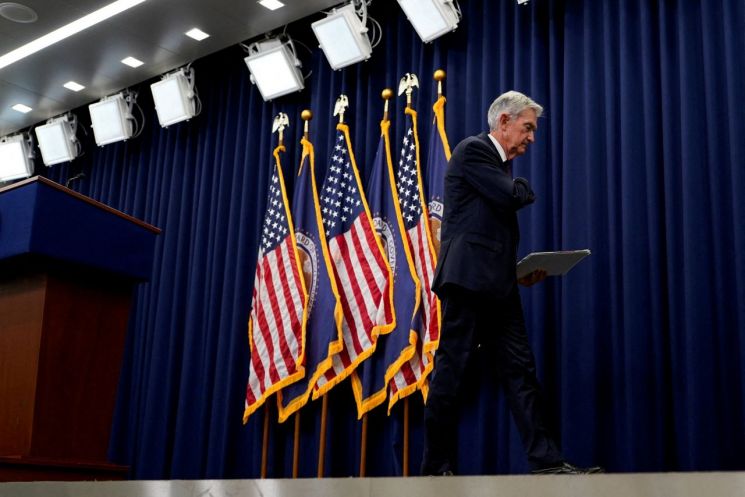
During a press conference held immediately after the regular meeting of the Federal Open Market Committee (FOMC), Powell commented on the possibility of an additional rate cut within the year, saying, "There are strong differences of opinion among policymakers on which direction to take in December." He also added that among Fed members, "there is a growing voice that we should wait at least one cycle (meeting) before cutting rates further."
On this day, the Fed cut the federal funds rate by 0.25 percentage points to a range of 3.75% to 4.0%, marking the second consecutive rate cut, and decided to end quantitative tightening (QT), which began in June 2022, in December. Of the 12 voting FOMC members, two opposed the rate cut decision: Fed Governor Steve Myron advocated for a 0.5 percentage point cut, while Jeffrey Schmidt, President of the Federal Reserve Bank of Kansas City, argued for holding rates steady, presenting completely opposing views. As Powell's remarks indicate, there is a widening divergence of opinion within the Fed regarding its dual mandate of price stability and full employment.
Regarding this, Powell said the U.S. economy is "overall in good shape," but explained that "in terms of policy, there are risks of rising inflation and declining employment, which is a very difficult issue for the central bank." He suggested the dilemma that interest rates must be raised to curb inflation, but lowered to support employment.
He assessed that the current benchmark rate is now closer to the neutral rate than before. Powell stated, "The current rate is much less restrictive than before," and added, "At the very least, it will help prevent further deterioration in the labor market." He also mentioned that the rate cut was a risk management measure to get closer to the neutral rate, following last month's move.
On inflation, Powell said that if the effects of President Donald Trump's tariff hikes are excluded, inflation is close to the Fed's target of 2%. He stated, "The rise in goods prices is due to tariffs," and added, "Although prices have not risen significantly, that does not mean people are not feeling the effects of high inflation."
Powell also explained that although the release of some economic indicators was delayed due to the U.S. federal government shutdown (temporary work stoppage), there has been little change in the economic and inflation outlook presented at the September FOMC, based on both public and private data.
The market reaction was immediate. Following Powell's hawkish remarks, expectations for an additional rate cut within the year dropped sharply in the interest rate futures market. According to CME FedWatch, the probability of the Fed cutting rates by another 0.25 percentage points in December, adjusting the rate to a range of 3.5% to 3.75%, fell from 90.5% the previous day to 56.4% on this day.
On the New York Stock Exchange, major indices turned downward and U.S. Treasury yields surged. As of 3:53 p.m., the Dow Jones Industrial Average was down 0.22% from the previous session, the S&P 500 was down 0.05%, while only the Nasdaq was up 0.52%. As expectations for monetary easing faded, the yield on the benchmark 10-year U.S. Treasury note, a global bond market benchmark, jumped 9 basis points (1bp = 0.01 percentage point) from the previous session to 4.08%. The yield on the 2-year U.S. Treasury note, which is sensitive to monetary policy, surged 10 basis points to around 3.6%.
© The Asia Business Daily(www.asiae.co.kr). All rights reserved.

















