Rule of Law Mentioned 12 Times
Improvement, Trust, Fairness, and Independence Follow
Judicial Petition Also Addressed
Kim Sanghwan (20th class of the Judicial Research and Training Institute), Chief Justice of the Constitutional Court, will mark his 100th day in office on October 31. An analysis of Chief Justice Kim’s eight official statements since his inauguration shows that the terms “fundamental rights,” “democracy,” and “rule of law” were mentioned most frequently.
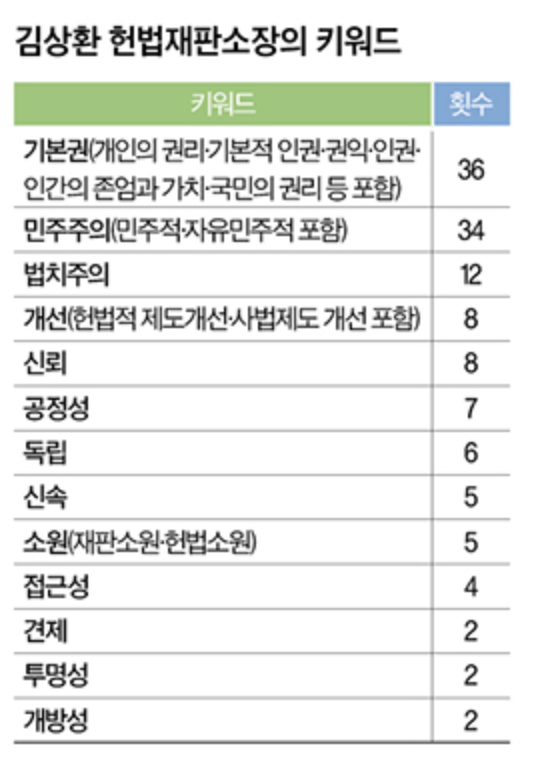
The Law Times analyzed Chief Justice Kim’s inaugural address on July 24; his congratulatory remarks at the 14th International Symposium of the Constitutional Research Institute on August 22; his speech at the 33rd Lawyers’ Convention for the Rule of Law on August 25; his opening address at the 5th International Conference of Judges of the Research Office of the Association of Asian Constitutional Courts and Equivalent Institutions (AACC) on August 26; his congratulatory remarks at the 32nd General Assembly and Academic Conference of the World Korean Legal Professionals Association on September 25; his remarks at the 2nd Korean Legal Scholars Conference on September 27; and his greeting and comprehensive responses during the National Assembly’s audit on October 17.
“Fundamental rights” was the concept most frequently mentioned in Chief Justice Kim’s official statements. Reflecting the Constitutional Court’s role in protecting the Constitution and safeguarding citizens’ fundamental rights, the term appeared 36 times. This includes references to “individual freedom and rights,” “basic human rights,” “interests,” “remedy of individual rights,” “dignity and value,” “citizens’ rights,” and “the right to receive assistance.”
“Judicial petition” was also mentioned as an extension of fundamental rights. On October 17, during the National Assembly Legislation and Judiciary Committee’s audit of the Constitutional Court, Chief Justice Kim stated that judicial petition-meaning a constitutional complaint against a finalized court ruling-was “more ideal in terms of protecting fundamental rights.” On October 23, the Constitutional Court distributed a reference note requesting that the term “judicial petition” not be described as a “four-instance system,” but rather as a “constitutional remedy procedure for finalized judgments.” Reflecting the view of judicial petition in light of fundamental rights, the reference note, which was about one and a half pages, mentioned the keyword “fundamental rights” four times.
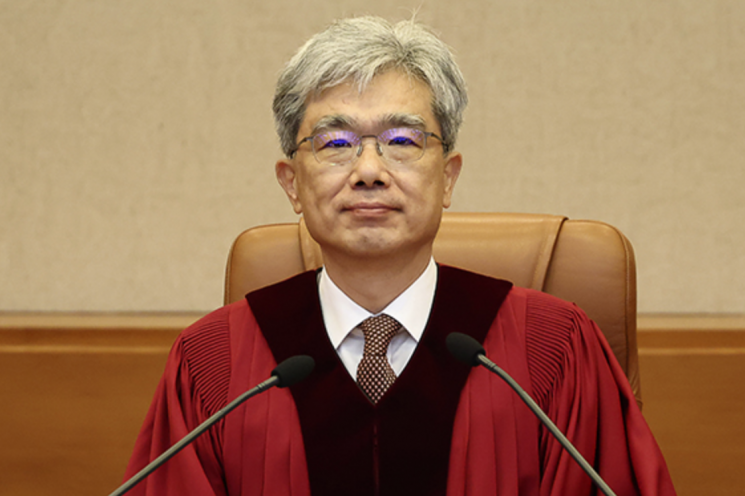 Kim Sanghwan, Chief Justice of the Constitutional Court, is seated for the judgment of a case held at the Grand Bench of the Constitutional Court. Photo by Yonhap News
Democracy, a core principle of the Constitution, was mentioned 34 times, and the rule of law 12 times, following fundamental rights. In August, Chief Justice Kim explained, “Our shared goals of protecting human rights, guaranteeing democracy, and promoting the rule of law through constitutional adjudication require continuous effort.” In September, he stated, “To uphold the constitutional values of democracy and the rule of law agreed upon by our community, the pioneering role of legal scholars in identifying the fundamental principles necessary for building and operating a just society is essential.”
The independence of the judiciary and trials was also mentioned six times. In his inaugural address, Chief Justice Kim referred to “independence” three times, stating, “The independence of trials is the premise for exercising the constitutional adjudicative authority granted by the people.” In August, at the International Symposium of the Constitutional Research Institute, he emphasized that the independence of the judiciary is a constitutional value. On October 17, during the National Assembly audit, he again mentioned the independence of judicial power and trials twice.
Cha Jina (31st class), professor at Korea University Law School, stated, “The protection of citizens’ fundamental rights is the reason for the existence of all state institutions, and democracy and the rule of law are likewise the two most important constitutional principles for judging the legitimacy of state institutions’ activities. It is only natural for the Chief Justice of the Constitutional Court to emphasize fundamental rights, democracy, and the rule of law.”
Professor Cha added, “At this point in time, the most important emphasis should be on the independence of the judiciary. For the Constitutional Court, the most crucial task is to avoid the impression of being swayed by public opinion or entangled in politics.”
Lee Inho, professor at Chung-Ang University Law School, also commented, “There is a tendency for constitutional concerns to be excessively focused on fundamental rights. There needs to be more active discussion about the national system, such as the structure of governance, and especially about the independence of the judiciary.”
Kim Jisoo, The Law Times Reporter
※This article is based on content supplied by Law Times.
© The Asia Business Daily(www.asiae.co.kr). All rights reserved.
![Clutching a Stolen Dior Bag, Saying "I Hate Being Poor but Real"... The Grotesque Con of a "Human Knockoff" [Slate]](https://cwcontent.asiae.co.kr/asiaresize/183/2026021902243444107_1771435474.jpg)
















