Establishing a Citizen-Led Collaborative Governance Model in the Post-APEC Era
Expansion of Everyday Policies Driven by Citizens, Including Pet Parks, Hyeongok Sidewalks, and Kindness Campaigns
Following the APEC Summit, Gyeongju, which has emerged as an international city, is now shifting its focus toward "citizen-centered governance."
Since 2019, the Gyeongju City Government has introduced the "Citizens' Roundtable Conference," establishing what is known as the "Gyeongju-style collaborative governance model" that connects citizen proposals directly to policy.
Now in its sixth year, this conference has evolved beyond simple discussion to become a genuine citizen participation platform that influences real municipal administration.
In the post-APEC era, Gyeongju is moving away from a top-down administrative approach and embracing a new paradigm of "participatory governance," where citizens' voices become the starting point for policy. This article examines this transformation. <Editor's Note>
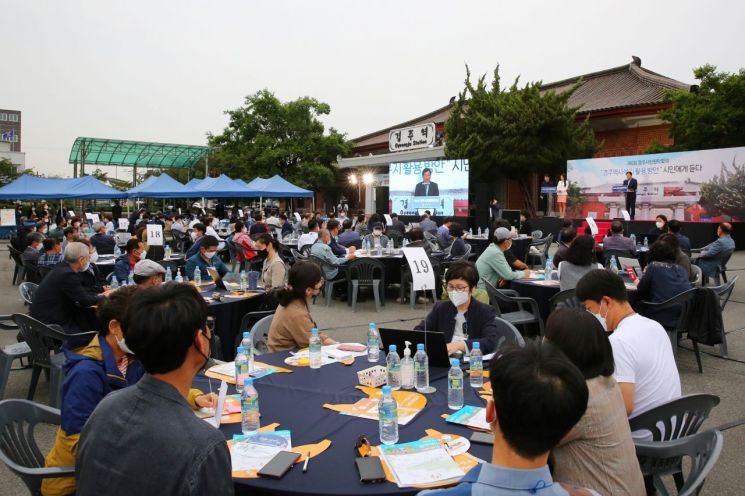 In June 2022, citizens are engaged in group discussions on the topic of 'Utilization Plans for Gyeongju Station History' at the 6th Gyeongju Citizens' Roundtable Conference held at the former Gyeongju Station Plaza. Provided by Gyeongju City
◆A Deliberative Forum Designed by Citizens and Administration Together
The Gyeongju Citizens' Roundtable Conference is not reserved for specific organizations or experts.
It is Gyeongju’s flagship citizen participation program, where any ordinary citizen can freely join, discuss, and make suggestions.
Since the inaugural session in 2019, a total of 18 conferences have been held as of September this year.
In accordance with the "Ordinance on the Operation and Support of the Citizens' Roundtable Conference," Gyeongju City holds these meetings regularly every year, and the structure has evolved to allow citizens to directly propose agendas and seek solutions through discussion.
Participants share opinions on a wide range of topics, from everyday inconveniences and local issues to the city’s long-term vision.
The city does not simply listen to the results of these meetings; instead, it reviews them through relevant departments and incorporates them into actual policies.
As a result, some proposals have already reached the implementation stage and are being recognized as "citizen-created policies."
Even during the COVID-19 pandemic, the events did not stop.
To broaden citizen participation, the city held multiple sessions and adopted digital technologies such as wireless voting systems.
By collecting and reflecting citizen feedback in real time, the reliability and transparency of the discussions were significantly enhanced.
In this way, the Gyeongju Citizens' Roundtable Conference has established itself not just as an administrative event, but as a deliberative forum where the collective intelligence of citizens drives city governance.
◆Citizens Propose, Administration Responds
The Gyeongju City Government does not simply listen and move on from the proposals raised at the Roundtable Conference.
Each time a meeting is held, the suggestions are reviewed by the relevant departments and reflected in municipal administration.
This has resulted in numerous examples of "participatory governance," where citizen ideas are transformed into policy through administrative processes.
At the 15th Citizens' Roundtable Conference in September last year, the topic was "Citizen Action Plans for the Successful Hosting of the APEC Summit." Citizens emphasized that "a friendly Gyeongju is key to APEC’s success" and proposed spreading a service culture free of price gouging.
In response, the city held regular hospitality training sessions for taxi drivers and restaurant staff, hosted "Hygiene and Kindness Talk Concerts" to improve citizen service culture, and developed volunteer campaigns such as "Clean Day" and "Welcome Day," encouraging direct citizen participation.
During the same meeting, the need for basic foreign language education for foreign tourists was also raised.
Accordingly, the city established short-term practical conversation courses in English, Chinese, Japanese, and Vietnamese at the Lifelong Learning and Family Center, enabling immediate application at tourist sites.
In anticipation of the APEC Summit, citizens first put forth ideas, and the administration promptly put them into action.
Citizen proposals have also extended beyond culture and tourism into everyday policy.
At the 14th conference in May last year, titled "Woof Meow: Let's Talk About the Pet Industry," participants suggested the need for a multi-purpose cultural space for people and their pets.
This proposal aligned with the city’s ongoing pet theme park project, accelerating its progress.
Subsequently, the city completed a site review and is currently conducting a basic planning study for the project this year.
As the development of a large-scale theme park equipped with sports fields, swimming pools, and walking trails gains momentum, the project is moving forward with strong public support.
There are also cases where everyday inconveniences have been resolved.
At the 11th Roundtable Conference in 2023, citizens proposed the installation of a sidewalk between Geumjang Intersection and Nawon Elementary School in Hyeon-gok-myeon.
This section, which was essential for pedestrian safety, was completed at the end of last year, alleviating long-standing inconvenience for students and residents using the school route.
As a result of citizens proposing and the administration responding, a previously dangerous road was transformed into a safe pedestrian path.
At the 13th conference held the same year, "Citizen Action Plans for a Carbon-Neutral City" were discussed.
Citizens created their own lists of everyday actions, and the city incorporated them into the "Gyeongju City Carbon Neutral Green Growth Master Plan."
With participation from small business owners, farmers, and various other groups, the foundation for a sustainable green city was established.
In this way, the Gyeongju Citizens' Roundtable Conference has become a channel where ideas turn into policy and proposals lead to concrete actions.
As the structure of citizens raising issues and the administration finding solutions becomes more established, Gyeongju is increasingly transforming into a "citizen-centered city."
◆Post-APEC, "Gyeongju: A Future City Created by Citizens"
The Gyeongju City Government operates the Citizens' Roundtable Conference not simply as a channel for gathering opinions, but as the starting point for policy implementation.
Proposals from these meetings are reviewed by the administration and incorporated into municipal policies, leading to the resolution of local issues and strengthening city competitiveness. The Roundtable Conference has now become a symbol and brand representing Gyeongju’s collaborative governance.
Especially after gaining global attention through the APEC Summit, Gyeongju is evolving from an "administration-led city" to a "citizen-designed city." As the axis of urban development shifts from the administration to the citizens, the direction of city governance is clearly moving toward "Gyeongju built together."
Going forward, the city plans to actively gather citizen proposals in a variety of fields, including daily life, culture, and the environment, and further broaden avenues for participation. By solidifying a structure in which citizens propose and the administration implements, the city aims to establish a strong foundation for collaborative governance in which anyone can participate in municipal affairs.
Joo Nakyoung, Mayor of Gyeongju, stated, "The Gyeongju Citizens' Roundtable Conference is the most dynamic channel for directly reflecting citizens’ voices in city governance," adding, "In the post-APEC era, we will design a better future for Gyeongju together through collaborative governance that puts citizens at the center."
© The Asia Business Daily(www.asiae.co.kr). All rights reserved.
![Clutching a Stolen Dior Bag, Saying "I Hate Being Poor but Real"... The Grotesque Con of a "Human Knockoff" [Slate]](https://cwcontent.asiae.co.kr/asiaresize/183/2026021902243444107_1771435474.jpg)















