88% Surge in Emergency Room Refusals Last Year
Highest Numbers in Daegu, Daejeon, and Busan
Seo Youngseok: "System Must Be Improved So No One Is Turned Away in Critical Moments"
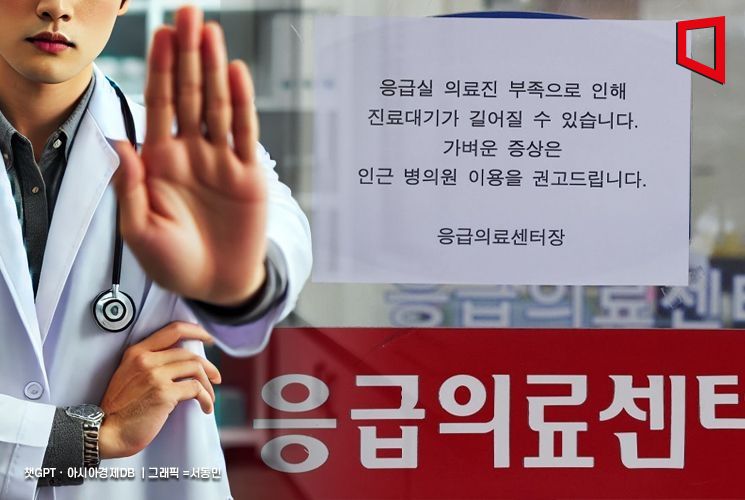
Last year, amid ongoing legislative conflicts, the number of emergency patients who could not receive treatment in emergency rooms due to a shortage of medical personnel surged 2.3 times compared to the previous year. The top 20 hospitals with the highest number of refusals were distributed across 11 cities and provinces nationwide, indicating that the shortage of medical staff occurred both in Seoul and in regional areas.
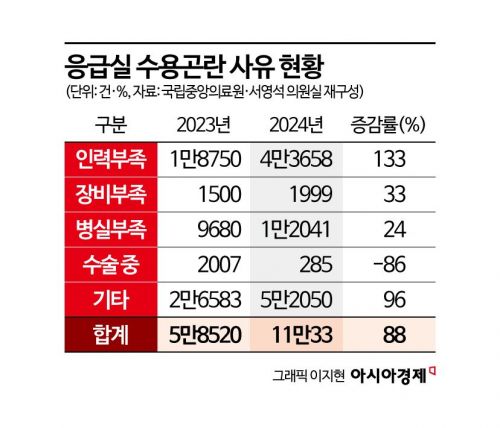
According to data on 'Notifications of Difficulty in Accepting Emergency Patients at Emergency Medical Institutions' submitted by Assemblyman Seo Youngseok of the Democratic Party of Korea, a member of the National Assembly Health and Welfare Committee, and provided by the National Medical Center, the number of such notifications increased by 88% in one year, from a total of 58,520 cases in 2023 to 110,033 cases last year.
By reason, 'staff shortage' accounted for 43,658 cases, a 133% increase from 18,750 cases in 2023. Other reasons (such as issues with medical departments or pre-transfer inquiries) rose by 96%, equipment shortages by 33%, and bed shortages by 24%. The number of cases citing ongoing surgery as the reason for refusal decreased by 86%.
From January to August of this year, among a total of 83,181 cases of difficulty in accepting patients, 'other reasons' accounted for the largest share at 52.9% (43,985 cases), followed by staff shortage at 36.7% (30,504 cases), bed shortage at 9.0% (7,462 cases), and equipment shortage at 1.3% (1,062 cases).
Last year, the top 20 emergency medical institutions with the highest number of notifications reported a total of 41,904 cases. Staff shortage accounted for 20,166 cases, or 48.1%, followed by other reasons at 32.6% (13,679 cases), and bed shortage at 13% (5,453 cases).
These top 20 institutions were spread across 11 out of the 17 cities and provinces nationwide. By region, Daegu had the highest number with 10,548 cases, followed by Daejeon with 6,532, Busan with 5,605, South Chungcheong with 4,752, and Seoul with 4,073. The reasons for refusal varied by region: staff shortage was the main cause in Daegu, South Chungcheong, Seoul, Sejong, Gangwon, and South Gyeongsang, while in Gyeonggi Province, bed shortage was overwhelmingly the main reason, accounting for 91.2% of cases.
Assemblyman Seo Youngseok emphasized, "The shortage of emergency room staff is spreading nationwide, affecting both the capital region and the provinces. We must swiftly restore the broken emergency medical system, expand emergency room staffing, improve working conditions, and reform the patient transfer coordination system to ensure that no citizen is turned away in a critical moment."
© The Asia Business Daily(www.asiae.co.kr). All rights reserved.
![Clutching a Stolen Dior Bag, Saying "I Hate Being Poor but Real"... The Grotesque Con of a "Human Knockoff" [Slate]](https://cwcontent.asiae.co.kr/asiaresize/183/2026021902243444107_1771435474.jpg)
















