The first domestic demonstration of artificial intelligence (AI) prediction technology developed to reduce pedestrian safety accidents is currently underway in Cheonan.
The Electronics and Telecommunications Research Institute (ETRI) announced on the 29th that since August, it has been conducting a demonstration of the "Predictive Pedestrian Safety Artificial Intelligence (AI) Service" at four major intersections in Cheonan.
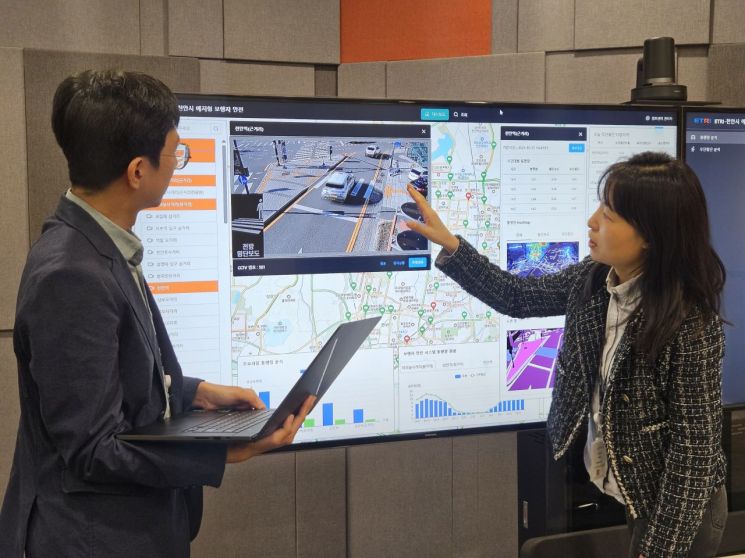 ETRI researchers are discussing the operation process of the "Predictive Pedestrian Safety Artificial Intelligence Service." Provided by Electronics and Telecommunications Research Institute of Korea
This technology focuses on predicting pedestrian movement paths to prevent traffic accidents. Its core feature is not only detecting pedestrians, but also preemptively recognizing pedestrians who are about to cross but are difficult for drivers to notice in advance, thereby preventing accidents beforehand.
The pedestrian alert systems already distributed to local governments require manual setting of specific "detection zones" by a person, which often leads to alarms being triggered even for pedestrians simply passing near the zone, resulting in unnecessary alerts. Additionally, whenever a camera is newly installed or its direction is changed, the detection zone must be reset, creating further inconvenience.
Most importantly, the existing systems only trigger warnings after a pedestrian has already entered the road, leaving drivers with insufficient time to react, and may mistakenly identify areas outside the preset detection zone as safe road sections.
Given these issues, the "Predictive Pedestrian Safety Service" developed by ETRI is distinguished from existing pedestrian alert systems by its ability to recognize and predict the possibility of traffic accidents in advance.
For example, this technology is operated using CCTV cameras installed on site, electronic display boards for drivers, controllers, and remote video analysis servers. Based on footage captured by CCTV, it automatically generates a road area map within two seconds, identifying the entire crosswalk and roadway as risk zones, thereby accurately reflecting the real traffic environment.
In particular, by predicting the future path of a pedestrian, the system can send a risk alert to drivers via the display board starting three seconds before the pedestrian enters the crosswalk. The alert visually displays risk information on the board in five levels (from 0 to 4) based on the predicted future movement path of the pedestrian, using pedestrian safety images.
This approach not only reduces unnecessary alerts by recognizing only pedestrians who are about to cross, but also helps drivers preemptively detect pedestrians in blind spots when making right or left turns.
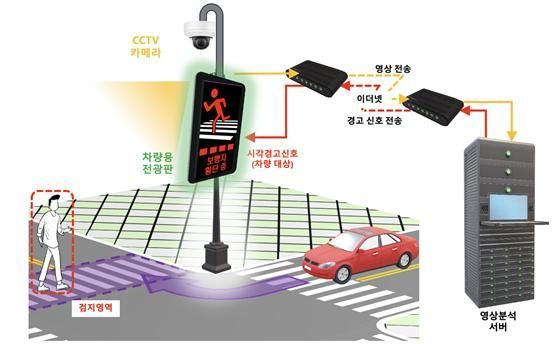 Schematic of the Yeji-type pedestrian safety system. Provided by Electronics and Telecommunications Research Institute.
Currently, ETRI has selected four locations with high pedestrian traffic-two near Cheonan Station and two at Terminal Intersection-where the system has been installed and is being demonstrated, targeting right-turning vehicles.
This technology is planned for full commercialization in 2027 and will be transferred to companies specializing in smart transportation solutions. ETRI also plans to expand the technology to local governments nationwide by pursuing demonstration agreements with municipalities other than Cheonan.
In the future, ETRI intends to further expand the system by adding features such as predicting the future route of vehicles to provide directional speaker alerts to pedestrians about approaching vehicles, as well as natural language-based traffic analysis Q&A functions.
Moon Jinyoung, head of the Visual Intelligence Research Laboratory at ETRI, stated, "This demonstration is the first case of applying a new traffic safety standard in the field that 'predicts a pedestrian's movement path and notifies the driver three seconds in advance.' In the demonstration, ETRI verified a safety system that automatically understands intersection environments and proactively alerts risks, and we will continue to advance predictive traffic safety standards through cooperation with local governments."
© The Asia Business Daily(www.asiae.co.kr). All rights reserved.
![Clutching a Stolen Dior Bag, Saying "I Hate Being Poor but Real"... The Grotesque Con of a "Human Knockoff" [Slate]](https://cwcontent.asiae.co.kr/asiaresize/183/2026021902243444107_1771435474.jpg)
















