"Claims of Same University and Mostly Ethnic Koreans from China Are Not True"
AI-Generated Videos Also Spreading as Real Footage
Rumors are spreading online that the 64 suspects repatriated from Cambodia to South Korea for involvement in online scams are graduates of a particular university. Some have claimed that, since 45 of them were transferred to the Chungnam Provincial Police Agency, they are alumni of a university in the Chungnam region. However, the police have dismissed these claims as false.
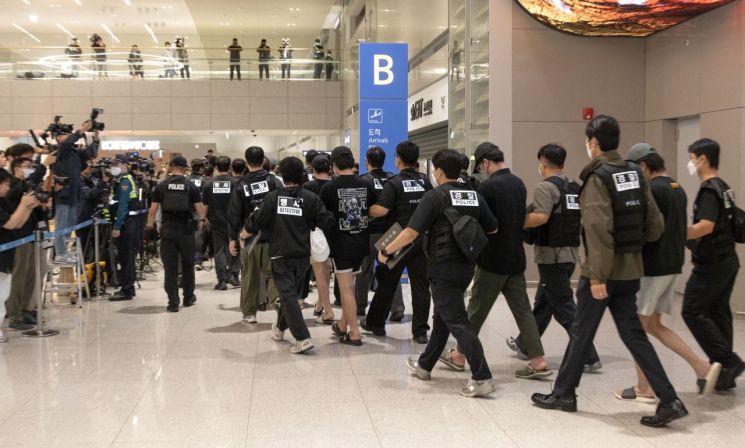 Koreans detained for involvement in online scams in Cambodia are being repatriated. Photo by Yonhap News Agency
An official from the Chungnam Provincial Police Agency stated, "The repatriated individuals became involved in the crimes through various channels, such as introductions from acquaintances and high-paying part-time job advertisements. There is no commonality in their educational backgrounds."
These rumors appear to have been influenced by a previous case involving Park, a South Korean university student who was lured to Cambodia by a criminal organization and died. Park, who was enrolled at University A, went to Cambodia through the introduction of a senior from the same university and became entangled with a criminal group, which led to his death. As a large number of repatriated suspects were transferred to the Chungnam Provincial Police Agency, which is investigating Park's case, misunderstandings about a connection between the cases have spread.
A representative from University A also emphasized, "Except for Park and the senior who introduced him, no other students from our university are involved in this case. The claim that all 45 repatriated suspects are from University A is also false."
There have also been online claims that most of the repatriated suspects are ethnic Koreans from China, but the police stated, "Most of these claims are not true." However, they declined to confirm whether any ethnic Koreans from China were among the suspects or to disclose their numbers.
Spread of Repatriate Photos and Passport Images... "Difficult to Confirm Identity"
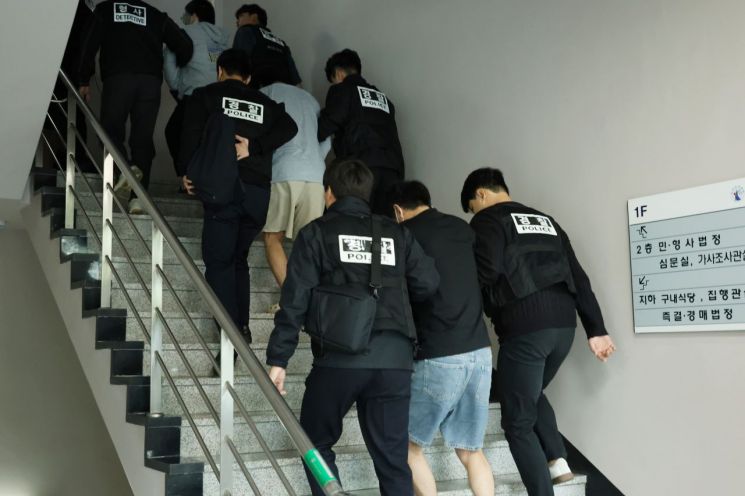 Suspects being extradited from Cambodia attending the detention hearing. Photo by Yonhap News Agency
Meanwhile, it is also difficult to confirm the identities of individuals in photos circulating online as the "faces of the repatriated suspects." These photos were originally released by local police in Phnom Penh, Cambodia, in September, when 48 members of an online scam ring-including 33 South Koreans-were arrested, as reported by the local media outlet Khmer Times.
While photos from the scene released by Cambodian authorities, as well as images of confiscated passports, have spread across social media and have been identified as those of the repatriated suspects, it has not been confirmed whether they are indeed the same individuals.
AI-Generated Videos Spreading as if Real Footage
Recently, videos generated by artificial intelligence (AI) related to Chen Zhi, Chairman of Prince Group, who has been identified as being behind the Cambodian crime syndicate, have been circulating as if they were real footage. Unlike the original videos, which were clearly labeled as "AI-generated," these explanations have disappeared during the sharing process, and the narrative has evolved to suggest, "Chen Zhi is walking around confidently."
AI-generated videos exposing the grim reality of Cambodian crime complexes were also originally accompanied by explanations stating they were "adapted based on actual public materials." However, as these videos were shared on other platforms, the explanations were omitted, causing them to spread as if they were real footage.
Lee Seungsun, a professor in the Department of Media and Communication at Chungnam National University, commented, "Sensational information, including hate against specific groups, is attracting the attention of content consumers. Even if it takes time, consumers need to make an effort to properly verify the sources of content."
© The Asia Business Daily(www.asiae.co.kr). All rights reserved.
![Clutching a Stolen Dior Bag, Saying "I Hate Being Poor but Real"... The Grotesque Con of a "Human Knockoff" [Slate]](https://cwcontent.asiae.co.kr/asiaresize/183/2026021902243444107_1771435474.jpg)

















