Emphasizing People-Centered Entrepreneurship
Over Technology in the Digital Era
The enthusiasm remained high on the second day of the Jinju K-Entrepreneurship International Forum in Gyeongnam on October 28.
The second day of the 『2025 Jinju K-Entrepreneurship International Forum』 was held at the 100th Anniversary Hall of Gyeongsang National University (Gyeongnam Esports Stadium) under the theme "The Role of Entrepreneurship in an Era of Global Transformation."
At the "Creation and Innovation Roundtable Session," moderated by Kim Keechan, President of the International Council for Small Business (ICSB), participants included Jason Woodard, Dean of the Academy of Innovation at the University of Hong Kong; David Storr, Dean of the Peter Drucker School of Management in the United States; Moon Gookhyun, Chairman of the Peter Drucker Society Korea; Shin Hyunhan, Professor at Yonsei University School of Business; Jack Yao, Secretary-General of CDCCN; and Nicholas Lum, Professor at HELP University Malaysia. The discussion focused on how creative innovation based on empathy can design a sustainable innovation ecosystem for the next generation.
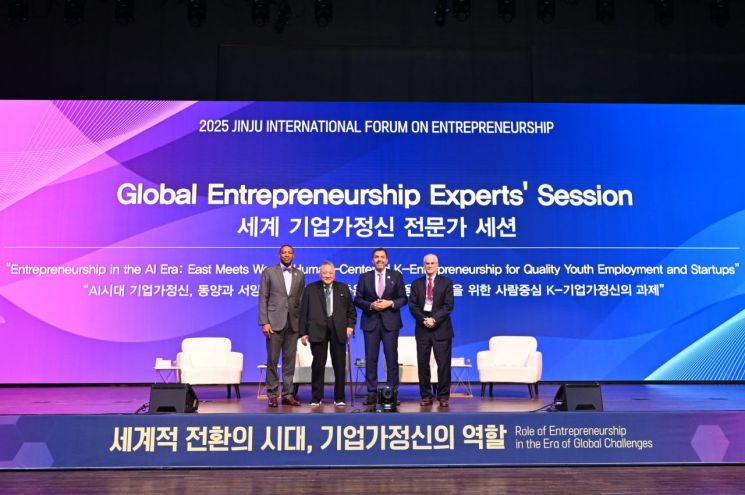
Kim Keechan, President of ICSB, emphasized the importance of people-centered entrepreneurship, stating, "Peter Drucker said that entrepreneurship is about enabling ordinary people to achieve extraordinary results."
David Storr, Dean of the Peter Drucker School of Management in the United States, stressed that "Innovation and Abandonment are the two pillars driving sustainable growth for companies." He presented the principles of innovation as unexpected successes and failures, incongruities, process improvements, changes in market structure, demographic shifts, changes in perception, and new knowledge, introducing the cases of Tesla and TSMC.
He went on to say, "Abandonment is difficult due to human nature, but it is as essential a core management competency as innovation." He emphasized, "Organizations should regularly ask themselves whether they would do the same thing if they started today, and true innovation becomes possible when abandonment is internalized as part of the culture."
Professor Jason Woodard highlighted the need to shift "from technology-centered innovation to human-centered innovation, and from disruption to inclusion," stressing that the answer lies in education. He supported this by presenting examples from Olin College of Engineering and the Innovation Academy at the University of Hong Kong.
Moon Gookhyun, Chairman of the Peter Drucker Society Korea, based his remarks on the philosophy of Peter Drucker, stating, "The creation of shared vision and values is a core challenge of modern management and entrepreneurship." He emphasized, "In the era of AI and global transformation, sustainable growth begins with shared values and human-centered leadership."
Quoting Peter Drucker's spirit of "continuous creative destruction," he said, "True entrepreneurship is about turning social problems into economic opportunities through creative destruction that generates new value."
He particularly evaluated Jinju's efforts to promote K-Entrepreneurship as "a new economic model that values people and community," stressing that "what is more important than technological innovation is moral intelligence and empathetic leadership."
Prior to this, the "Global Entrepreneurship Experts Session," attended by entrepreneurship experts from around the world, drew significant attention from international forum participants.
Ayman Tarabishy, President of ICSB, served as moderator, with speakers including Winslow Sargeant, former Chief Counsel for Advocacy at the U.S. Small Business Administration (SBA); Stanley O, Chairman of Delta Asia Financial Group; and Steve Young, Secretary-General of the Cox Roundtable (CRT). They explored strategies to create jobs and entrepreneurial opportunities by integrating Eastern Confucian values and Western innovation-driven entrepreneurship, based on people-centered entrepreneurship in the age of AI.
Ayman Tarabishy, President of ICSB, emphasized, "The AI era is not merely an era of technological innovation but an era of human revolution," adding, "Technology should not replace people, but serve as a tool to help them."
He also evaluated "Jinju K-Entrepreneurship as an innovation model centered on humanity, community, and creativity, a value the world should pay attention to," and stated, "When AI is combined with these human-centered values, sustainable development and youth employment become possible."
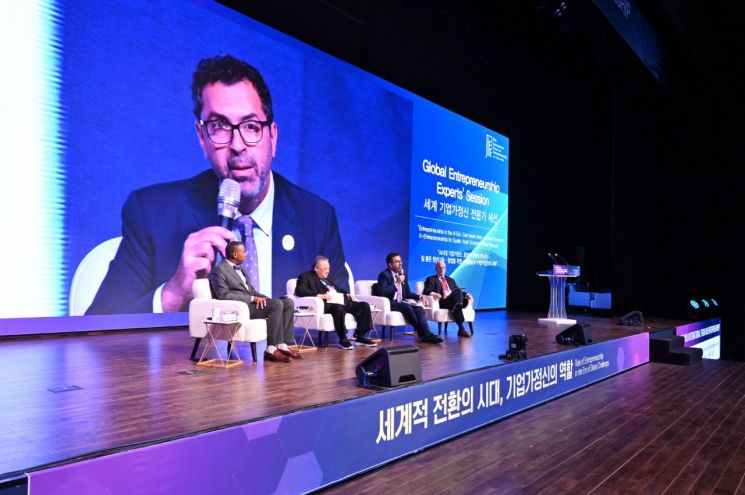
Stanley O, Chairman of Delta Asia Financial Group, emphasized, "Youth entrepreneurship must pursue both profit and purpose, and the government and society should foster an innovation ecosystem that combines morality and creativity." He added, "When the people-centered vision of K-Entrepreneurship in Jinju is combined with global innovation, youth employment and sustainable growth can be achieved together."
Steve Young, Secretary-General of CRT, presented moral capitalism as a human-centered capitalism model that achieves sustainable economic growth and social trust through the harmony of private and public interests. He warned, "Markets are sources of wealth, but if moral values are lacking, they collapse due to greed, inequality, and corruption," emphasizing the need to restore moral sensitivity.
© The Asia Business Daily(www.asiae.co.kr). All rights reserved.
![Clutching a Stolen Dior Bag, Saying "I Hate Being Poor but Real"... The Grotesque Con of a "Human Knockoff" [Slate]](https://cwcontent.asiae.co.kr/asiaresize/183/2026021902243444107_1771435474.jpg)
















