Ministry of Health and Welfare to Announce "Exam First, Training Later" Policy This Month
First-Year Residents to Be Selected by Integrating First and Second Half Interns
Concerns Raised in Medical Community Over "Decline in Training Quality"
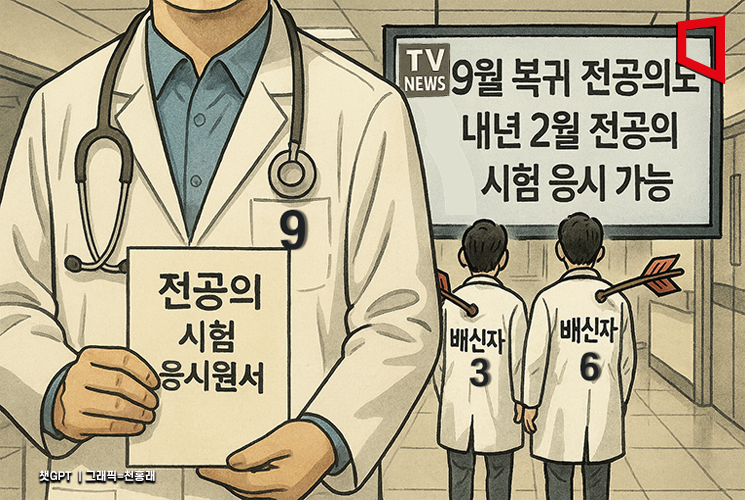
The government has decided to break precedent and allow resident doctors who returned to hospitals last month to take the specialist exam early next year. Under this plan, they will sit for the exam first and then complete their remaining training. This has sparked criticism that the move is a special favor for residents who participated in collective action, as well as controversy over reverse discrimination against those who returned earlier.
According to the medical community on October 29, the Ministry of Health and Welfare recently finalized this plan after discussions with the training council and is expected to officially announce it later this week. The Emergency Response Committee of the Korean Intern Resident Association (KIRA) also notified its members that “for those in their final year of residency, even if some requirements are not met, they can be classified as conditional candidates and take the specialist exam in February 2026. First-year residents will be selected by integrating both the first and second half of the internship period.”
Residents who resumed their training in September will not finish their program until August next year, so, in principle, they are not eligible to take the specialist exam in February 2026. They would have to wait about six more months after completing their training and apply for the February 2027 exam.
In contrast, those who returned in March this year can take the exam as scheduled early next year. For those who returned in June, interns are eligible for a shortened training period and can be promoted to residents early next year, while residents can take the specialist exam after completing about three additional months of training.
However, since the majority of residents who resigned returned only in September, there would be a sharp decline in the number of new specialists, and holding an additional exam would require about 3 billion KRW (approximately 2.2 million USD) in extra funding. Taking these factors into account, the government decided to allow the “exam first, training later” approach. If only those who returned in March and June were selected as residents, it could lead to regional and essential medical service gaps due to concentration in metropolitan areas and popular specialties. Therefore, the government will also allow those who returned in September to apply for first-year residency positions in the first half of next year.
Nonetheless, there are internal concerns within the medical community that, in this case, those who pass both the specialist exam and resident selection may not receive sufficient additional training. A professor at a major general hospital in Seoul commented, “It is urgent to resolve the manpower shortage, and if those who returned in September have to wait until the exam the year after next, new problems will arise. Although some professional societies opposed the plan due to concerns about declining training quality and disruption of the training system, I understand that the Ministry of Health and Welfare, resident organizations, and the medical association all agreed to it.”
Among residents who returned early in March and June, there is growing discontent that this policy constitutes reverse discrimination against them-some even report being called “traitors”-and that special treatment continues for those who participated in collective action.
An intern who returned to training in March said, “Out of a sense of responsibility to prevent a medical service vacuum, we endured excessive workloads despite staff shortages and contributed to normalizing hospital operations, even as we faced negative perceptions and isolation from colleagues. Now, we find ourselves in a situation where we are actually being discriminated against, and some seniors are even mocking and threatening us, saying they will give us the lowest possible scores in next year’s resident selection.”
© The Asia Business Daily(www.asiae.co.kr). All rights reserved.
![Clutching a Stolen Dior Bag, Saying "I Hate Being Poor but Real"... The Grotesque Con of a "Human Knockoff" [Slate]](https://cwcontent.asiae.co.kr/asiaresize/183/2026021902243444107_1771435474.jpg)
















