"Nothing Has Changed in the Structure of Bilateral Relations"
"Focus Only on Narrow Issues Instead of Core Matters"
On October 30, the first U.S.-China summit under the second Trump administration is set to take place. However, analysts predict that both sides will avoid addressing fundamental issues and instead focus on narrow topics, meaning the core points of conflict are unlikely to be resolved. Since the root causes of the conflict remain unaddressed, there are concerns that even if the two countries enter a truce, a trade war could reignite at any time.
On October 27 (local time), Bloomberg reported that the U.S. and Chinese trade negotiation delegations have prepared a series of diplomatic achievements for President Donald Trump and Chinese President Xi Jinping to announce at the summit. While these "easy wins" have satisfied investors, the report pointed out that the main sources of conflict between the two countries remain unresolved.
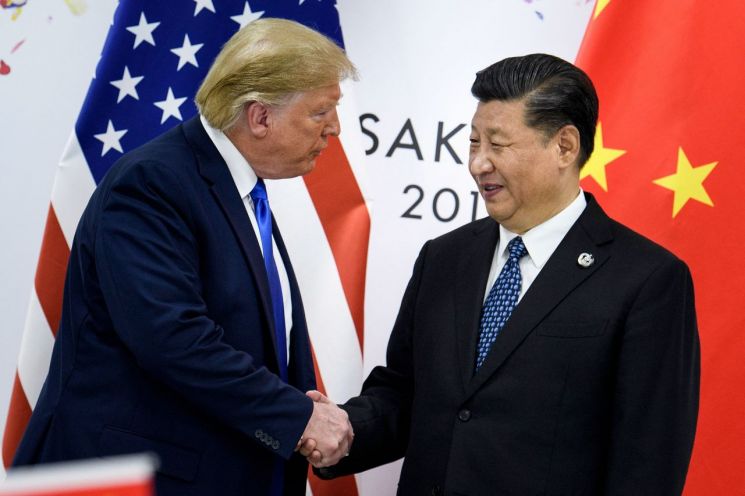 Donald Trump, President of the United States (left), and Xi Jinping, President of China. Photo by AFP
President Trump stated the previous day, "I feel very good about the agreement with China." Over the weekend, the two countries' trade delegations concluded the fifth round of high-level trade talks in Malaysia. China has reportedly agreed to resume imports of U.S. soybeans, while the United States has tentatively agreed to withdraw the additional 100% tariffs in exchange for China suspending its rare earth export controls for one year.
However, experts have pointed out that the trade agreement President Trump and President Xi are about to sign ignores fundamental issues. In particular, they noted that key issues related to national security have not been addressed, and that resolving the "trade imbalance" emphasized by President Trump is unlikely. Chinese investment in the United States also remains restricted.
Sun Chenghao, a researcher at Tsinghua University's Institute of International Security and Strategy in China, said, "Picking the low-hanging fruit first makes the road ahead more difficult because the hard and risky issues are left for last." He emphasized that serious differences must be resolved in areas where the two sides' systems fundamentally clash, such as state subsidies, technological competition, and national security. Sun added that in the coming years, the two countries are more likely to continue reaching small deals rather than achieving a major agreement.
Daniel Kritenbrink, former Assistant Secretary of State for East Asian and Pacific Affairs, said in an interview with Bloomberg TV, "Both sides seem to be focusing on immediate stability," but added, "The fundamental structure of the relationship between the two countries has not changed at all."
One of the core issues is China's restrictions on rare earth exports. U.S. Treasury Secretary Scott Besant stated that after the fifth round of high-level trade talks, China's rare earth export restrictions are expected to be suspended for one year. However, the United States' decision to impose export controls on advanced semiconductors to China, which prompted China's measures, remains in place.
As Secretary Besant clarified that lifting U.S. export controls is not on the table for this round of talks, Bloomberg noted that it is uncertain how long China's suspension of rare earth export restrictions will last, considering that China would gain little beyond a reduction in tariff threats.
Dexter Roberts, Senior Fellow at the Atlantic Council, said, "China will never give up its leverage over rare earths," adding, "From China's perspective, that would be foolish."
The implementation of the "Phase One Trade Agreement" signed during the first Trump administration in 2019 is also a core issue. On October 24, the Office of the United States Trade Representative (USTR) announced that it is investigating whether China has fully implemented the Phase One Trade Agreement under Section 301 of the Trade Act. At the time, China pledged to increase its annual imports of U.S. goods and services by at least $200 billion over 2017 levels for the following two years, but failed to do so, and both sides continue to dispute the matter.
However, there is still a possibility for further dialogue. President Trump said the previous day, "If things go well, we may withdraw the investigation." He also mentioned that he plans to visit China "early next year," and that President Xi could visit Washington or his private estate, Mar-a-Lago in Florida, during the same year.
Scott Kennedy, Senior Adviser at the Center for Strategic and International Studies (CSIS), said that the current agreement only addresses minor issues, stating, "Both sides are postponing the core issues and focusing solely on very specific and narrow topics. Major issues such as China's economic system or security have been set aside," adding, "The likelihood of directly addressing such broad issues is very low."
© The Asia Business Daily(www.asiae.co.kr). All rights reserved.
![Clutching a Stolen Dior Bag, Saying "I Hate Being Poor but Real"... The Grotesque Con of a "Human Knockoff" [Slate]](https://cwcontent.asiae.co.kr/asiaresize/183/2026021902243444107_1771435474.jpg)
















