Trump and Takaichi Pledge Cooperation for "New Golden Age"
White House Publishes Joint Statement Document
Takaichi Nominates Trump for Nobel Peace Prize
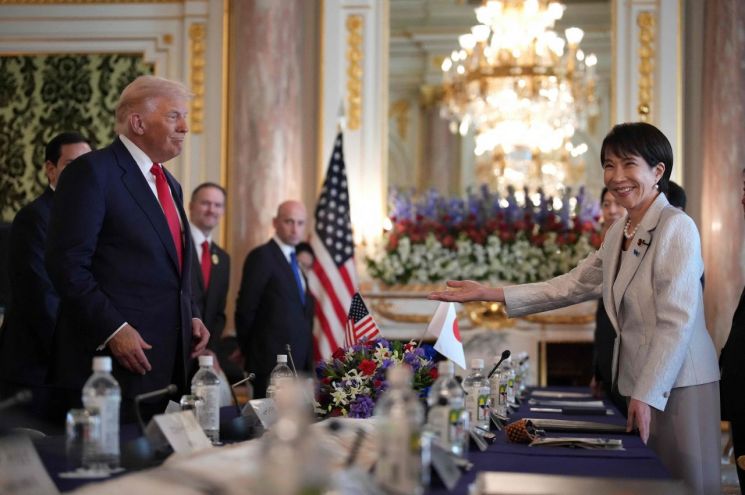 U.S. President Donald Trump (left) and Japanese Prime Minister Sanae Takaichi are holding their first U.S.-Japan summit on the morning of the 28th at the Akasaka Palace State Guest House (Betsugyu) in Tokyo. Photo by AFP Yonhap News
U.S. President Donald Trump and Japanese Prime Minister Sanae Takaichi confirmed their commitment to strengthening the bilateral alliance and discussed security and economic issues during their first U.S.-Japan summit on the 28th. The two leaders agreed to actively cooperate in opening a "New Golden Age" for the U.S.-Japan alliance. President Trump maintained a relatively cordial attitude toward Prime Minister Takaichi, but continued his transactional diplomatic approach by binding Japan’s $550 billion investment plan in the U.S. with enforceable terms.
40-Minute Summit Held in a Friendly Atmosphere
The two leaders created a warm and friendly atmosphere during the approximately 40-minute summit by sharing common ground, such as their connections with the late former Prime Minister Shinzo Abe and Major League Baseball player Shohei Ohtani of the Los Angeles Dodgers.
At the beginning of the meeting, Prime Minister Takaichi attempted to build rapport by saying, "Former Prime Minister Abe often spoke about your dynamic diplomacy." President Trump responded, "Thank you very much, and congratulations on your appointment as Prime Minister," adding, "Shinzo Abe was a great friend. He held you (Prime Minister Takaichi) in very high regard."
President Trump also said, "If former Prime Minister Abe knew that you are now serving as Prime Minister, he would have been very pleased," and added, "I felt great sorrow at the time of his assassination."
Prime Minister Takaichi expressed her gratitude for the congratulatory message President Trump sent immediately after her election as Prime Minister. She also highly praised Trump’s efforts in mediating the ceasefire agreement between Thailand and Cambodia. She said, "I deeply appreciate your unwavering commitment to world peace and stability. I, too, have been deeply impressed and inspired," praising President Trump. She added, "I am ready to further deepen cooperation with the United States to achieve our shared goal of a Free and Open Indo-Pacific."
Although Prime Minister Takaichi did not make a direct reference during the summit, Kyodo News, citing the White House, reported that she conveyed her intention to nominate President Trump for the Nobel Peace Prize. Former Prime Minister Abe, who had a close relationship with President Trump, also nominated him for the Nobel Peace Prize in 2019, citing efforts to ease tensions with North Korea.
Trump: "We Are the Strongest Allies"
After Prime Minister Takaichi’s opening remarks, President Trump reaffirmed the alliance by saying, "We are prepared to provide any favor necessary to support Japan," and "We are allies at the strongest level." He also praised the fact that Prime Minister Takaichi is Japan’s first female prime minister, saying, "That is truly remarkable. You will become one of the great prime ministers in Japanese history."
Sensitive issues such as tariffs, a source of friction between the U.S. and Japan, and Japan’s investment commitments in the U.S. were not discussed. The methods for project selection and the extent of Japan’s authority to participate have not been clearly disclosed.
However, President Trump insisted that the U.S.-Japan trade agreement, which includes Japan’s $550 billion investment in the U.S., is "a very fair agreement." Although Japan’s investment in the U.S.-including the investment timeline, procedures, and profit-sharing methods-has been criticized domestically for being highly favorable to the U.S., President Trump made it clear that he does not intend to alter the terms.
President Trump also mentioned Japan’s increased defense spending, stating, "I am aware that Japan is significantly strengthening its military capabilities. The United States has received substantial orders for military equipment from Japan."
Previously, Prime Minister Takaichi, seemingly conscious of such concerns from the Trump administration, stated in a parliamentary speech last week that Japan would accelerate its largest postwar defense buildup. She also announced that Japan would move up the timeline for increasing its defense budget to 2% of GDP by two years, achieving this target in the 2025 fiscal year (April 2025 to March 2026).
White House Announces Joint Statement on "New Golden Age"
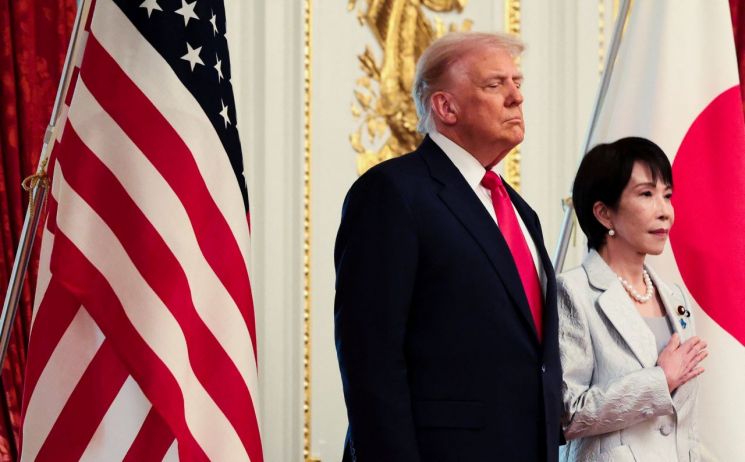 Donald Trump, President of the United States (left), and Sanae Takaichi, Prime Minister of Japan. Photo by Reuters Yonhap News
After concluding their first summit, President Trump and Prime Minister Takaichi immediately signed a joint statement titled "Toward a New Golden Age of the U.S.-Japan Alliance."
According to the document released by the White House, the two leaders reaffirmed that both countries are continuously implementing the U.S.-Japan Framework Agreement signed on July 22 and the Memorandum of Understanding (MOU) on strategic investment announced on September 4. They also instructed their respective ministers to take additional measures toward the "New Golden Age" of the ever-evolving U.S.-Japan alliance.
The White House stated that the two leaders reaffirmed their commitment to strengthening economic security, promoting economic growth, and continuously driving global prosperity through faithful implementation of the agreements.
The joint statement specifically includes the establishment of a cooperative framework in the fields of critical minerals·rare earth elements. Previously, President Trump had signed rare earth agreements with four Southeast Asian countries in Malaysia. As the U.S.-China summit is scheduled to take place in Korea on the 30th, this move is seen as an effort to strengthen the U.S. negotiating position.
In addition, the U.S. and Japan agreed to jointly select projects to address supply chain gaps and to provide financial support within six months. The statement also includes plans to hold a "Minerals and Metals Investment Ministerial Meeting" within 180 days.
Details regarding Japan’s tariffs on U.S. imports and the $550 billion investment agreement, which are considered key elements of the bilateral trade deal, were not included. However, since U.S. Secretary of Commerce Howard Lutnick, regarded as a key figure in the trade negotiations, provided relatively detailed information about the investment plan in an interview with Japan’s Nikkei newspaper, it is expected that these details will be followed.
Secretary Lutnick told Nikkei that Japan’s investment in the U.S. would be directed toward infrastructure projects such as power plants and pipelines, where the risk of loss is close to zero. The Trump administration plans to finalize the first Japanese investment project in the U.S. within this year, with the initial project likely to be in the power infrastructure sector. In addition, to encourage Japanese companies to invest in the U.S., the Department of Commerce will expedite the factory permitting process and directly handle visa issuance for factory construction personnel.
Takaichi Presents Cherry Trees and Gold Golf Balls as Gifts
Demonstrating her role as "Abe’s successor," Prime Minister Takaichi extended exceptional hospitality to President Trump during the summit. She announced plans to donate an additional 250 cherry trees to Washington, D.C. next year in celebration of the 250th anniversary of the founding of the United States. Fireworks produced in Akita Prefecture will also be presented for next year’s Independence Day celebrations.
Prime Minister Takaichi is also reported to have gifted President Trump, an avid golfer, a "golden golf ball" crafted using Kanazawa’s gold leaf technique from Ishikawa Prefecture, as well as golf equipment previously used by former Prime Minister Abe.
Outside the summit venue, a Ford F-150 pickup truck and a Toyota car manufactured in the United States were displayed. With the Japanese government reportedly considering the purchase of 100 Ford F-150 trucks, this display was intended to allow President Trump to see and appreciate the vehicles firsthand.
Meanwhile, the two leaders began the summit later than scheduled after watching games played by their respective teams together. During the meeting, Prime Minister Takaichi mentioned the World Series, a global baseball tournament, stating, "Currently, the Los Angeles Dodgers are leading the Toronto Blue Jays 1-0." Shohei Ohtani, a Japanese Major League Baseball player, is currently playing for the Los Angeles Dodgers.
After the summit, President Trump and Prime Minister Takaichi had lunch together and met with families of Japanese abductees. According to Kyodo News, President Trump expressed his determination to resolve the abduction issue, stating that he could not forget the matter.
In the afternoon, the two leaders are expected to board the U.S. presidential helicopter "Marine One" together and move to the U.S. Navy base in Yokosuka. Japanese media reported that President Trump is scheduled to give a speech at the naval base. Both leaders will board the U.S. nuclear-powered aircraft carrier George Washington together.
© The Asia Business Daily(www.asiae.co.kr). All rights reserved.
![Clutching a Stolen Dior Bag, Saying "I Hate Being Poor but Real"... The Grotesque Con of a "Human Knockoff" [Slate]](https://cwcontent.asiae.co.kr/asiaresize/183/2026021902243444107_1771435474.jpg)

















