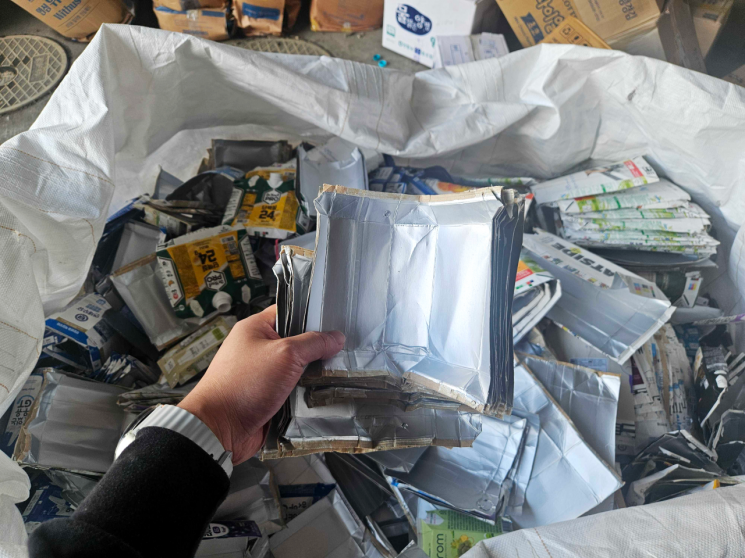
With the recycling rate of aseptic cartons in Korea standing at only 2%, the Ministry of Environment announced that, starting in 2027, these cartons will be designated as a separate collection category and institutionalized. Although aseptic cartons are inherently recyclable resources, many citizens dispose of them as general waste due to the label "difficult to recycle," making actual recycling even more challenging. While this label was intended to indicate technical complexity, consumers have interpreted it as meaning recycling is impossible, thereby blocking resource circulation.
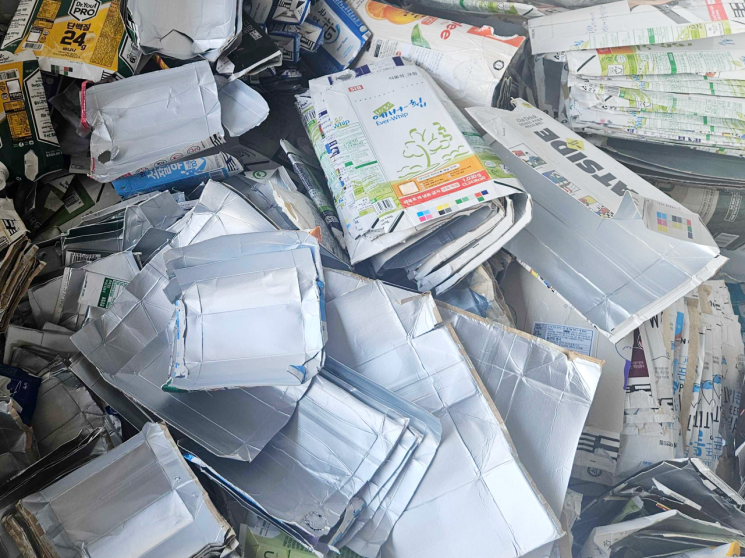
To break down this barrier of perception, HRM Co., Ltd. officially launched the "ECOYA Earth" app. This app collects washed and dried aseptic cartons from users, sorts and processes them at HRM's Cheongju ECC, and transforms the results into recycled tissue or hand towels. ECOYA Earth goes beyond simple recycling, functioning as a practical platform where citizens can directly participate in resource circulation.
ECOYA Earth is distinguished by its "direct circulation" advantage. While typical collection services cannot trace the flow of resources after collection, ECOYA Earth connects the entire process from collection to reprocessing through HRM's own resource circulation infrastructure. According to HRM's internal collection data, from May 2024 to September 2025, a total of 23,574 kg of aseptic cartons-equivalent to about 1.96 million 190ml cartons-were collected through ECOYA Earth. At the Cheongju ECC, where resources are recovered and raw materials are manufactured, 666,200 kg, or approximately 55.51 million cartons, were collected. As a result, HRM collected a total of 689,774 kg, or about 57.47 million aseptic cartons, for recycling, demonstrating a meaningful achievement made possible by HRM's unique circulation structure that operates both a citizen participation platform and industrial-scale infrastructure.
In particular, citizens who participate in resource circulation through ECOYA Earth also receive "Carbon Neutral Practice Points" in connection with the Korea Environmental Industry & Technology Institute's initiative. Whenever users request collection and certify aseptic cartons, the actual carbon reduction effect is quantified and awarded as points, creating a system where eco-friendly actions by citizens are visibly rewarded. By offering both "Earth Credits" and "Carbon Neutral Practice Points," ECOYA Earth is expanding everyday eco-friendly actions into sustainable habits.
HRM has a strong ally in building this circular structure: global packaging company Tetra Pak. Tetra Pak supports HRM's aseptic carton circulation business, serving as a catalyst for steadily increasing participation in resource circulation.
Based on this data, HRM is also expanding collaboration with local governments and businesses. The company has conducted aseptic and paper carton collection projects with Kakao Makers, Korea Expressway Corporation, and Gyeonggi-do daycare centers, compiling performance data for each project and providing it as carbon neutrality indicators. More recently, HRM has participated in Gyeonggi-do's "Climate Action Opportunity Income" initiative, working to build a model that converts citizens' eco-friendly behavior data into tangible climate income.
A representative from ECOYA Earth stated, "Aseptic cartons are by no means unrecyclable resources. The surest way to correct this misconception is for citizens to become the main agents of circulation themselves," adding, "ECOYA Earth is paving the way for citizens to take the lead in environmental policy, ahead of institutional changes."
ECOYA Earth represents a new form of consumption that begins at the end of discarded resources and serves as the starting point of a circular economy created through citizen participation. HRM and ECOYA Earth are accelerating the societal shift from the notion that 'recycling is difficult' to the common understanding that 'reuse is the norm.'
© The Asia Business Daily(www.asiae.co.kr). All rights reserved.