Focusing on Criticizing Government Policies Ahead of Next Year’s Local Elections
Ruling Party’s “No-Conflict Proposal” Denounced as “Forcing Silence to Cover Up Real Estate Disaster”
The People Power Party's approval rating continued to rise for the third consecutive week, particularly among people in their 30s and in the Seoul area. Analysts attribute this trend to the party's intensified criticism of the government's October 15 real estate measures and its increased offensive against the ruling party.
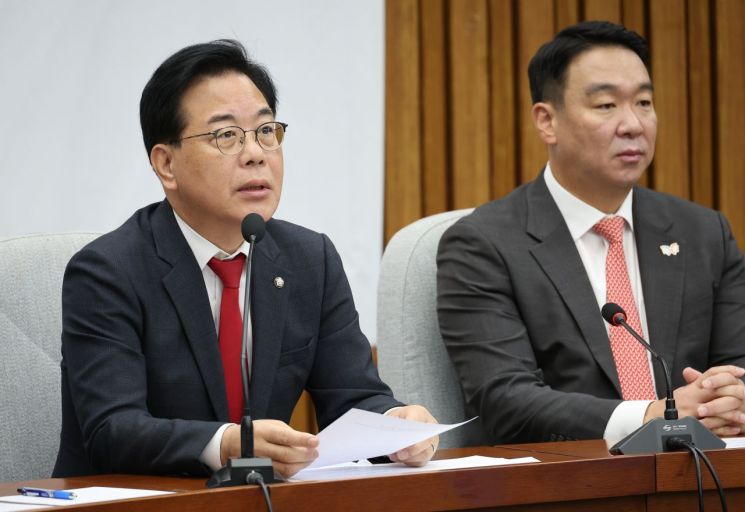 Song Unseok, floor leader of the People Power Party, is speaking at the National Assembly audit countermeasure meeting held at the National Assembly in Yeouido, Seoul on the 28th. Photo by Yonhap News
According to a party approval rating survey conducted by polling agency Realmeter at the request of Energy Economy News on October 23-24, the People Power Party's support rose by 0.6 percentage points from the previous week to 37.3%. The Democratic Party of Korea recorded 44.1%, a drop of 2.4 percentage points.
Since the beginning of the month, the Democratic Party's support has declined for three consecutive weeks, from 47.2% to 46.5% and then to 44.1%. In contrast, the People Power Party's support has edged up from 35.9% to 36.7% and then to 37.3%. The gap between the two parties has narrowed from 11.3 percentage points to 6.8 percentage points.
The most significant changes were seen among people in their 30s, who make up the largest group of real homebuyers. The People Power Party's support in this age group jumped by 6.7 percentage points in a week to reach 39.6%, while the Democratic Party's support fell by 5.9 percentage points during the same period.
There was also a notable shift in Seoul, which was hit hard by the strict regulations of the October 15 real estate measures. In Seoul, the People Power Party's support rose by 7.5 percentage points in a week, while the Democratic Party's support dropped by 2.3 percentage points. The difference between the two parties in Seoul now stands at only 0.8 percentage points.
The People Power Party is not only benefiting from the backlash against ruling party figures' alleged gap investments and inappropriate remarks, but is also ramping up its "real estate crackdown." Believing that real estate issues will have a significant impact on the 9th nationwide local elections scheduled for June 3 next year, the party is focusing its efforts on highlighting the government's missteps.
Song Unseok, floor leader of the People Power Party, said at the National Assembly audit countermeasure meeting on October 28, "Ordinary people are seeing their dreams of homeownership crushed, and the middle class is struggling under the burden of taxes, prices, and interest rates. Right now, the people are crying out over soaring home prices and loan regulations."
Regarding Democratic Party leader Jeong Cheongrae's proposal for a "non-confrontational week" ahead of this week's Asia-Pacific Economic Cooperation (APEC) meeting, Song commented, "This is telling the people to keep silent while ignoring their suffering. It is an attempt by the Lee Jaemyung administration to cover up the economic and real estate disasters it has caused, by forcing silence and distracting from the real issues."
Kim Doeup, policy committee chair of the People Power Party, criticized the Democratic Party for abruptly shifting to a "cautious approach" on easing or abolishing the reconstruction excess profit recovery system (commonly known as 'rebuilding profit recapture'), after initially considering such moves but then yielding to public criticism. He said, "The government and the ruling party are repeating confusion and inconsistency without even sharing a basic philosophy on real estate policy. This is a reflection of the 'amateurish and incompetent administration' that is out of touch with real estate realities."
He once again urged the Democratic Party to pass the bill abolishing the rebuilding profit recapture system. "The reason home prices are rising is because reconstruction projects have stalled due to the burden of this system, which has blocked supply. If the system is abolished, private sector redevelopment projects will regain momentum, urban housing supply will expand, and the real estate market will naturally stabilize," he argued.
The People Power Party plans to hold an on-site discussion session of the "Special Committee for Normalizing Real Estate Policy" at the Seoul Youth Center in Mapo District this afternoon to directly hear the concerns of people in their 20s and 30s. This follows a visit to the Sanggye 5 redevelopment promotion zone in Nowon District, Seoul, on October 24, where party members listened to local residents' issues. The party intends to continue such on-site meetings at redevelopment and reconstruction sites, as well as unsold housing complexes in the greater Seoul area, in an effort to win over public sentiment in the region.
© The Asia Business Daily(www.asiae.co.kr). All rights reserved.
![Clutching a Stolen Dior Bag, Saying "I Hate Being Poor but Real"... The Grotesque Con of a "Human Knockoff" [Slate]](https://cwcontent.asiae.co.kr/asiaresize/183/2026021902243444107_1771435474.jpg)















