Trump Says "No Problems in Negotiations"
Besant: "Complicated Talks... Difficult to Reach Agreement at the Summit"
Lee: "Everything Is a Point of Contention"... Outcome on the 29th Remains Uncertain
U.S. Treasury Secretary Scott Besant predicted that it would be difficult to reach a final trade agreement between South Korea and the United States at the summit scheduled for the 29th, Korea Standard Time. As differences between the two countries persist over South Korea's $350 billion investment package in the U.S., both South Korea and the United States have adopted a more cautious approach to tariff negotiations than before, drawing attention to the implications.
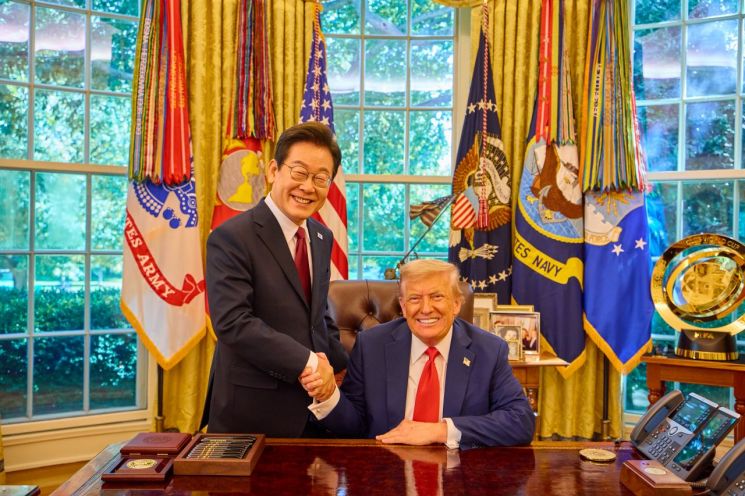
On the 27th (local time), U.S. President Donald Trump, when asked by reporters aboard Air Force One en route from Malaysia to Japan whether there was a snag in the South Korea-U.S. tariff negotiations, replied, "No, I don't think so."
However, Secretary Besant, who was present at the same location, commented on the possibility of concluding the tariff negotiations at this summit, saying, "I think not quite." He added, "But the overall framework is complete, and now it's just a matter of crossing the t's and dotting the i's in terms of fine-tuning. It's a very complex negotiation, but we are very close to a deal."
President Trump then asked Jamison Greer, the U.S. Trade Representative, who was also present, to provide additional explanation.
Representative Greer mentioned that the negotiations with South Korea involve multiple issues, including national security, pure trade, and investment. He stated, "In terms of trade, South Korea has maintained non-tariff barriers for a long time, and we have resolved many of those. The next issue is investment, and South Korea has an excellent plan to expand its investment in the U.S. shipbuilding industry beyond previous levels. We are discussing how to carry out that investment most efficiently within the United States."
The two countries reached a broad trade agreement at the end of July, but have failed to finalize the negotiations for three months due to ongoing differences over the $350 billion investment package South Korea pledged in exchange for tariff reductions from the United States. There were expectations that the tariff negotiations might be dramatically concluded at the summit on the 29th, held on the sidelines of the Asia-Pacific Economic Cooperation (APEC) summit in Gyeongju, South Korea, but the outcome remains uncertain.
In particular, the South Korean government maintains its stance that it will not rush the negotiations, viewing the U.S. demands as excessive. President Lee Jaemyung, in a Bloomberg interview conducted on the 24th and reported on the 27th, stated, "Every aspect, including the method and amount of investment, the timeline, the sharing of losses, and the dividend structure, remains an issue," adding, "A delay does not necessarily mean failure," suggesting that more time is needed for the tariff negotiations.
The United States had initially indicated that a deal with South Korea was imminent, but Secretary Besant's remarks on this day signaled a more cautious tone from the U.S. side as well. This contrasts with President Trump's comment on the 25th that "the South Korea-U.S. tariff negotiations are very close to a conclusion" and "if they are ready, I am ready too."
Some observers do not completely rule out the possibility of a dramatic trade agreement being reached through direct talks between the leaders at this summit, but they also warn that if this opportunity is missed, the negotiations could drag on for an extended period.
© The Asia Business Daily(www.asiae.co.kr). All rights reserved.
![Clutching a Stolen Dior Bag, Saying "I Hate Being Poor but Real"... The Grotesque Con of a "Human Knockoff" [Slate]](https://cwcontent.asiae.co.kr/asiaresize/183/2026021902243444107_1771435474.jpg)











