Kimchi Imports Reach Record High This Year... Napa Cabbage Imports Quadruple
Annual Imports Expected to Hit 350,000 Tons, 99% from China
Sharp Increase in Chinese Imports of Napa Cabbage, Radish, and Red Pepper Powder
Kimchi imports have reached an all-time high. In contrast, exports have begun to decline, resulting in a "kimchi trade reversal" that has continued for three consecutive years. With the kimjang season approaching, imports of key raw materials such as napa cabbage and radish have also increased, leading to concerns about the growing "dependence on China" within the domestic kimchi industry.
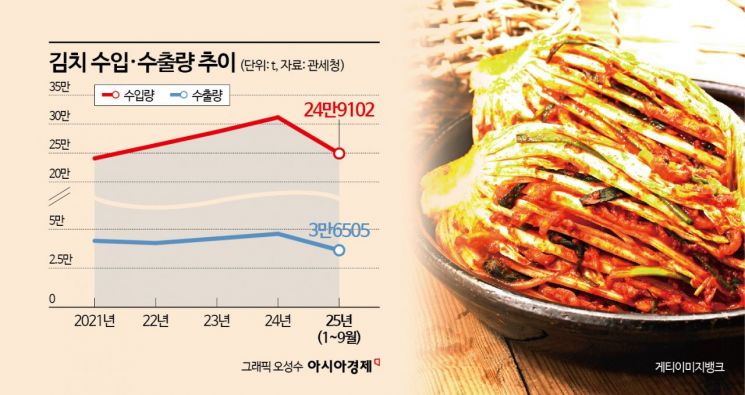
According to the Korea Customs Service on October 28, kimchi imports from January to September this year totaled 249,102 tons, with an import value of 143.59 million US dollars. This represents a 12% increase compared to the same period last year (222,056 tons). Kimchi import volumes have risen every year: 240,606 tons in 2021, 263,434 tons in 2022, 286,545 tons in 2023, and 311,570 tons in 2024. At this rate, annual imports are expected to reach around 350,000 tons this year, setting a new record. Chinese products account for 99% of imported kimchi.
In contrast, exports have stagnated. From January to September this year, kimchi exports amounted to 36,505 tons, with an export value of 125.58 million US dollars, showing little change from the same period last year (34,900 tons and 121.67 million US dollars). Export value, which stood at 159.91 million US dollars in 2021, only increased to 163.57 million US dollars in 2024-a rise of just over 2% in four years. The import volume is 6.8 times higher than exports, and even in terms of value, imports exceed exports. The kimchi trade balance has remained in deficit for three consecutive years since 2022.
'Less than half the price of domestic products... 1 in 2 restaurants use imports'
According to the Korea Agro-Fisheries & Food Trade Corporation (aT)'s "Kimchi Industry Survey," the domestic kimchi industry generated sales of about 2.22 trillion won in 2023, with exports accounting for only about 7% of this figure. In contrast, imported kimchi (mainly from China) makes up 36% of domestic consumption and dominates more than half of the food service and catering markets.
Some 71.2% of imported kimchi is supplied through food ingredient distributors. Since most restaurants purchase ingredients through these channels, a substantial portion of imported kimchi ends up in restaurants. The survey found that 37% of restaurants use imported kimchi as a side dish, while 55.4% use it for cooking.
Among restaurants using napa cabbage kimchi as a side dish, the highest proportion of domestic kimchi was found in foreign cuisine restaurants (86.0%) and institutional cafeterias (77.5%). In contrast, Chinese restaurants had the lowest rate of domestic kimchi usage at 24.8%. Korean restaurants (45.7%), gimbap/snack shops (34.9%), and takeout specialty stores (44.3%) also fell short of the halfway mark. Only 25.2% of napa cabbage kimchi purchased by restaurants for cooking purposes was domestic. In particular, it was found that all radish kimchi and young radish kimchi used in restaurants are imported.
The price gap is clear. According to the Korea Kimchi Association, domestically produced napa cabbage kimchi costs around 3,600 won per kilogram, while Chinese kimchi is about 1,700 won per kilogram-less than half the price.
An industry insider said, "With rising labor and raw material costs in Korea, it has become difficult for restaurants and catering companies to continue using domestic kimchi. Bringing in salted Chinese cabbage and seasoning it domestically-a 'semi-processed method'-is more profitable."
Imports of napa cabbage, radish, and red pepper powder on the rise
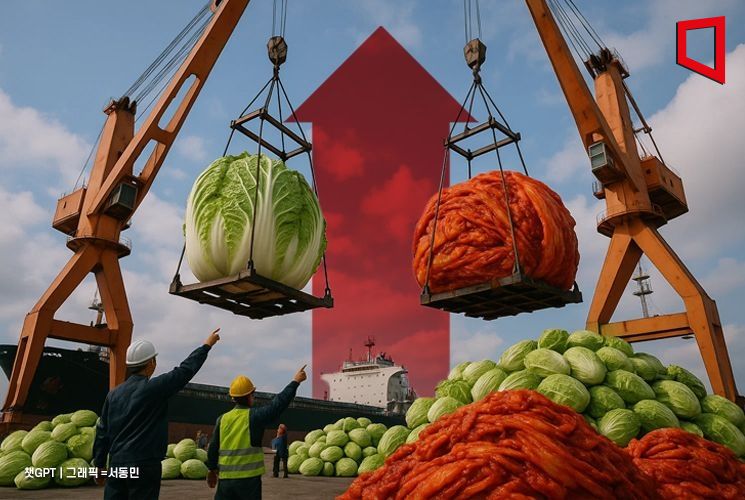
Imports of raw materials are also increasing. From January to September this year, napa cabbage imports reached 16,955 tons, which is four times last year's figure (4,395 tons). In 2021, imports were only 446 tons, meaning they have grown 38-fold in four years. Not only napa cabbage but also radish imports rose from 3,016 tons in 2023 to 18,253 tons this year-a sixfold increase. Red pepper powder imports have already surpassed last year's total, reaching 1,968 tons. Garlic imports also totaled 41,864 tons, exceeding last year's figure (40,749 tons). This means that dependence on Chinese imports has increased not only for finished kimchi products but also for key raw materials. More than 95% of imports of napa cabbage, radish, and seasonings come from China.
The main reason for increased raw material imports this year was a sharp rise in prices in the first half. Due to prolonged heat and heavy rains leading up to Chuseok (September 17), summer napa cabbage production fell, causing prices to rise. Foreign products were imported to fill the supply gap.
Another serious issue is that these imported raw materials are sometimes passed off as "domestic kimchi." As the use of imported kimchi expands, especially in restaurants and cafeterias, violations of country-of-origin labeling are also on the rise. According to data submitted by the office of Assemblyman Seo Chunho of the People Power Party, a member of the National Assembly's Agriculture, Food, Rural Affairs, Oceans & Fisheries Committee, to the Ministry of Agriculture, Food and Rural Affairs, there were 365 cases of false labeling and 82 cases of missing labels for imported kimchi from January to August this year, totaling 447 violations. Last year, there were 574 cases of false labeling and 176 cases of missing labels, for a total of 750 violations.
A representative of the Korea Kimchi Association said, "To boost domestic kimchi consumption, we are implementing the voluntary domestic kimchi labeling system and the 'restaurant kimchi voucher,' which supports a portion of the purchase cost for restaurants that switch to domestic kimchi after using imported kimchi for more than six months. These measures aim to help domestic kimchi regain its place in the food service and catering markets, where it is losing ground to imports."
© The Asia Business Daily(www.asiae.co.kr). All rights reserved.



















