The Korea Customs Service is set to provide customs administration support to boost domestic demand.
On the 27th, the Korea Customs Service announced that it has formulated and will implement the "Customs Administration Support Plan for Revitalizing Domestic Demand." The plan focuses on enhancing customs clearance and immigration services, revitalizing the duty-free industry, stabilizing prices, supporting region-specific specialized industries, and assisting the management of domestic companies.
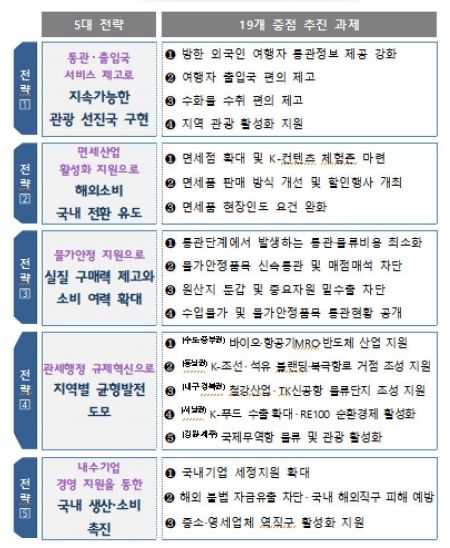
The enhancement of customs clearance and immigration services is centered on supporting the realization of a sustainable, advanced tourism nation. To this end, the Korea Customs Service will gradually expand the "Green Cap Service," currently operated for foreign tourists at six major airports and ports nationwide, including Incheon, Gimhae, Gimpo, and Jeju airports, as well as Incheon and Pyeongtaek ports.
The Green Cap Service is a system in which multicultural family members employed by customs provide guidance on customs procedures in various languages to foreign tourists at arrival halls.
The agency will also establish a "Mobile Baggage Arrival Information System" to enable travelers to easily check the arrival status of their baggage. Additionally, it will continue to expand assistance for retrieving luggage and dedicated departure lane services for people with disabilities, pregnant women, and other transportation-vulnerable groups.
To revitalize the duty-free industry, the agency will increase the number of new duty-free licenses at tourist hotspots such as Myeong-dong and Jeonju. It will also set up "K-Content Experience Zones" inside stores to strengthen experiential tourism, offering activities such as traditional games and K-beauty classes.
Furthermore, by introducing mobile identity verification in the duty-free goods pickup process, procedures will be simplified. The nationwide duty-free discount event, "Korea Duty Free Festa," will be held from October 29 to November 30 to stimulate consumption.
The agency will support expedited customs clearance for price stabilization items to reduce customs duties and logistics costs passed on to consumers. It will also strengthen customs management by cracking down on hoarding within bonded areas and the smuggling of key resources such as copper, thereby contributing to price stability.
In particular, the Korea Customs Service explained that it will prevent the misrepresentation of imported agricultural products as domestic ones in the distribution stage after customs clearance, and will expand the public disclosure of import prices and customs clearance status for items subject to quota tariffs to prevent price distortions in the market.
On September 1, the Korea Customs Service launched the "Customs Administration Price Stabilization Response Task Force," which is implementing 13 detailed measures focused on restoring the livelihood economy through price stabilization.
The agency will also support balanced regional development through regulatory innovation in customs administration. For example, in the Seoul metropolitan and Chungcheong regions, it will allow new factories to be integrated with existing bonded factories to facilitate the rapid establishment of industrial clusters. It will also classify aircraft MRO (Maintenance, Repair, and Overhaul) businesses as manufacturing, enabling them to utilize bonded processing procedures.
In the southeastern region (Busan, Ulsan, Gyeongnam), the agency will foster new growth engines such as K-shipbuilding, petroleum blending, and the development of Arctic shipping route hubs. Improvements will be made to allow imported raw materials to be immediately delivered to outsourced workplaces after pre-arrival usage declaration, and the designation of oil tanks as comprehensive bonded areas will be expanded to vitalize manufacturing and energy-based industries.
Additionally, in the Daegu-Gyeongbuk region, the agency will strengthen the competitiveness of the steel industry and support the creation of the Daegu-Gyeongbuk integrated (TK) new airport logistics complex. In the southwestern region (Jeonbuk, Gwangju, Jeonnam), it will promote K-food exports and activate the RE-100 circular economy. In the Gangwon and Jeju regions, it will support the development of international maritime and air logistics hubs and promote tourism.
Moreover, to help small and medium-sized enterprises secure liquidity and increase domestic investment, the Korea Customs Service will ease requirements such as omitting collateral for payment extensions and installment payments, and strengthen export refund support by finding unclaimed refunds and providing automatic refund information. These measures are intended to support the management of domestic companies and stimulate domestic production and consumption.
Lee Myunggu, Commissioner of the Korea Customs Service, stated, "Korea has a high dependence on exports, making it sensitive to external shocks such as global economic fluctuations and trade regulations. Recognizing that revitalizing domestic demand is a key task for stabilizing the livelihood economy, the Korea Customs Service will swiftly implement support measures so that the effects of customs administration are quickly reflected in the domestic market."
© The Asia Business Daily(www.asiae.co.kr). All rights reserved.
![Clutching a Stolen Dior Bag, Saying "I Hate Being Poor but Real"... The Grotesque Con of a "Human Knockoff" [Slate]](https://cwcontent.asiae.co.kr/asiaresize/183/2026021902243444107_1771435474.jpg)
















