"Isolation and Loneliness Must Be Addressed Through Relational Welfare"
"Welfare Is About Connection and Restoring Relationships"
"Gwangju-style Integrated Care: An Experiment in Economic Welfare"
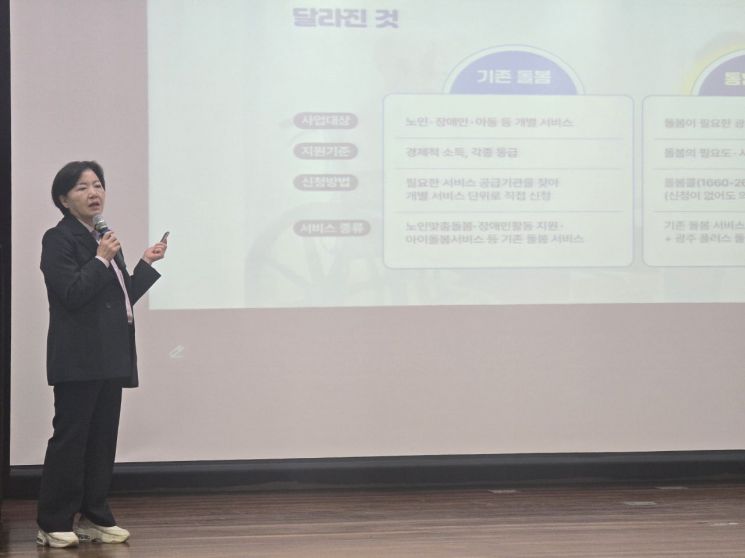 On the 24th, Park Mijeong, a council member of Gwangju City, gave a special lecture at the "2025 International Academic Conference" held at Dasan Hall, Sogang University, Seoul. Provided by Gwangju City Council
Park Mijeong, a member of the Gwangju City Council (Democratic Party of Korea, Dong-gu District 2), announced on the 26th that she gave a special lecture at the "2025 International Academic Conference" held at Dasan Hall, Sogang University in Seoul on the 24th.
This academic conference was held under the theme of "The Intersection of Connection and Isolation in a Hyperconnected Society." Assemblywoman Park delivered a presentation titled "Isolation and Loneliness: How Should We Respond? - Focusing on Gwangju-style Integrated Care."
Assemblywoman Park emphasized, "Isolation in a hyperconnected society does not arise from welfare blind spots, but from the breakdown of relationships," adding, "Restoring community-based welfare, where citizens care for one another, is a crucial task of our time."
She also pointed out, "South Korea has the highest suicide rate among OECD countries, and it is estimated that 3% of young people aged 19 to 39 are socially withdrawn." She stressed, "Welfare should shift from simple support to restoring connections and relationships." Park went on to introduce "Gwangju-style Integrated Care," the first of its kind in the nation, which was launched based on the "Gwangju City Integrated Care Support Ordinance" that she sponsored.
Assemblywoman Park explained, "This system is the only one in the country that allows people to receive care with a single application, and it also provides proactive outreach care for those who do not apply, thereby addressing welfare blind spots."
She added, "Gwangju-style Integrated Care is an experiment in 'relational welfare and economic welfare' based on the region's history and sense of community, achieving a shift from government-led welfare to welfare created together by citizens."
Currently, about 1,200 care workers are active across 97 neighborhoods in Gwangju's five administrative districts, and 13 new services are being offered, including home-visit nursing, exercise guidance, and care-assured housing. Last year, this initiative received the top prize at the UCLG International Urban Innovation Awards and has been recognized as a model case for local welfare.
Assemblywoman Park stated, "By enacting the Support Ordinance for the Socially Withdrawn (2019) and establishing the Social Withdrawal Support Center, we have expanded the scope of responses to social isolation." She explained, "Since 2022, the center has provided 1,400 counseling sessions and supported 571 participants in various programs, serving not just as a counseling institution but as a 'relationship recovery center.'"
She emphasized, "The essence of welfare is realized through citizen participation, not administrative action," adding, "Gwangju is the city leading the way in experimenting with this change."
© The Asia Business Daily(www.asiae.co.kr). All rights reserved.

















