Effectiveness in Question: 93% of Soldiers Prefer Combat Caps
Pilot Program Allows Both Berets and Combat Caps During Leave and Outings
The Republic of Korea Army is working on a plan to gradually phase out berets and transition to a system centered on combat caps.
According to data submitted by Army Headquarters to Assemblyman Park Sunwon of the National Defense Committee of the National Assembly on October 26, the Army has been running a pilot program since last month, allowing soldiers to choose between wearing berets and combat caps for both on-base and off-base activities such as leave and outings.
The Army officially adopted the dark green beret as its standard military cap in 2011. Given that the Army does not wear a separate dress uniform, the beret was intended to serve as a symbol of the "official uniform."
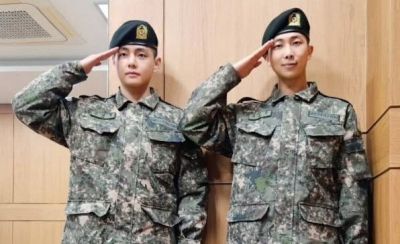 Members RM (right) and V of the group BTS wearing berets during their military service. Screenshot from social networking service (SNS)
However, as heatwaves have intensified and the service environment for soldiers has changed, the practicality of the beret has been continuously questioned. Criticism has persisted that the beret, which lacks a brim, provides little protection from sunlight and poor ventilation, causing significant discomfort when worn in the summer. In actual combat situations, soldiers wear bulletproof helmets, so the beret is also considered to have little relevance to combat effectiveness.
This trend was also confirmed in a survey conducted by the Army in January this year, targeting 1,730 personnel from eight units, including the 1st Division. Of the respondents, 93% preferred wearing the combat cap, and 65% supported standardizing the military cap to a single type-the combat cap.
Budget and procurement issues are also cited as reasons behind the discussion of discontinuing the beret. Supplying both berets and combat caps results in overlapping costs. Currently, there is only one company producing berets, leading to procurement delays and limitations in quality improvement.
To address these issues, the Army reintroduced the combat cap as a "special military cap" in 2020 and allowed its use on base during rainy or cloudy weather that same year. In 2021, the scope was expanded to permit the wearing of combat caps during general on-base and off-base activities. However, complaints and inconvenience regarding beret use have not subsided. In particular, it has become common for soldiers to remove their berets immediately after passing through the guard post during outings in hot weather, highlighting the need for further improvement.
Currently, the Army is reviewing the effectiveness of the expanded pilot program, which gives soldiers the option to choose their headgear as the first phase of the transition. The results of the pilot will be submitted to the Ministry of National Defense in November. In the next phase, targeted for 2027, the Army plans to increase the supply of combat caps from one to two per soldier and revise the standard uniform regulations, effectively designating the combat cap as the standard military cap and increasing its distribution.
© The Asia Business Daily(www.asiae.co.kr). All rights reserved.
![Clutching a Stolen Dior Bag, Saying "I Hate Being Poor but Real"... The Grotesque Con of a "Human Knockoff" [Slate]](https://cwcontent.asiae.co.kr/asiaresize/183/2026021902243444107_1771435474.jpg)















