More Than 20% Drop in Applicants to Medical, Pharmacy, and Korean Medicine Schools
24,000 Applications to Four Major Science and Technology Institutes
Competition Rate Reaches 14 to 1
This year, in university rolling admissions, the number of applicants to medical and related fields was the lowest in the past five years, while the number of applicants to science and technology institutes and artificial intelligence (AI)-related departments increased significantly. Analysts say that the application trends among top-performing students are shifting from medical fields to science and engineering.
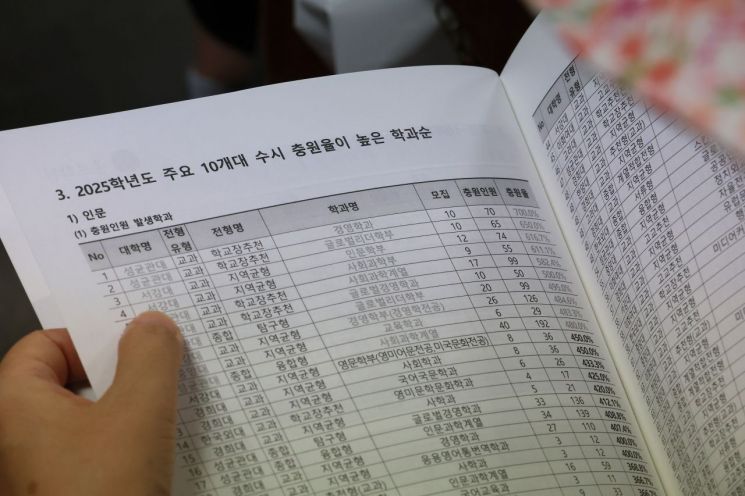
According to data compiled by Jongno Academy on October 26, the number of applicants to the four major science and technology institutes-Korea Advanced Institute of Science and Technology (KAIST), Gwangju Institute of Science and Technology (GIST), Ulsan National Institute of Science and Technology (UNIST), and Daegu Gyeongbuk Institute of Science and Technology (DGIST)-for the 2026 academic year rolling admissions reached 24,423, an increase of 16.1% from the previous year. This is the largest figure since the 2022 academic year.
By institution, UNIST had the highest number of applicants at 7,919, followed by KAIST with 6,991, DGIST with 6,182, and GIST with 3,331. The average competition rate was 14.14 to 1, continuing an upward trend every year since the 2022 academic year (8.77 to 1).
The popularity of AI-related departments also stood out. A total of 17,901 students applied to 28 undergraduate programs in 20 universities nationwide, including Korea University, Sogang University, and Chung-Ang University, marking a 4.2% increase from the previous year. The Language & AI Convergence Department at Hankuk University of Foreign Studies received 1,489 applications for 28 available spots, resulting in the highest competition rate of 53.18 to 1. The AI departments at Chung-Ang University and Sogang University also recorded competition rates exceeding 33 to 1.
In contrast, the number of applicants to medical, dental, Korean medicine, pharmacy, and veterinary schools was 112,364, a 21.9% decrease from the previous year’s 143,935. This is the lowest figure in the past five years. Notably, applications to medical schools dropped by 29.2%, marking the largest decline, and pharmacy, Korean medicine, and veterinary schools also saw decreases across the board.
Lim Sung-ho, CEO of Jongno Academy, commented, "Even considering the slight reduction in medical-related admissions quotas, it is rare to see simultaneous declines in pharmacy and Korean medicine schools as well. This suggests that the government's science and engineering-focused policies and changes in industrial demand are leading top-performing students to adjust their application strategies."
He added, "As advanced industries such as AI and semiconductors emerge as promising fields, the preference for science and engineering is likely to continue to spread."
© The Asia Business Daily(www.asiae.co.kr). All rights reserved.
![Clutching a Stolen Dior Bag, Saying "I Hate Being Poor but Real"... The Grotesque Con of a "Human Knockoff" [Slate]](https://cwcontent.asiae.co.kr/asiaresize/183/2026021902243444107_1771435474.jpg)















