Chinese Officials and Distinguished Taiwanese Guests Attend Diaoyutai Reception After Main Ceremony at the Great Hall of the People
Taiwanese Authorities Criticize Commemoration Day as "Reinforcing a Distorted Historical Narrative"... Some Call It a "Legal Maneuver"
As U.S. President Donald Trump announced plans to meet with Chinese President Xi Jinping to discuss the Taiwan issue, China held a ceremony on October 25 to commemorate the recovery of Taiwan.
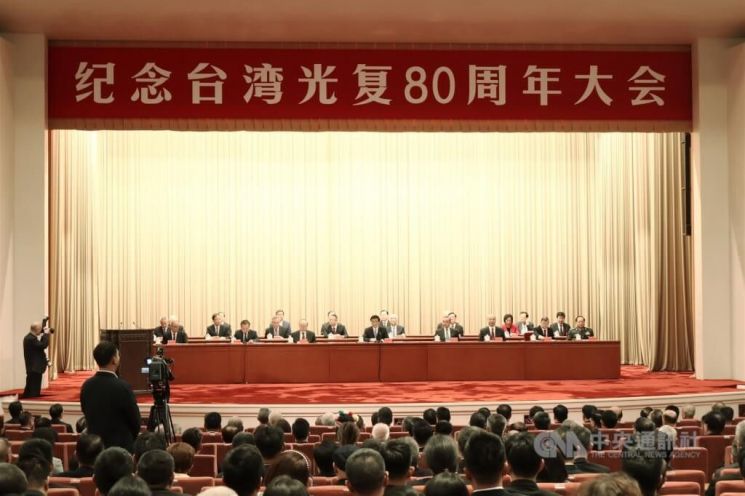
According to China Central Television (CCTV), the Taiwan Affairs Office of the State Council, which is responsible for Taiwan policy, held a reception at noon at the Diaoyutai State Guesthouse in Beijing to celebrate the establishment of Taiwan Recovery Commemoration Day. The reception was attended by distinguished guests from various sectors in Taiwan and relevant Chinese representatives who had participated in the main ceremony for the 80th anniversary of Taiwan's recovery earlier that morning. Chinese state media did not provide specific details about the main event or the list of attendees.
The Central News Agency (CNA) of Taiwan reported that the 80th anniversary ceremony of Taiwan's recovery was held at the Great Hall of the People in Beijing on this day. According to CNA, attendees included Wang Huning, Chairman of the Chinese People's Political Consultative Conference (CPPCC); Li Gan-jie, Head of the United Front Work Department of the Communist Party's Central Committee; Li Hongzhong, Vice Chairman of the National People's Congress (NPC, equivalent to the National Assembly in Korea); Wang Yi, Director of the Office of the Central Foreign Affairs Commission of the Communist Party (also serving as Foreign Minister); Zhang Youxia, Vice Chairman of the Central Military Commission; and Song Tao, Director of the Taiwan Affairs Office.
Wang Huning, Chairman of the CPPCC, stated, "At this historic moment marking the 80th anniversary of Taiwan's recovery, the Communist Party of China and the state have established this commemoration day to demonstrate that people of all ethnic groups across the country uphold the 'One China' principle and remain steadfast in defending national sovereignty and territorial integrity." He continued, "From the perspective of the overall interests and long-term development of the Chinese nation, we must all work together to advance the cause of unification," emphasizing, "The One China principle will never tolerate foreign interference." He added, "While we will fully consider the current situation in Taiwan, we will never leave any room for any form of 'Taiwan independence and separatist' activities."
CCTV reported that the recovery of Taiwan is clear evidence that the Chinese government restored sovereignty over Taiwan, and that it is an important part of both the historical fact and the legal connection that Taiwan is part of China. CCTV added that compatriots in Taiwan have repeatedly stated that the establishment of Taiwan Recovery Commemoration Day is a timely and significant measure.
Previously, China announced that it would designate the controversial 'Taiwan Recovery Day' as a national commemoration day, to be observed at the state level. The Standing Committee of the National People's Congress explained that it held its 18th meeting the previous day and approved a draft decision on the designation of Taiwan Recovery Commemoration Day, stating that various types and forms of national commemorative events would be held every year on October 25.
Taiwan Recovery Commemoration Day marks the return of Taiwan, which had been under Japanese colonial rule since 1895, to the Republic of China government on October 25, 1945, following Japan's defeat in World War II. In Taiwan, it was a statutory holiday during the Kuomintang administration, but when the pro-independence Democratic Progressive Party came to power in 2000, it was removed from the list of holidays on the grounds that the return to the Republic of China could not be considered a "recovery."
The Democratic Progressive Party has emphasized Taiwan's unique history, arguing that from the perspective of indigenous peoples or the benshengren (Han Chinese who migrated from mainland China during the Ming and Qing dynasties), the Nationalist government also occupied Taiwan by force as an external power. Accordingly, the party removed the holiday designation, arguing that the return to the Republic of China could not be considered a "recovery." However, this year, the government reinstated the statutory holiday by designating "Taiwan Recovery and Kinmen Guningtou Victory Commemoration Day" to also commemorate the victory in the Battle of Guningtou on Kinmen Island.
In response, the Mainland Affairs Council (MAC), Taiwan's agency responsible for relations with mainland China, criticized the move, stating, "Taiwan Recovery Day has nothing to do with the People's Republic of China," and "It is also unrelated to the Communist Party of China, which made no substantial contribution to the war against Japan." The MAC added, "This is an attempt to reinforce a distorted historical narrative and a biased political framework that 'the two sides of the strait (China and Taiwan) are one China.'"
Some analysts have described China's establishment of Taiwan Recovery Commemoration Day as an unusual legal maneuver. Wang Hsin-hsien, a distinguished visiting professor at the Institute of East Asian Studies at National Chengchi University in Taiwan, told CNA, "This is part of a legal struggle targeting Taiwan, and establishing a separate commemoration day is a very unusual approach among the various domains." He added, "The Communist Party of China has mainly addressed the Taiwan issue through historical interpretation in the past, so invoking a 'legal connection' is quite rare," and "It is an attempt to gain the initiative on the Taiwan issue." Hung Yao-nan, assistant professor at the Department of Diplomacy and International Relations at Tamkang University in Taiwan, also analyzed, "The main purpose and significance of this commemoration day designation is for domestic propaganda," and "It will not have much effect in the battle for international public opinion."
© The Asia Business Daily(www.asiae.co.kr). All rights reserved.
![Clutching a Stolen Dior Bag, Saying "I Hate Being Poor but Real"... The Grotesque Con of a "Human Knockoff" [Slate]](https://cwcontent.asiae.co.kr/asiaresize/183/2026021902243444107_1771435474.jpg)
















