"Jaechohwan was a flawed system from the start"
People Power Party signals introduction of housing package-type childbirth policy
The People Power Party proposed on the 24th that the law to abolish the Reconstruction Excess Profit Recovery System (REPRS) be handled through bipartisan agreement during this regular session of the National Assembly.
Kim Do-eup, chairman of the Policy Committee of the People Power Party, said at the National Assembly inspection countermeasure meeting held at the National Assembly that morning, "After the Democratic Party announced inconsistent real estate measures such as the October 15 demand suppression policy, they faced public criticism and backlash, and have now said they will consider abolishing the REPRS, which the People Power Party has consistently advocated."
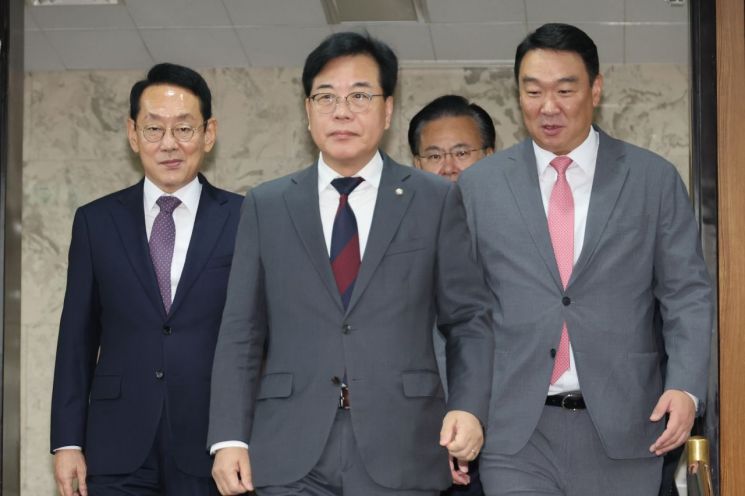 Song Eon-seok, floor leader of the People Power Party, and Kim Do-eup, chairman of the Policy Committee, along with other floor leadership members, are attending the National Assembly inspection countermeasure meeting held on the 24th at the National Assembly in Yeouido, Seoul. Photo by Yonhap News Agency
Chairman Kim criticized, "The REPRS was a poorly designed system from the start," adding, "Because it imposes taxes on unrealized, hypothetical gains, it infringes on property rights and serves as a representative regulation hindering redevelopment and reconstruction projects."
He further explained, "There is an absurd situation where a resident who owns a single home must pay taxes immediately after moving into a new apartment following reconstruction. This is the contradiction of the REPRS."
Additionally, the People Power Party announced plans to consider introducing a 'housing package-type childbirth system,' which would include easing the loan-to-value (LTV) and debt-to-income (DTI) ratios for first-time homebuyers and households with newborns.
Chairman Kim criticized, "Treating policies designed to boost the birth rate as part of real estate regulations is a prime example of an amateur and incompetent administration," and pointed out, "The ceiling for the Didimdol Loan was unilaterally reduced from 500 million won to 400 million won, and the ceiling for the Bogeumjari Loan was cut from 300 million won to 240 million won."
He added, "What is even more absurd is that, in an attempt to control housing prices in the Seoul metropolitan area, the government imposed restrictions on special newborn loans even in provincial areas with unsold homes. The restrictions on special newborn loans should be lifted not only in the metropolitan area but also throughout the provinces."
© The Asia Business Daily(www.asiae.co.kr). All rights reserved.

















