Publication of Domestic Officetel Market Report
Supply Cliff and Tighter Regulations: Structural Recovery Possible for Officetel Market
Growing Investor Interest in Living Sector, Including Co-living and Rental Housing
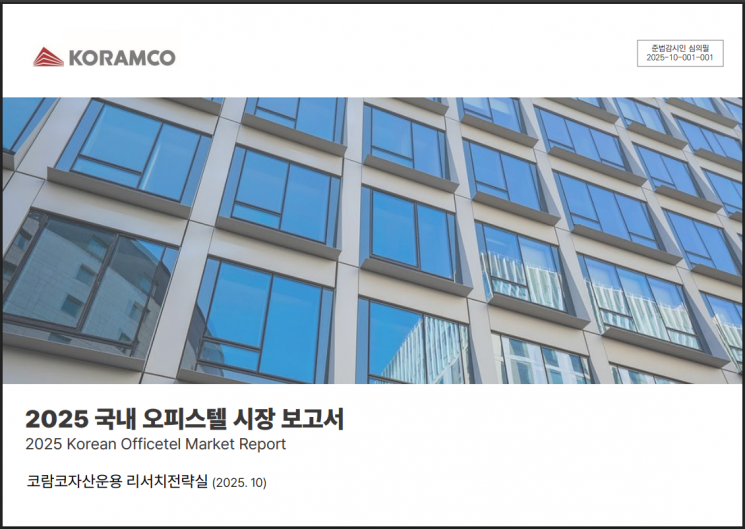
Koramco Asset Management published the "2025 Domestic Officetel Market Report" on October 24, covering trends in the officetel market and investment directions.
The report forecasts that the living sector, including officetels, is highly likely to emerge as a new source of demand. It diagnosed that the officetel market, where supply has rapidly contracted compared to demand in recent years, has entered a "supply cliff" phase. In addition, the report expects that, due to the government's "October 15 Housing Market Stabilization Measures," which expanded regulated areas in the Seoul metropolitan area and tightened lending restrictions, both end-users and investors facing limited housing purchase conditions will shift to the living sector, such as officetels, rental housing, and co-living.
According to the report, the nationwide number of officetel permits peaked in 2019 and has been declining since, reaching a historic low last year. The number of new units scheduled for occupancy by 2029 is only about 60,000, suggesting that supply will decrease rapidly over the next five years. With single- and two-person households accounting for 67% of the total and a growing preference for urban living, the end-user base is becoming increasingly solid. The report also noted that the average rental yield in the Seoul metropolitan area has recovered to 5.2%, and vacancy rates continue to fall, reinforcing the stability of income-generating residential assets.
Recently, the officetel pre-sale market has been shifting from being driven by individual buyers to a structure led by institutional investors focusing on purchase-type rental housing. The report emphasized that value-add strategies, such as converting existing officetels and hotels into co-living spaces, are becoming more active, and the living sector is establishing itself as a key pillar of alternative investment, following offices and logistics centers.
Global investment firm Morgan Stanley is pursuing co-living development projects such as "Episode Convini Doksan" and "Sangsu" in partnership with DDPS, an SK D&D affiliate. KKR is also collaborating with co-living specialist WeLiving to remodel officetel and hotel assets in Gangnam and Hoegi into co-living spaces. In addition, numerous global alternative investment managers, including ICG, CPPIB, and Hines, are expanding their investments in the living sector, focusing on prime locations such as Seongsu, Yongdu, and Myeong-dong.
The report also predicted that policy changes will have a significant impact. With the October 15 Housing Market Stabilization Measures, all of Seoul and 12 areas in Gyeonggi Province have been newly designated as regulated or overheated speculation zones. Financial regulations have been significantly strengthened, including reduced mortgage loan limits and higher stress rates. In addition, to restrict non-end-user transactions, the government has expanded land transaction permit zones and imposed a two-year mandatory occupancy requirement after housing acquisition. This is expected to both restrict the use of leverage for home purchases and stimulate demand for leasing and small-to-medium urban residences, increasing the likelihood that demand will shift to jeonse, monthly rent, and rental-type products.
The tightening of regulations is expected to dampen transactions in the general housing market while increasing the likelihood that demand will shift to officetels and quasi-residential properties, which are less affected by regulations. The new land transaction permit zone regulations under the October 15 measures apply only to housing, while officetels and commercial properties retain the existing LTV (70%). This is expected to have a positive effect on investment sentiment for officetels. The report advised that, since the scope and intensity of regulations may vary depending on the building's use (commercial or residential), legal status (quasi-residential), and detailed enforcement ordinances, investors should carefully review regional, product, and financing conditions.
In terms of price and yield, the officetel market is experiencing both a polarization of pre-sale prices and a gradual recovery in rental yields. In major transit areas in Seoul, the premium for high-end officetels is strengthening, while in many other regions, the triple burden of pre-sale price, interest rates, and construction costs is restricting new supply. Koramco explained that, as interest rates stabilize and the effects of the supply cliff accumulate, upward pressure on rents is likely to continue.
Based on the report, Koramco plans to gradually increase the proportion of its portfolio allocated to the living sector. The company is also reportedly considering investment strategies that combine value-add and operational efficiency in residential assets such as co-living and rental housing, with the aim of strengthening mid- to long-term income returns.
Kim Yulmae, Head of Research & Strategy at Koramco Asset Management, stated, "Due to the reduction in permit volumes over the past several years, supply will also decrease over the next five years." She added, "Changes in the policy environment are becoming prerequisites for purchase and development decisions, and going forward, the precision of regional targeting, demand segmentation, and operational strategies will be key to the success of officetel projects."
© The Asia Business Daily(www.asiae.co.kr). All rights reserved.
![Clutching a Stolen Dior Bag, Saying "I Hate Being Poor but Real"... The Grotesque Con of a "Human Knockoff" [Slate]](https://cwcontent.asiae.co.kr/asiaresize/183/2026021902243444107_1771435474.jpg)
















