The issue of water leakage at Osong Station has become a major topic during the National Assembly audit. There are growing calls for structural improvements, as the problem has persisted for a long time due to unclear management responsibilities.
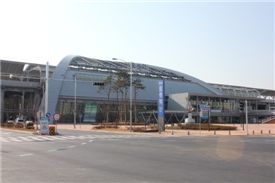 KTX Osong Station exterior. Photo by The Asia Business Daily DB
At a recent National Assembly audit by the Land, Infrastructure and Transport Committee, Assemblywoman Lee Yeonhee (Democratic Party of Korea, Heungdeok District, Cheongju, North Chungcheong Province) pointed out, "For ten years, every time it rains, Osong Station experiences water leakage, causing inconvenience to users. Despite repeated criticisms from the National Assembly, the issue remains unresolved. How long will we continue to overlook the same problem? Thorough management and supervision are needed from the construction stage."
As of last year, the management of high-speed (semi-high-speed) rail station facilities was divided among Korea Railroad Corporation (KORAIL) with 21 stations, Korea Rail Network Authority with 39 stations, and 3 stations jointly managed by both organizations. Stations managed by KORAIL are those in which KORAIL has invested and thus manages directly, while non-invested stations are managed by the Korea Rail Network Authority.
Except for Gwangmyeong and Cheonan-Asan Stations, most major high-speed rail stations nationwide are non-invested stations, including Osong Station, which was highlighted during this year's audit.
The core issue is that water leakage at railway stations continues to occur due to institutional and structural inefficiencies, as the management authority is not unified.
An industry insider stated, "Because the organizations responsible for constructing the facilities and those operating them are different, there are gaps in management. Unless the management authority is clearly defined or unified, there is no guarantee that issues such as water leakage at railway stations will not continue to recur."
He added, "One possible solution to the railway station management problem is for KORAIL to take full responsibility for both the operation and management by investing in non-invested stations. If KORAIL holds both responsibility and leadership in station management and operation, it will be able to address issues more proactively."
© The Asia Business Daily(www.asiae.co.kr). All rights reserved.
![Clutching a Stolen Dior Bag, Saying "I Hate Being Poor but Real"... The Grotesque Con of a "Human Knockoff" [Slate]](https://cwcontent.asiae.co.kr/asiaresize/183/2026021902243444107_1771435474.jpg)














