"Assessment and Outlook on Recent Export and Current Account Trends"
Semiconductors Lead Export Growth Driven by AI Investment Demand
Record Current Account Surplus Expected This Year Despite Tariff Impact
"Semiconductor Export Growth to Slow Ne
The proportion of semiconductors in South Korea's exports has continued to increase, reaching 23% this year. This growing dependence is due to semiconductors driving the overall rise in exports, to the extent that they have offset the tariff shock originating from the United States. However, there are projections that the growth rate of semiconductor exports may slow next year, and the impact of U.S. tariffs could become more pronounced.
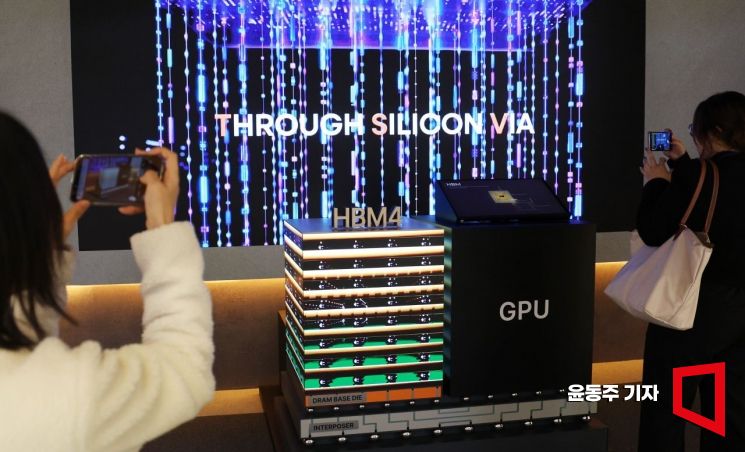 Visitors attending the '2025 Semiconductor Expo' held at COEX in Gangnam-gu, Seoul on the 22nd are viewing SK Hynix's HBM4-related exhibits. 2025.10.22 Photo by Yoon Dongju
On October 23, the Bank of Korea stated in its report, "Assessment and Outlook on Recent Export and Current Account Conditions," that "the recent boom in the semiconductor industry could be a double-edged sword for our economy."
Fueled by investment demand for artificial intelligence (AI), semiconductor exports reached an all-time high in the third quarter of this year, leading the overall increase in South Korea's exports. Of the 6.5% export growth rate, semiconductors contributed 5.6 percentage points, accounting for most of the total export increase. This has created the illusion that the impact of U.S. tariffs is nonexistent. This trend is also reflected in the current account, with the Bank of Korea projecting a record surplus of 110 billion dollars this year.
As a result of the strong performance in semiconductor exports, South Korea's export dependence on semiconductors has further expanded. The share, which was around 10% from 2002 to 2010, rose to 19% between 2021 and 2024, and reached 23% from January to September this year.
The Bank of Korea pointed out, "While the improvement in semiconductor exports, driven by the global semiconductor market expansion, has cushioned the negative effects of U.S. tariffs, the increased dependence means that if the semiconductor market shifts into a downturn, the impact on the overall economy will be greater than before."
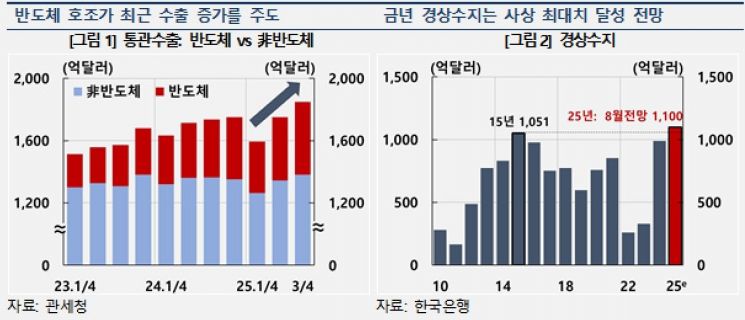
The Bank of Korea also predicted that next year's semiconductor export market will follow a different trend from this year. The Bank of Korea stated, "Although semiconductor exports are likely to remain strong for a considerable period, the growth rate will slow compared to this year." The report cited the already high level of semiconductor export value and the fact that, unlike when general-purpose memory was the main product, domestic semiconductor companies are conservatively expanding their high-bandwidth memory (HBM) production capacity. In particular, while semiconductor exports surged in the second half of this year due to increased AI investment, next year the growth is expected to slow due to a decrease in the global AI investment growth rate, the dissipation of this year's advance demand effect, and the possibility of tariffs being imposed on certain semiconductor products.
Relatively, the impact of U.S. tariffs is likely to increase. The Bank of Korea noted, "If the U.S.-China trade conflict reignites, leading to sluggish global trade, or if increased inflows of foreign securities investment funds result in higher primary income payments, the surplus could be partially constrained. In particular, as the impact of U.S. tariffs on non-IT exports grows next year, export sluggishness could intensify, especially in automobiles and steel." Against this backdrop, the current account surplus is also expected to shrink compared to this year.
The Bank of Korea suggested that, to overcome the challenging external environment and heightened uncertainty for exports, it is necessary to enhance competitiveness in the IT sector. The research team, including Lim Ungji, Deputy Head of the International Trade Team, emphasized, "The advancement of AI should not stop at infrastructure investment; it is important to take the lead in new industries such as robotics, autonomous vehicles, and AI agent services. In addition, expanding infrastructure such as large-scale AI data centers is essential to secure stable and affordable energy supply capabilities."
© The Asia Business Daily(www.asiae.co.kr). All rights reserved.


















