Held at the family burial site in Suwon, Gyeonggi Province
Attended by Chairman Jay Y. Lee, Hong Ra-hee, and other family members
Executives including Jun Young-hyun and Oh Se-chul also present
Luncheon at Samsung Human Resources Developmen
Samsung Electronics announced on the 23rd that a memorial service commemorating the fifth anniversary of the late former Chairman Lee Kun-hee will be solemnly held on the morning of the 24th at the family burial site in Suwon, Gyeonggi Province.
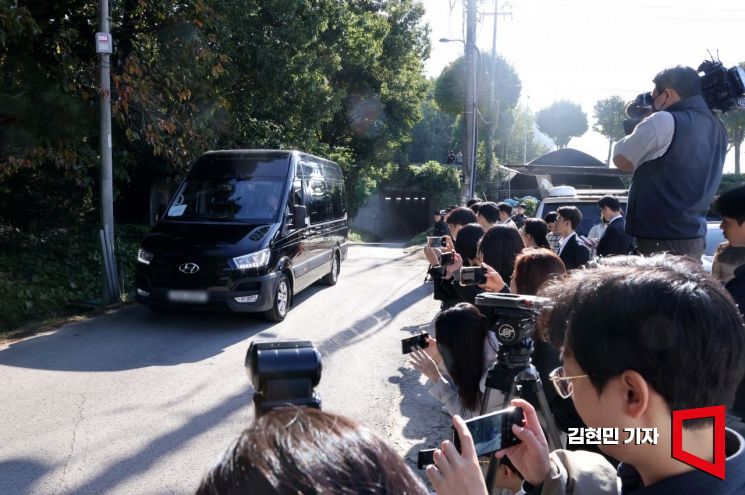 On October 25 last year, marking the fourth anniversary of the late Lee Kun-hee, Chairman of Samsung Group, a van carrying Samsung executives entered the Samsung family burial site in Jangan-gu, Gyeonggi Province. Photo by Kim Hyun-min
The memorial service will be attended not only by the bereaved family, including Samsung Electronics Chairman Jay Y. Lee, Leeum Samsung Museum of Art Honorary Director Hong Ra-hee, Hotel Shilla President Lee Boo-jin, Samsung C&T President Lee Seo-hyun, and Samsung Global Research President Kim Jae-yeol, but also by about 150 current and former group executives such as Samsung Electronics Vice Chairman Jun Young-hyun, Samsung C&T President Oh Se-chul, and Samsung Life Insurance President Hong Won-hak.
After the memorial service, Chairman Lee and the presidents of affiliated companies will gather for a luncheon at the Samsung Human Resources Development Center in Yongin, Gyeonggi Province, to honor the memory of the late former Chairman Lee.
On the occasion of this fifth anniversary, the value of the legacy left by the late Chairman Lee has once again drawn public attention. In 2021, Chairman Lee and his family honored his wishes by contributing to society through the donation of artworks and medical philanthropy. The late Chairman donated more than 23,000 cultural assets and artworks he had collected throughout his life to national institutions for the advancement of Korean art. He also donated a total of 1 trillion won for medical contributions, including 700 billion won to help overcome infectious diseases and 300 billion won to support children with cancer and rare diseases. While there was speculation that a significant portion of the inheritance would be sold to pay the more than 12 trillion won inheritance tax, the family defied expectations and chose to give back to society.
The donation of over 23,000 pieces from the late Chairman Lee's collection is unprecedented in scale in Korea. Specifically, 21,600 antique artworks, including 14 National Treasures and 46 Treasures, were donated to the National Museum of Korea, while more than 1,600 modern works by Korean and international artists were given to the National Museum of Modern and Contemporary Art. In addition, 143 pieces of Korean modern art were donated to regional museums across the country, including the Lee Jung Seop Art Museum in Jeju, the Park Soo Keun Museum in Gangwon, the Jeonnam Museum of Art, the Gwangju Museum of Art, and the Daegu Art Museum. These donations have been credited with raising the level of regional museum collections and enhancing local cultural infrastructure.
Since 2021, the National Museum of Korea and the National Museum of Modern and Contemporary Art have held a total of 35 touring exhibitions of the "Lee Kun-hee Collection" at major museums and art galleries nationwide, attracting more than 3.5 million visitors. According to the art-specialized media outlet Art Newspaper, the success of the Lee Kun-hee Collection exhibitions led the National Museum of Korea to be ranked among the world's top five most-visited museums in 2022.
The "Lee Kun-hee Collection" is also scheduled to be exhibited sequentially at world-renowned museums such as the Smithsonian Institution and the Art Institute of Chicago in the United States, as well as the British Museum in the United Kingdom. The overseas touring exhibitions of the "Lee Kun-hee Collection," jointly hosted by the National Museum of Korea and the National Museum of Modern and Contemporary Art together with major museums abroad, are expected to serve as an opportunity to widely promote the value of Korean art on the global stage, drawing significant interest from the cultural sector.
The "Lee Kun-hee Collection" will be on display at the Smithsonian National Museum of Asian Art in the United States from November this year through February next year, at the Art Institute of Chicago from March to July next year, and at the British Museum from September next year through January 2027.
The late Chairman Lee was known for emphasizing that "cultural literacy should grow in people's everyday lives" and took a keen interest in raising the cultural awareness of the public. At the opening ceremony of Leeum Museum of Art in 2004, he said, "Even though collecting and preserving cultural heritage may require enormous costs and time, I believe this is for the future of human culture and is a duty of our time for all of us." He also repeatedly expressed regret over Korea's precious cultural assets being scattered at home and abroad, stressing the need to gather them to enhance the status of the National Museum. He was also passionate about selecting talented individuals and supporting their overseas training. Notable artists such as Nam June Paik, Lee Ufan, and Kun-Woo Paik are among those who received support from the late Chairman for their international activities. He also established the Samsung Ho-Am Prize for the Arts to recognize artists who have made significant contributions to the advancement of human culture and the arts, thereby contributing to the development of Korean culture.
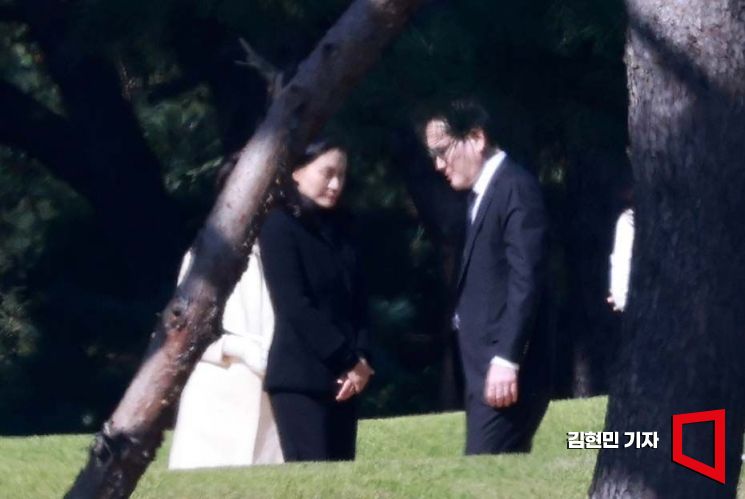 Samsung Electronics Chairman Jay Y. Lee and Samsung Welfare Foundation Chairwoman Seo-Hyun Lee are attending the 4th anniversary memorial service of the late Samsung Group Chairman Kun-Hee Lee, held on October 25 last year at the family burial site in Jangan-gu, Gyeonggi Province. Photo by Hyunmin Kim
The family, in keeping with the late Chairman's wishes that "the healthy and happy growth of children is our mission," also donated 300 billion won to support treatment for children with cancer and rare diseases and to establish advanced medical support systems. This bold donation has been credited with raising awareness in society about the need to support children suffering from cancer and rare diseases. Based on the 300 billion won donated by the family, medical institutions across the country, including Seoul National University Children's Hospital, came together to launch the "Pediatric Cancer and Rare Disease Support Project Group." Currently, more than 1,000 medical professionals from over 160 institutions nationwide are participating in the project. The initiative consists of three divisions: pediatric cancer, rare diseases, and joint research. Launched in 2021, this is a long-term project set to continue for 10 years until 2030. To date, the project group has carried out 86 initiatives related to diagnosis, treatment, and research, providing support to a cumulative total of 22,462 children. As of the end of last year, nearly 10,000 children had received diagnoses and were exploring treatment options, and almost 4,000 children had begun treatment with the support provided. Chairman Lee and Director Hong personally attended the "Lee Kun-hee Pediatric Cancer/Rare Disease Overcoming Project: Opening Hope, Opening the Future Together" event held at Seoul National University Children's Hospital in October last year to encourage the children, their families, and medical staff.
In addition, in 2021, when the world was suffering from COVID-19, the family donated 700 billion won to help build the infrastructure needed to respond to and overcome infectious diseases, which had emerged as humanity's greatest threat. Of the 700 billion won, 500 billion won is being used to construct the National Infectious Disease Hospital, which will serve as a "control tower" for responding to new infectious disease crises such as COVID-19. The National Infectious Disease Hospital, equipped with advanced facilities including general and intensive care beds, high-level negative pressure rooms, negative pressure operating rooms, and biosafety laboratories, will have 150 beds and is scheduled for completion by 2028. The remaining 200 billion won is being used to build state-of-the-art research facilities for the National Institute of Infectious Diseases under the Korea Disease Control and Prevention Agency and to expand infrastructure for infectious disease response, including research and development of vaccines and treatments.
© The Asia Business Daily(www.asiae.co.kr). All rights reserved.


















