A Historic Stage Created Together with Citizens
"Preparations Are Complete, Now It's Time for Results"
The 2025 APEC Summit is now just one week away.
Gyeongju City successfully secured the event by highlighting its identity as "the most Korean city" and "a safe international conference city."
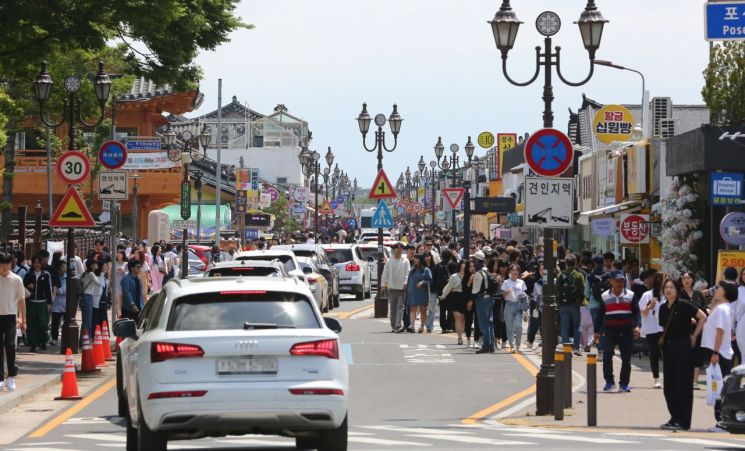 A panoramic view of Hwangridan-gil in Gyeongju, where tradition and youth culture coexist. Provided by Gyeongju City
This summit is more than a simple diplomatic event; it is a testbed for Gyeongju as it strives to become a global cultural city.
Gyeongju, where a thousand years of history meets cutting-edge preparations, is now at a new turning point.
This article examines the strategies of Gyeongju City as it heads toward its "second golden age," the efforts of its citizens, and the challenges that lie ahead. <Editor's Note>
◆A Proven International Conference City, the Result of Thorough Preparation
Since 2023, Gyeongju City has teamed up with the central government, Gyeongbuk Province, and the local community to bid for the APEC Summit.
Competing with prominent cities such as Incheon, Busan, and Jeju, Gyeongju focused on its unique identity as "the most Korean city," while also emphasizing its strengths as a "safe city" and a "proven international conference city."
The HICO Convention Center and the Bomun Tourism Complex already have the infrastructure needed to host international events.
Gyeongju has demonstrated its capabilities by successfully hosting major international events such as the 2005 APEC Senior Officials' Meeting in Busan, the 2010 G20 Finance Ministers and Central Bank Governors Meeting, and the 2011 UNWTO (World Tourism Organization) General Assembly.
Based on these achievements, the city emphasized to the government that it is a "city ready for immediate action."
Its symbolic status as a cultural city with UNESCO World Heritage sites and its high satisfaction ratings among foreign visitors also worked as advantages.
The concept of a "dignified conference city embracing a millennium of cultural heritage" was praised for ensuring both stable hosting conditions and global promotional effects.
Gyeongju City adopted a practical, work-focused strategy throughout the bidding process. The city held multiple task force meetings with related agencies, presenting detailed plans for conference flows, accommodation assignments, and security and protocol simulations.
Thorough preparation and meticulous responses built strong trust, which ultimately became the decisive factor in Gyeongju being selected as the final host city.
◆Conference Venues, Accommodation, and Transportation Fully Prepared... "All That's Left Is to Host"
Concerns raised immediately after Gyeongju was selected as the host-such as "lack of preparation time" and "facility limitations"-have long since disappeared.
Gyeongju City has now completed all preparations and is ready to host the event.
Renovations to improve security, communications, and protocol facilities at the designated venue, HICO Convention Center, were completed last month.
Detailed arrangements for the main conference hall, session spaces, media center, and security control room have also been finalized.
Accommodation is also sufficient.
To provide top-level accommodations (PRS), the governor and mayor formed a PRS Committee with hospitality industry representatives and experts, established a standard model, and completed remodeling and new construction for 35 PRS units.
Guest rooms for government delegations, business leaders, and media participants were secured in consultation with government ministries, ensuring that up to 7,700 people can be accommodated during the event.
In particular, to meet additional demand from business participants, the city has also coordinated with accommodation facilities in nearby cities such as Pohang and Ulsan, as well as two cruise ships docked at Pohang Yeongilman Port.
The transportation system is also fully prepared.
Gimhae Airport and KTX Gyeongju Station will serve as transportation hubs.
Twenty-seven dedicated APEC shuttle bus routes will run frequently between participant accommodations and transportation hubs.
Additional KTX and SRT trains between Seoul and Gyeongju, as well as increased domestic flights between Incheon and Gimhae airports, will ensure participants can travel to Gyeongju quickly and safely. Temporary parking lots have been added within the Bomun Complex.
During the event, a traffic control center with participation from relevant agencies will operate 24 hours a day, led by the security and safety control team.
Joo Nakyoung, Mayor of Gyeongju, stated, "APEC has moved from the preparation stage to the execution stage," adding, "Dedicated event routes will be kept safe, while regular traffic for citizens will be maintained as usual."
◆Citizen-Driven Dignity... Minimizing Inconvenience and Encouraging Voluntary Participation
Gyeongju City is emphasizing citizen-centric APEC operations.
The city has made minimizing inconvenience for citizens and hosting APEC together with the community key priorities for the event's success.
City buses and taxis will operate as usual, with temporary circular shuttle buses deployed in sections where some controls are expected. During the summit, city buses passing through the Bomun Complex will run on detour routes.
Field situation rooms will be operated 24 hours a day to address any inconveniences related to roads, transportation, safety, and the environment.
Support for small business owners and the tourism industry will also be provided in parallel.
The city is conducting hospitality and hygiene training for the accommodation and restaurant industries, expanding the number of "good price" establishments, and running a campaign to stabilize accommodation prices.
Voluntary citizen participation is particularly noteworthy.
At the "APEC Citizen Volunteer Welcoming Day" event held on the 23rd of last month, about 700 citizens participated, and at the citywide action pledge rally on the 31st, about 3,000 citizens committed themselves to ensuring the event's success.
The city has implemented a "one organization, one responsibility zone" system, with around 1,500 people from 70 organizations regularly conducting cleanliness activities in key areas such as the central shopping district, Hwangridan-gil, and the bus terminal.
On the fourth week of every month, the city operates "APEC Clean Day," during which agencies, schools, businesses, and social organizations work together to improve the urban environment.
Ongoing, community-based activities include removing illegal banners, collecting trash, and cleaning roads and streams.
Additionally, at a citizen roundtable held under the theme "Post-APEC: Building a Global City Together with Citizens," about 120 citizens attended to discuss the future direction of Gyeongju after APEC.
Mayor Joo Nakyoung said, "This summit is not a government-led event, but a festival created together with citizens," adding, "Citizen participation, order, and hospitality are Gyeongju's greatest strengths."
◆APEC's Economic Impact... 7 Trillion Won Ripple Effect on the Local Economy
According to analyses by the Korea Chamber of Commerce and Industry and Deloitte Consulting, the total economic impact of hosting APEC in Gyeongju is estimated at approximately 7.4 trillion won.
Of this, the short-term direct effect is estimated at 3.3 trillion won, while the mid- to long-term added value from tourism and consumption is projected at 4.1 trillion won.
The employment inducement effect is expected to reach about 22,600 people.
With concentrated spending on accommodation, dining, and shopping, short-term sales are projected to reach several hundred billion won.
Gyeongju City is implementing various on-site support measures to directly link these effects to the local economy.
The city is strengthening quality improvement training for the restaurant, accommodation, and tourism industries, and has designated 150 foreigner-friendly restaurants, providing multilingual menus, translation devices, and outdoor signage support.
Additionally, in cooperation with Gyeongbuk Province, the city is promoting voluntary agreements on accommodation prices and service improvement training to encourage industry self-stabilization.
Mayor Joo Nakyoung emphasized, "APEC is not just a diplomatic event, but a turning point that will transform the local economy."
◆After APEC, Becoming a "City People Return To"
Gyeongju City has set a goal of elevating its global status through APEC.
The city plans to strengthen its position as an international conference city by continuously attracting international conferences and industry forums based on the International Conference Complex Zone (GGCC) centered around HICO Convention Center.
It will also expand stay-type tourism infrastructure by linking major attractions such as the Bomun Tourism Complex, Hwangridan-gil, and Bulguksa Temple.
By combining nighttime scenery with cultural content, the city aims to increase the length of stay for foreign tourists, and will operate familiarization tours for journalists and travel agencies from APEC member countries so they can directly experience Gyeongju's cultural heritage and tourism appeal.
Gyeongju City is also pursuing the attraction of an "Asian Davos Forum" following the APEC Summit, aiming to continue its reputation as an international conference city.
The goal is to establish a permanent international forum in Gyeongju where global leaders, companies, and research institutions can gather to discuss future agendas in economics, culture, climate, and technology.
Mayor Joo Nakyoung stated, "APEC is not the end, but the beginning," adding, "This summit will not be an event created by the government, but a historic stage created together with citizens."
He continued, "Even after APEC, Gyeongju City will continue to develop through the power of its citizens, advancing as a global city where peace, culture, and economy meet," emphasizing, "Gyeongju is now fully prepared to welcome the world, and after APEC, it will rise as a city the world wants to visit again."
© The Asia Business Daily(www.asiae.co.kr). All rights reserved.
![Clutching a Stolen Dior Bag, Saying "I Hate Being Poor but Real"... The Grotesque Con of a "Human Knockoff" [Slate]](https://cwcontent.asiae.co.kr/asiaresize/183/2026021902243444107_1771435474.jpg)















