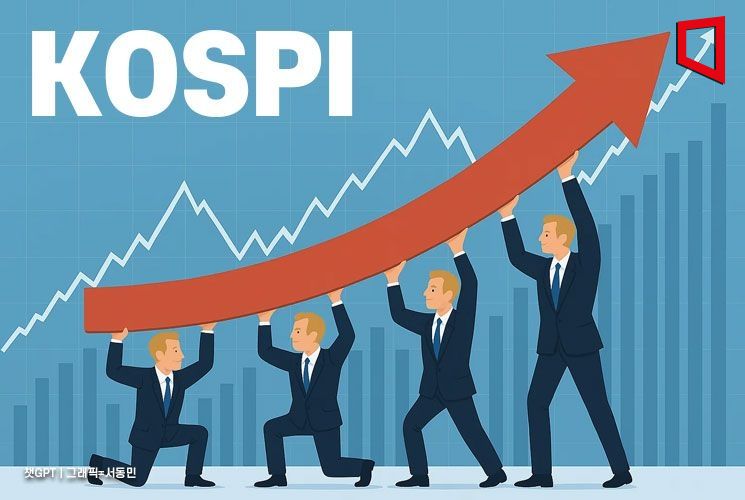
On October 23, the KOSPI broke through the 3,900 mark during trading for the first time ever, bringing the achievement of the “Sacheonpi” (KOSPI 4,000) within sight.
At around 11:48 a.m. on this day, the KOSPI rose by 16.96 points (0.44%) from the previous session to reach 3,900.64, surpassing the 3,900 level for the first time. This milestone came just three trading days after the KOSPI first broke through the 3,800 mark during trading on October 20.
Earlier, the KOSPI began the session at 3,835.79, down 47.89 points (1.23%) from the previous close, as caution spread due to overnight weakness on the New York Stock Exchange and escalating U.S.-China trade tensions. The index, which at one point fell to 3,822.33, rebounded as bargain hunters entered the market, climbing as high as 3,902.21. As of 12:13 p.m., it was trading in the 3,898 range.
The upward momentum was driven by individual investors, often referred to as “Donghak Ants.” Individuals made net purchases worth 314 billion won in the KOSPI market. Institutions also turned to net buying during the session, purchasing 50 billion won. In contrast, foreign investors continued net selling, offloading around 400 billion won.
Most of the top market capitalization stocks, which had started the day lower, also managed to rebound. Hanwha Aerospace jumped more than 4%, while SK Hynix (up 1.14%) and KB Financial Group (up 0.30%) also posted gains. On the other hand, Doosan Enerbility (down 2.28%), Hyundai Motor (down 1.72%), Kia (down 1.35%), LG Energy Solution (down 0.55%), and Samsung Electronics (down 0.41%) remained weak.
KOSDAQ, which also opened lower alongside the KOSPI, managed to turn positive around 11:20 a.m. but soon slipped back into negative territory. As of 12:22 p.m., it was trading in the 878 range.
Lee Jaewon, a researcher at Shinhan Investment Corp., commented, “Individual investors have supported the downside of the index by net buying for two consecutive trading days. While the Korean market is showing a unique upward momentum among Asian stock markets, ultimately, the key is earnings.”
Lee Woongchan, a researcher at iM Investment & Securities, noted, “Now is the time to factor in additional catalysts for next year’s stock market. With nearly all asset prices-except for U.S. Treasuries and energy-surging this year, there is no clear answer as to where to invest next year. Global stock markets are expected to navigate a period of heightened volatility for the time being, driven by a variety of events.”
© The Asia Business Daily(www.asiae.co.kr). All rights reserved.
![Clutching a Stolen Dior Bag, Saying "I Hate Being Poor but Real"... The Grotesque Con of a "Human Knockoff" [Slate]](https://cwcontent.asiae.co.kr/asiaresize/183/2026021902243444107_1771435474.jpg)















