First General Committee Meeting with 93 Organizations from Industry, Academia, Research, and Government
Strengthening Cooperation for Advancement and Commercialization of Five Core Technologies
The government is officially launching a nationwide collaborative platform to accelerate the independence and industrialization of clean hydrogen technology.
On October 23, the Ministry of Science and ICT announced that it held the first General Committee meeting of the "Clean Hydrogen R&D Innovation Alliance" at the National Research Foundation of Korea, where participants discussed strategies for clean hydrogen technology development and commercialization through collaboration among industry, academia, research institutes, and government. This was the first official meeting since the launch of the Innovation Alliance on September 9.
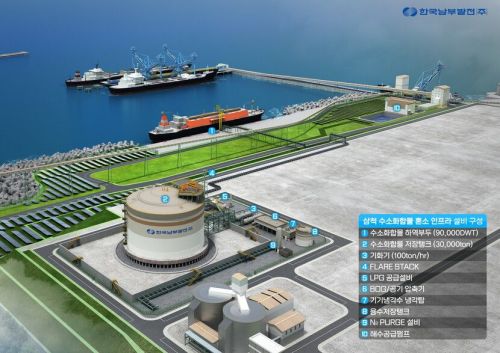 Perspective view of the Southern Power Clean Hydrogen Compound Infrastructure Facility. The Asia Business Daily DB
The Innovation Alliance is a public-private consultative body led by the Ministry of Science and ICT, comprising 93 organizations, including 67 companies, 10 research institutes, and 16 universities. Its goal is to achieve a 100% localization rate for clean hydrogen production technology by 2030.
The main areas of collaboration are the five core technologies: alkaline (ALK) water electrolysis, polymer electrolyte membrane (PEM) water electrolysis, solid oxide (SOEC) water electrolysis, anion exchange membrane (AEM) water electrolysis, and liquid organic hydrogen carrier (LOHC).
The General Committee meeting was chaired by Kim Junbeom, a professor at Ulsan National Institute of Science and Technology, and attended by officials from the Ministry of Science and ICT, representatives from demand companies (such as BHI, Samsung C&T, HD Hyundai Heavy Industries, and POSCO Holdings), heads of national hydrogen-focused research labs, and academic experts-totaling more than 20 participants. Attendees agreed on the need to strengthen demand-driven R&D systems and expand technology demonstration to ensure that laboratory research results are translated into industrial applications.
Industry representatives emphasized that, given the domestic technology level is lower than that of leading countries such as the United States and Europe, the government should actively support demonstration platforms that companies can utilize. The research community stated that they would build a reliable collaborative ecosystem by enhancing technology verification and exchange among companies, research institutes, and universities.
The Ministry of Science and ICT plans to invest 119 billion won in 30 core research labs in the five key areas by 2029, scaling up ALK and PEM water electrolysis systems to 10 MW and several MW, respectively, and establishing a performance verification system for materials and component technologies. Starting next year, the ministry will also launch clean hydrogen technology development projects in which companies can participate from the early stages of R&D, and will operate "technical subcommittees" for each field to strengthen ongoing collaboration.
Kim Seongsu, Director General for R&D Policy at the Ministry of Science and ICT, stated, "The Innovation Alliance is a truly comprehensive clean hydrogen R&D collaboration platform. To avoid missing the golden time for technological independence, we will establish a full-cycle collaborative system and support innovation in the clean hydrogen industry ecosystem."
© The Asia Business Daily(www.asiae.co.kr). All rights reserved.
![Clutching a Stolen Dior Bag, Saying "I Hate Being Poor but Real"... The Grotesque Con of a "Human Knockoff" [Slate]](https://cwcontent.asiae.co.kr/asiaresize/183/2026021902243444107_1771435474.jpg)















