Lee Eog-weon, Chairman of the Financial Services Commission, Holds On-Site Meeting on Low-Income Financial Services and Debt Adjustment
"Raising the Maximum Eligible Debt Amount for Debt Adjustment Support for Vulnerable Groups"
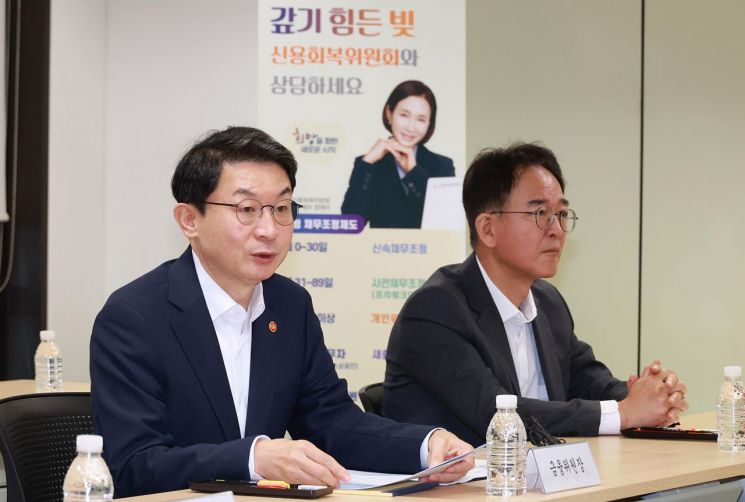 Lee Eog-weon, Chairman of the Financial Services Commission (left), visited the Central Integrated Support Center for Low-Income Financial Services in Jung-gu, Seoul, on the morning of the 23rd. He toured the consultation site, listened to the firsthand voices of the on-site counselors, and discussed directions for improving the current system. Photo by Financial Services Commission
Going forward, victims of voice phishing will be able to apply for debt adjustment through the Credit Recovery Committee, which will help reduce their debt burden. In addition, the maximum debt amount eligible for debt adjustment support will be raised from the current 15 million won to further assist vulnerable groups in restarting their financial lives.
Active Support for Debt Adjustment for Voice Phishing Victims
The Financial Services Commission announced that Chairman Lee Eog-weon visited the Central Integrated Support Center for Low-Income Financial Services in Jung-gu, Seoul, on the 23rd, where he held an on-site discussion on low-income financial services and debt adjustment.
During the meeting, participants discussed ways to improve debt adjustment for voice phishing victims, expanding the eligible debt amount for liquidation-type debt adjustment, and strengthening debt adjustment for minor heirs.
One issue raised on-site was that "victims of voice phishing, who suddenly incur excessive debt, have visited the Credit Recovery Committee for help, but under the current regulation limiting the ratio of new debt, they are unable to apply for debt adjustment immediately, which is unfortunate." The Credit Recovery Committee currently prohibits applications for debt adjustment if debts incurred within the past six months account for more than 30% of total debt, in order to prevent moral hazard by discouraging intentional default after taking out new loans.
Chairman Lee stated, "Since voice phishing is a financial crime and not the victim's fault, it is necessary to provide active protection." He added, "Debts resulting from voice phishing will be excluded from the calculation of the new debt ratio when determining eligibility for debt adjustment applications through the Credit Recovery Committee." In this regard, the Financial Services Commission explained that it would revise the credit recovery support agreement after discussions with participating institutions by the end of this year.
Another opinion raised on-site was that "basic livelihood security recipients, the elderly, and people with severe disabilities often lack the ability to repay, so even if they are granted debt adjustment, they frequently give up midway, resulting in arrears and the termination of the arrangement. Therefore, more active support is needed." In response, Chairman Lee said, "To actively support debt adjustment for vulnerable groups, we will raise the maximum eligible debt amount for the liquidation-type debt adjustment system, which exempts the remaining debt of diligent low-income debtors under the Credit Recovery Committee, from the current 15 million won, taking into account the debt reduction standards of the New Leap Fund."
The liquidation-type debt adjustment system of the Credit Recovery Committee is designed to support the economic recovery of socially vulnerable groups with extremely low repayment capacity. If they make a minimum effort to repay over a set period, the remaining debt is forgiven. After a principal reduction of up to 90%, if they repay for more than three years (at least half of the adjusted debt), the remaining debt is discharged. Currently, basic livelihood security recipients, people with severe disabilities, and low-income seniors aged 70 or older with total principal debt of 15 million won or less are eligible. The Financial Services Commission plans to increase this amount after discussions with credit recovery support institutions.
Debt Burden for Minor Heirs Also to Be Eased
Going forward, the debt burden on minor heirs will also be eased. When minors inherit debt from parents or others, their lack of financial knowledge often prevents them from renouncing the inheritance or applying for limited approval, resulting in the automatic succession of debt. There have been calls to treat economically disadvantaged minor heirs similarly to basic livelihood security recipients or people with severe disabilities when considering debt adjustment, so that they can escape the burden of debt and lead normal lives as adults. The Financial Services Commission explained that by the end of the year, it would include minor heirs as eligible for liquidation-type debt adjustment to ease their debt burden.
Chairman Lee emphasized, "As the difficult economic situation continues, active capital provision and debt adjustment are urgently needed to alleviate the suffering of low-income and vulnerable groups and to expand the overall economic pie." He added, "We will continue to listen to the voices on the front lines of low-income financial policy and work together with the field to keep improving."
© The Asia Business Daily(www.asiae.co.kr). All rights reserved.
![Clutching a Stolen Dior Bag, Saying "I Hate Being Poor but Real"... The Grotesque Con of a "Human Knockoff" [Slate]](https://cwcontent.asiae.co.kr/asiaresize/183/2026021902243444107_1771435474.jpg)















