Securing Yeosu and Gwangyang Ports as Northeast Asia's Key Hubs
Launching Full-Scale Development as an Eco-Friendly Energy Hub Port
Yeosu Gwangyang Port Authority (Acting President Hwang Hakbeom, hereinafter referred to as "the Authority") announced on the 23rd that it had signed a Memorandum of Understanding for the joint implementation of policy tasks to pioneer the Arctic route with Korea National Oil Corporation, BS Hanyang, and Oil Hub Korea Yeosu at the Authority's headquarters on the 22nd.
This agreement aims to establish an organic cooperative system among the participating institutions and companies, enabling mutual collaboration to secure Yeosu Gwangyang Port's position as a key hub port for the Northeast Asia Arctic route and to develop it into an eco-friendly Arctic energy logistics and distribution hub.
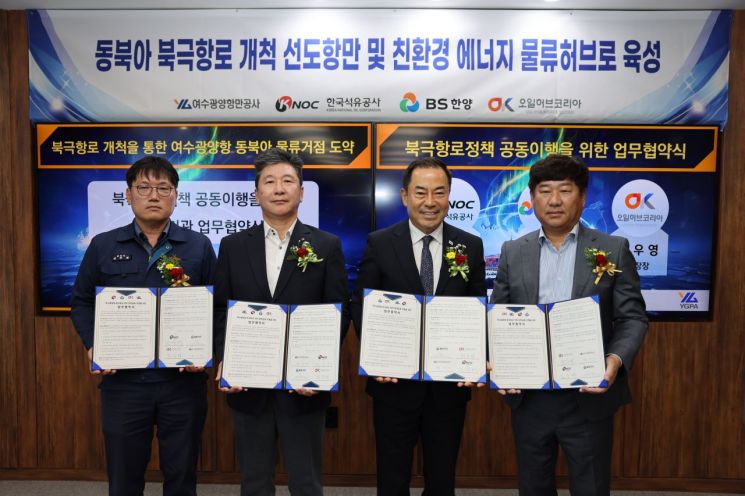 Yeosu Gwangyang Port Authority signed a Memorandum of Understanding on the 22nd at its headquarters with Korea National Oil Corporation, BS Hanyang, and Oil Hub Korea Yeosu to jointly implement policy tasks for pioneering the Arctic route. Provided by Yeosu Gwangyang Port Authority
Under the agreement, each institution and company will closely cooperate on building and investing in the infrastructure necessary for pioneering the Arctic route, formulating strategies for the stable transport of polar energy, promoting demonstration projects for energy resource transport via the Arctic route, and developing Yeosu Gwangyang Port into an energy logistics hub and a port for eco-friendly fuel bunkering.
The Arctic route is attracting attention as a next-generation maritime logistics pathway that can connect Asia and Europe via the shortest distance. With the recent expansion of navigable periods due to climate change, its value as a practical alternative route is increasing.
In particular, as the Asian market is emerging as the largest potential or developing consumer of energy resources near the Arctic Ocean, the potential of domestic ports as bases for transportation and distribution is coming to the fore.
In the case of Yeosu Gwangyang Port, it is not only a major consumer of abundant energy resources due to its proximity to the Yeosu National Industrial Complex and POSCO Gwangyang Steelworks, but also continues to see the construction of large-scale crude oil and natural gas storage and distribution facilities. As a result, the port is highly regarded for its potential to become a storage, reserve, and distribution base for Arctic route energy cargoes in Northeast Asia.
With the recent construction and expansion of POSCO's LNG Terminal 2 and the completion of the Myodo Northeast Asia LNG Hub Terminal jointly promoted by BS Hanyang and GS Energy, Yeosu Gwangyang Port is also expected to serve as a supply base for eco-friendly fuel bunkering in response to global shipping companies' efforts to reduce vessel greenhouse gas emissions.
Hwang Hakbeom, Acting President, stated, "This agreement marks a meaningful first step for Yeosu Gwangyang Port to become a key hub port for the Northeast Asia Arctic route," adding, "By uniting public institutions and private energy companies, we will play a leading role in pioneering the Arctic route and achieve results that contribute to the national energy and resource supply strategy."
© The Asia Business Daily(www.asiae.co.kr). All rights reserved.

















