"Tesla's E2E Approach Becomes Mainstream... Gradual Transition Needed"
Waymo and Tesla Find Solutions in a 'Hybrid' Middle Ground
Massive GPU Investment Required... Government Support Is Crucial
As Tesla's 'end-to-end (E2E)' technology becomes the dominant trend in the global autonomous driving industry, there are calls in South Korea for a phased introduction that takes into account the country's current realities. Instead of adopting E2E, which comes with high costs due to requirements such as high-performance GPUs, a 'hybrid' model that combines deep learning with existing systems is being discussed as a more practical alternative.
Yoo Minsang, Executive Director of Autonomous A2Z, stated at the Korea Automobile Journalists Association Symposium held at EXCO in Buk-gu, Daegu, during the '2025 Future Innovation Technology Expo (hereinafter FIX 2025)' on the 22nd, "Until now, the traditional 'rule-based' method has been applied to over 95% of autonomous vehicles worldwide, including Waymo, a subsidiary of Google. However, since Tesla began transitioning to E2E with Full Self-Driving (FSD) v12 last year, E2E has become the mainstream." He made these remarks during his presentation.
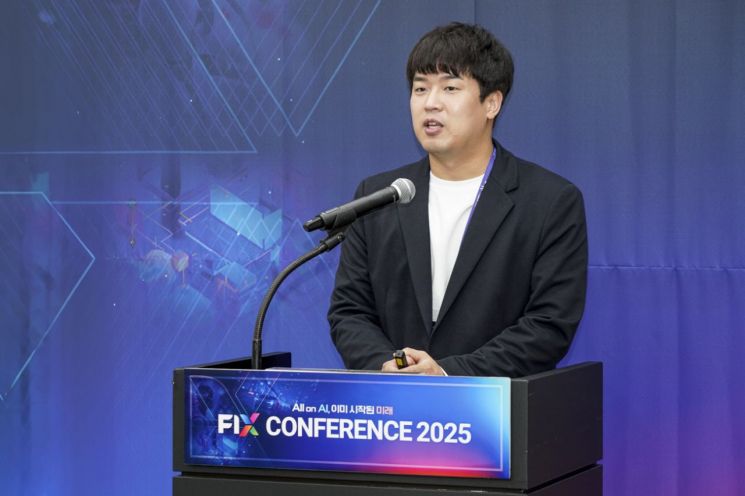 Yoo Minsang, Executive Director of Autonomous A2Z, is speaking at the Korea Automobile Journalists Association Symposium held on the 22nd at EXCO in Buk-gu, Daegu during the 2025 Future Innovation Technology Expo. Korea Automobile Journalists Association
The rule-based approach enables autonomous vehicles to perceive road conditions using sensors such as cameras and LiDAR, as well as high-precision maps, and then operate according to pre-set human rules. While this method delivers stable performance, it has limitations in terms of flexibility when faced with unexpected situations.
In contrast, E2E allows a large-scale AI model within the vehicle to independently perform all tasks required for autonomous driving. This approach offers greater flexibility in responding to unforeseen events compared to the rule-based method, but it requires high-performance graphics processing units (GPUs), resulting in significantly higher costs.
For this reason, Yoo advocated for a so-called 'hybrid' approach, which involves gradually moving closer to E2E by adding deep learning to the rule-based system. For example, when an autonomous vehicle encounters a construction site while driving, the rule-based method would have the vehicle stop, recognize the conditions for a lane change, and wait until the lane is clear. However, by incorporating deep learning that enables the vehicle to 'recognize a construction site and avoid it by changing lanes,' the hybrid approach allows for smoother driving even in construction environments.
Yoo said, "Thanks to the addition of deep learning, autonomous driving has become as smooth as human driving. Waymo is also increasing the use of deep learning within its rule-based system by applying this practical hybrid approach, and our company has implemented more than 10 deep learning models in the perception domain." He added, "To expand autonomous driving zones and achieve commercialization, a phased transition is needed-from rule-based, through hybrid, to E2E methods."
There were also opinions that expanding GPU resources and data is essential for implementing E2E. Yoo pointed out, "Tesla owns 135,000 GPUs, while our company has only 13, and even across all of South Korea, there are only about 2,000. Building servers requires an enormous amount of resources, with each GPU costing about 100 million won."
Kwon Soon, CEO of autonomous driving startup FutureDrive, also commented, "In E2E, data is life." He added, "Although the Ministry of Science and ICT is collecting a lot of public AI data, it is still insufficient compared to other countries. If the government actively pursues the data dam project, it will help accelerate the transition to E2E."
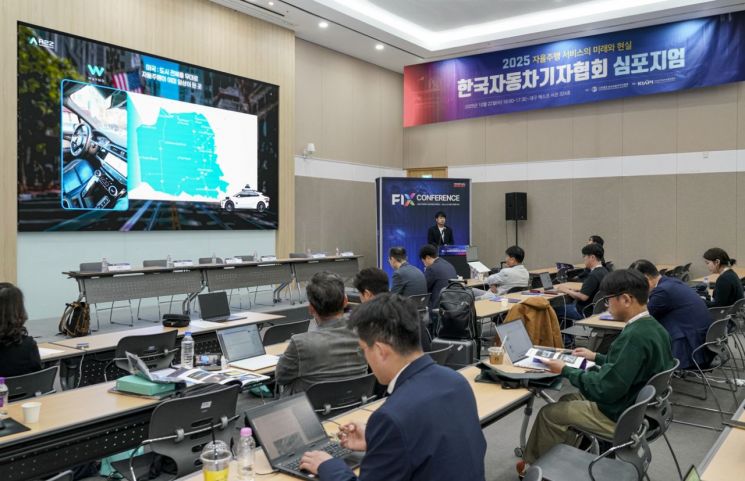 Yoo Minsang, Executive Director of Autonomous A2Z, is speaking at the Korea Automotive Journalists Association Symposium held on the 22nd at EXCO, Buk-gu, Daegu, during the 2025 Future Innovation Technology Expo. Korea Automotive Journalists Association
© The Asia Business Daily(www.asiae.co.kr). All rights reserved.
![Clutching a Stolen Dior Bag, Saying "I Hate Being Poor but Real"... The Grotesque Con of a "Human Knockoff" [Slate]](https://cwcontent.asiae.co.kr/asiaresize/183/2026021902243444107_1771435474.jpg)
















