Housing Prices and Transaction Volumes Must Stabilize...
Effectiveness of October 15 Measures Needs Verification
$35 Billion US Investment Uncertainty and Growing Exchange Rate Volatility Add Pressure
Downward Pressure on Economy Remains; M
On the 23rd, the Monetary Policy Committee of the Bank of Korea decided to keep the base interest rate unchanged at 2.50% per annum. This decision came immediately after the announcement of the October 15 Real Estate Measures, which were introduced to cool down the surging housing prices in Seoul. Additionally, increased uncertainty surrounding the 350 billion dollar investment in the United States has heightened concerns over exchange rate volatility, prompting the central bank to prioritize financial stability. The Bank of Korea plans to maintain the current rate this month to assess the effectiveness of the October 15 measures, while also closely monitoring developments in Korea-China and Korea-US tariff negotiations around the Asia-Pacific Economic Cooperation (APEC) summit.
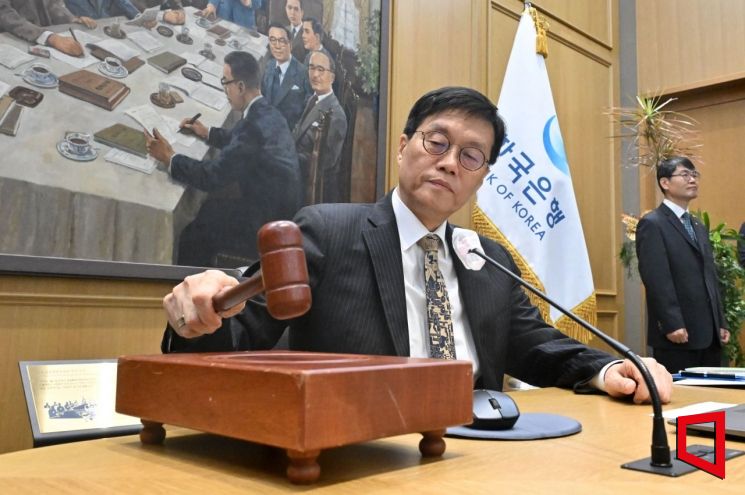 Lee Changyong, Governor of the Bank of Korea, is attending the Monetary Policy Committee plenary meeting held at the Bank of Korea in Jung-gu, Seoul, on the morning of the 23rd, striking the gavel. Photo by Joint Press Corps
The Monetary Policy Committee announced at the monetary policy direction meeting held at the Bank of Korea headquarters in Jung-gu, Seoul, that it would keep the base rate at 2.50% per annum. This marks the third consecutive freeze following July and August, aligning with market expectations. In a recent survey conducted by The Asia Business Daily, all 15 experts predicted a rate freeze this month.
The primary reason for this month’s freeze is the overheated real estate market. In Korea, where real estate assets are highly concentrated, heightened expectations of rising home prices, increased transaction volumes, and growing household debt all significantly constrain monetary policy operations. According to weekly apartment price trends released by the Korea Real Estate Board, apartment prices in Seoul surged by 0.54% over the two weeks including the Chuseok holiday, as of October 13. The upward trend was particularly pronounced in the Han River Belt regions such as Seongdong-gu (1.63%), Gwangjin-gu (1.49%), and Mapo-gu (1.29%), where demand for gap investment (sales with jeonse tenants) surged amid expectations that these areas would soon be designated as regulated zones. Preferred areas in southern Gyeonggi Province also saw a greater increase in prices. According to the Seoul Real Estate Information Plaza, the number of apartment transactions in Seoul in September reached 8,090 cases (as of October 23), nearly matching the levels seen in May (7,439 cases) and June (11,023 cases), when transaction volumes spiked.
Some interpret the freeze as an effort to align with government policy measures. With the recent resurgence in Seoul housing prices following the June 27 measures and the subsequent introduction of the October 15 measures, there is no reason for the Bank of Korea to lower rates, which could reignite the market and create policy discord. Ahn Yeha, a researcher at Kiwoom Securities, noted, “Given the strength of the new regulations, the Bank of Korea has also opted for a freeze as part of policy coordination.” Lee Changyong, Governor of the Bank of Korea, also reiterated during the National Assembly’s Planning and Finance Committee audit on October 20, “From the Bank of Korea’s perspective, we do not intend to further increase liquidity and fuel the real estate market.” The Monetary Policy Committee is expected to pay closer attention than ever to market conditions over the next month, until the next rate decision in November, to confirm whether the housing market is stabilizing.
The recent volatility and instability in the exchange rate have also been a burden. The won-dollar exchange rate has climbed to around the 1,430 won level amid uncertainty over investment negotiations with the United States, coupled with renewed concerns over a possible resumption of the US-China trade dispute. In such circumstances, lowering the base rate could further weaken the value of the won. With the real estate market showing no signs of stabilizing and concerns growing over increased volatility in the foreign exchange market, caution regarding a rate cut has intensified.
Market opinions are divided on the timing of the next rate cut. While many expect a cut in November, an increasing number of experts predict that the timing may be pushed back to the first or second half of next year. Some believe that with continued instability in the real estate market and improving export prospects, the rate cut cycle has effectively ended.
Moon Hongcheol, a researcher at DB Financial Investment, emphasized, “In the short term, exchange rate instability due to negotiations with the United States remains, and core real estate prices are still rising. However, with domestic demand under pressure and inflation generally stable, a rate cut is likely within the year.” On the other hand, Park Jungwoo, an economist at Nomura Securities, argued, “The instability in the real estate market is due to structural factors such as supply shortages, and the current demand-side policies focused on loan regulations will only have a short-term effect. Export prospects are also likely to be revised upward next year. I believe the rate cut cycle has effectively ended.”
© The Asia Business Daily(www.asiae.co.kr). All rights reserved.
![Clutching a Stolen Dior Bag, Saying "I Hate Being Poor but Real"... The Grotesque Con of a "Human Knockoff" [Slate]](https://cwcontent.asiae.co.kr/asiaresize/183/2026021902243444107_1771435474.jpg)
















