Key Sticking Points Remain in Korea-U.S. Tariff Negotiations
If Talks Proceed Smoothly, Security Achievements May Also Be Announced
No Disclosure Even of Agreed Items If Differences Remain
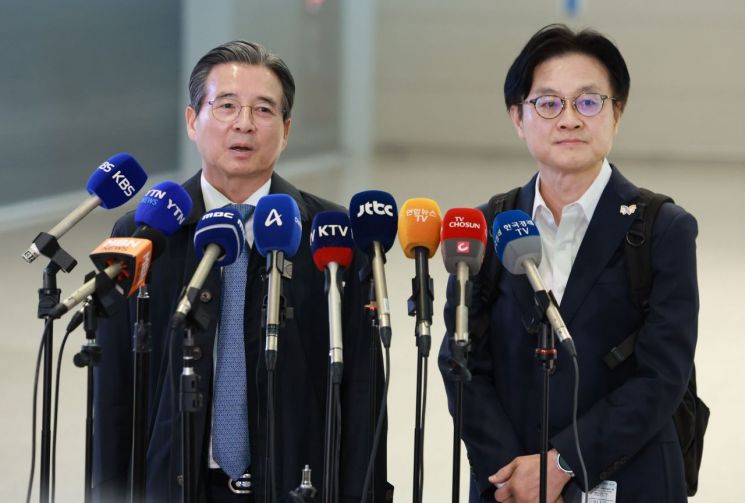
Kim Yongbeom, Chief Presidential Secretary for Policy, who will be visiting Washington, D.C. for tariff negotiations with the United States, told reporters at Incheon International Airport on the 22nd, "Although the two countries have narrowed their differences on many issues, there are still one or two areas where opinions remain sharply divided." He added, "The government is not considering signing a memorandum of understanding (MOU) based only on the contents agreed upon up to a certain point while outstanding issues remain."
On this day, President Lee Jaemyung did not schedule any official events and instead reviewed key pending issues, including the U.S. tariff negotiations. In particular, President Lee emphasized the significance of the Win-Win Cooperation Job Fair held on the 21st, expressing hope that the trend of large corporations participating in recruitment would spread to mid-sized companies.
The presidential office is closely monitoring the U.S. tariff negotiations because it considers this a crucial variable for the domestic economy, which is in need of a new leap forward. The administration believes that skillfully responding to the Korea-U.S. tariff negotiations amid changing international dynamics is essential for creating a new turning point for economic growth.
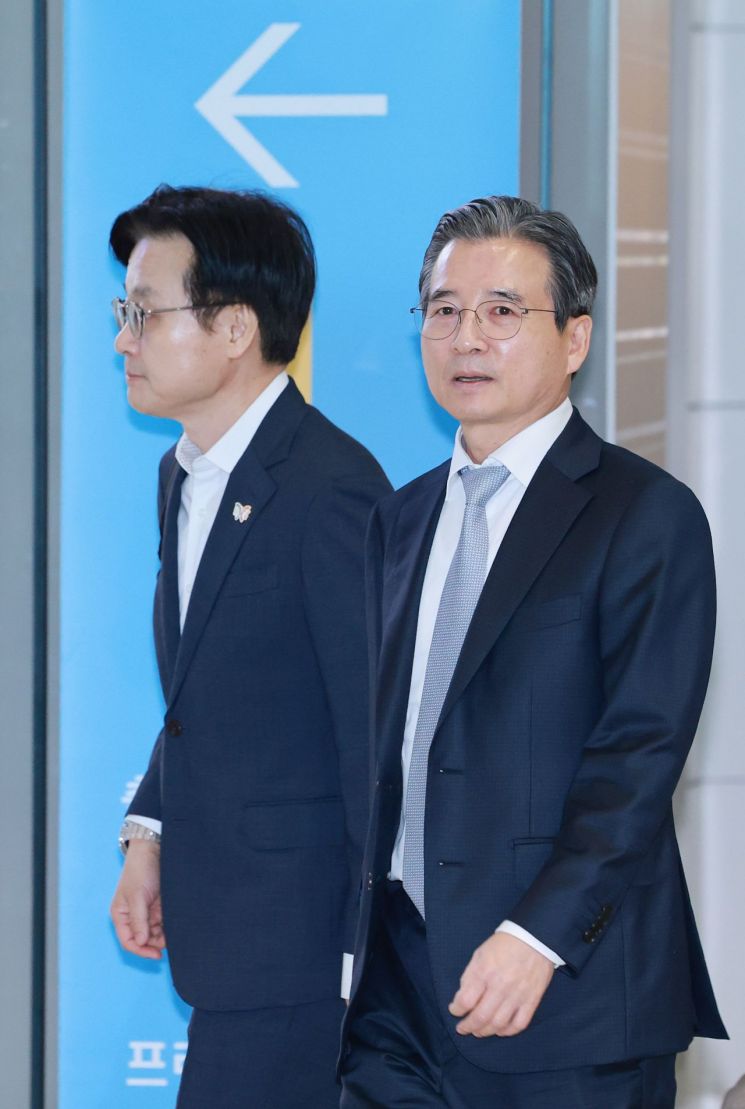
Kim Yongbeom, accompanied by Minister of Trade, Industry and Energy Kim Jeonggwan, explained the background of their departure and key points of interest to reporters at Incheon International Airport just before boarding the plane. Previously, after visiting the United States, Kim Yongbeom returned on the 19th and Minister Kim on the 20th. Kim Yongbeom stated, "This time as well (as last time), I plan to meet with U.S. Secretary of Commerce Howard Lutnick."
Regarding the most pressing issue-the Korea-U.S. tariff negotiations-since the negotiation team reported the results of discussions on the details of the 350 billion dollar (about 500 trillion won) "U.S. investment package" to President Lee on the 21st, the goal is now to fully resolve the remaining one or two contentious issues. Depending on the decisions of the leaders of both countries, it is expected that whether a tariff agreement is reached will be determined before the Asia-Pacific Economic Cooperation (APEC) summit to be held in Gyeongju next week.
It is known that Kim Yongbeom is departing again following President Lee's instructions. An official from the presidential office said, "There are still one or two outstanding issues, and he is going to the United States with the President's position on those matters." If all issues are resolved in this round of negotiations, the parties are expected to begin final coordination on the announcement method and wording.
According to the presidential office and relevant ministries, the U.S. government recently proposed an advanced negotiation plan regarding the "U.S. investment package" that the Korean government has maintained, including: ▲ adjustment of investment amount and phased investment; ▲ adjustment of the ratio of cash investment, guarantees, and loans; ▲ authority to select investment destinations and profit sharing; and ▲ foreign exchange market stabilization measures. This is the result of persistent negotiations by key officials such as Minister of Trade, Industry and Energy Kim Jeonggwan, who have visited the U.S. whenever the opportunity arose to meet their counterparts.
Depending on the level of negotiations, the Korea-U.S. summit at APEC may see not only a tariff reduction agreement but also a security agreement announced simultaneously. Kim Yongbeom said, "There were significant achievements at the last Korea-U.S. summit in Washington, but they were not organized and announced in a unified way to the public," adding, "If the MOU on trade is finalized, I expect that the major achievements tentatively agreed upon at the Washington summit could be announced all at once."
If the agreement proceeds smoothly, issues such as an increase in defense spending, purchases of U.S.-made weapons, and amendments to the nuclear agreement could also be included. However, Kim Yongbeom cautioned, "Negotiations always involve the other party and circumstances can change at any time, so it is difficult to make any predictions in advance."
If Korea and the U.S. fail to narrow their differences, it is likely that no joint statement will be issued at the Korea-U.S. summit during APEC. This means they do not intend to use APEC as the deadline for concluding negotiations. Some observers predict that even if a joint statement or agreement is announced at APEC, the signing of the MOU, which would put the tariff reductions into effect, may be delayed further.
Minister Kim Jeonggwan, who is visiting the U.S. with Kim Yongbeom to meet Secretary of Commerce Howard Lutnick, said, "Rather than being the conclusion of negotiations, I think there will be continued tension until the very last moment," emphasizing, "We will do our utmost to ensure that our national interests are reflected in the final agreement, right up to the last minute and second."
Meanwhile, President Lee stated via a social media message on this day, "The government and companies have come together as a 'one team' to address the urgent challenge of creating jobs for young people. The Win-Win Cooperation Job Fair held yesterday is the fruit of that cooperation and a meaningful event that demonstrated new hope." He added, "The employment issue cannot be solved by government efforts alone. That is why we requested active participation from companies last month."
President Lee said, "Many companies, including Samsung, SK, POSCO, and Hanwha, have announced recruitment plans and joined this initiative. I hope this trend will spread to mid-sized companies as well. The government will also devise every possible support measure, including economic incentives, so that companies can actively engage in hiring." President Lee added, "I envision a society where companies provide young people with opportunities to take on challenges, and young people drive innovation within companies-a virtuous cycle of mutual growth. I dream of a society where young people work at their desired workplaces through their own efforts, receive fair compensation for their labor, and create a better tomorrow."
© The Asia Business Daily(www.asiae.co.kr). All rights reserved.
![Clutching a Stolen Dior Bag, Saying "I Hate Being Poor but Real"... The Grotesque Con of a "Human Knockoff" [Slate]](https://cwcontent.asiae.co.kr/asiaresize/183/2026021902243444107_1771435474.jpg)
















