On the morning of October 22, at approximately 8:10 a.m., North Korea launched a ballistic missile into the East Sea. This marks the first such launch since the inauguration of the Lee Jaemyung administration, drawing particular attention as it comes just ahead of U.S. President Donald Trump's visit to South Korea for the upcoming Asia-Pacific Economic Cooperation (APEC) summit next week.
The Joint Chiefs of Staff announced in a press briefing that "several projectiles, presumed to be short-range ballistic missiles, were detected as being launched northeastward from the Chunghwa area in North Hwanghae Province, North Korea."
According to the military, the detected North Korean missile flew approximately 350 kilometers. However, regarding the exact specifications, the authorities stated that "South Korea and the United States are conducting a detailed analysis." The Joint Chiefs of Staff added, "South Korean and U.S. intelligence agencies had been monitoring signs of North Korea's missile launch preparations in advance, and tracked the launch immediately after detection. Relevant information was closely shared with the United States and Japan." They further emphasized, "Our military, under a robust South Korea-U.S. combined defense posture, is closely monitoring North Korea's various activities and maintaining the capability and readiness to respond overwhelmingly to any provocation."
In response, the National Security Office at the presidential office convened an emergency security situation assessment meeting on the morning of October 22, attended by officials from the National Security Office, the Ministry of National Defense, and the Joint Chiefs of Staff. In a press release, the presidential office stated, "We have been monitoring the North Korean ballistic missile launch situation in real time and reporting relevant developments to the President, while closely observing the situation. Through the emergency security situation assessment meeting, we reviewed the response measures of the National Security Office, the Ministry of National Defense, and the military, and assessed the potential impact on the Korean Peninsula." The office added, "We will continue to closely monitor related developments, including the possibility of additional missile launches by North Korea, and will review necessary measures accordingly."
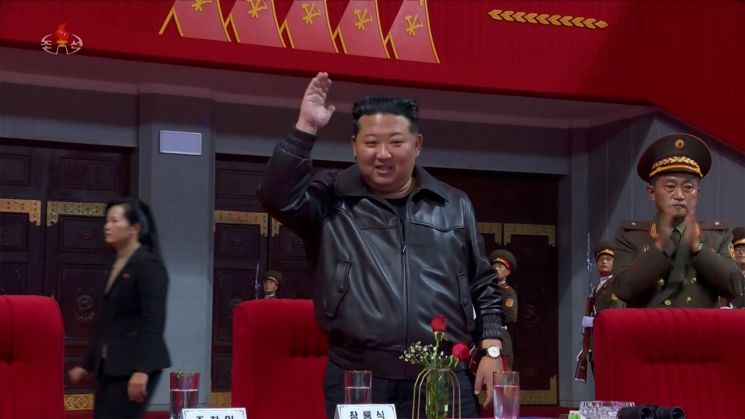
This latest ballistic missile provocation by North Korea comes about five months after it last launched multiple types of short-range ballistic missiles (SRBMs) on May 8. The timing is particularly noteworthy, as President Trump is scheduled to visit South Korea next week, raising the possibility of a surprise summit between the leaders of North Korea and the United States. The United Nations Command, which oversees Panmunjom, is reportedly suspending special tours of the Joint Security Area (JSA) during President Trump's visit. U.S. media have also reported that the U.S. government is privately discussing a possible meeting with Kim Jong Un, Chairman of the State Affairs Commission of North Korea.
However, there remains considerable caution regarding whether a North Korea-U.S. summit will actually take place. North Korea seeks to be recognized as a nuclear-armed state by the United States and others, but this is virtually impossible to accept, as it would violate the Nuclear Non-Proliferation Treaty (NPT), a commitment of the international community. Observers also note that, unlike in 2019, North Korea is unlikely to rush into dialogue with the United States, given its current economic cooperation with Russia and China.
Hong Min, Senior Research Fellow at the Korea Institute for National Unification, commented, "Launching a missile a week before the APEC summit, at a time when significant political and security repercussions are expected, is a move with strong political intent." He added, "The provocative nature can be interpreted differently depending on how close it is to APEC; if it had been three days prior, it could be seen as a major challenge threatening APEC, but launching it a week in advance appears to be a calculated show of force aimed at signaling North Korea's presence and sending a message, while avoiding being interpreted as excessively provocative." He further explained, "North Korea tends to launch missiles during such events either to assert its presence and position when excessively isolated early in a regime, or when it feels confident in a favorable situation. This time, it is closer to the latter, aiming to strongly highlight its stance on North Korea-related discussions that may arise at the APEC summit. Regardless of the possibility of a North Korea-U.S. summit, North Korea is signaling that it is not fixated on dialogue and will continue to focus on strengthening its nuclear capabilities."
© The Asia Business Daily(www.asiae.co.kr). All rights reserved.
![Clutching a Stolen Dior Bag, Saying "I Hate Being Poor but Real"... The Grotesque Con of a "Human Knockoff" [Slate]](https://cwcontent.asiae.co.kr/asiaresize/183/2026021902243444107_1771435474.jpg)















