Jeonse Shortage Deepens Amid Loan Regulations
"Conversion from Jeonse to Monthly Rent Likely to Continue for Now"
The average monthly rent for apartments in Seoul has reached a record high of 1.44 million won, breaking previous records. With the supply of jeonse (lump-sum deposit leases) decreasing, government lending regulations and changes in the lease system are rapidly increasing the burden of monthly rent.
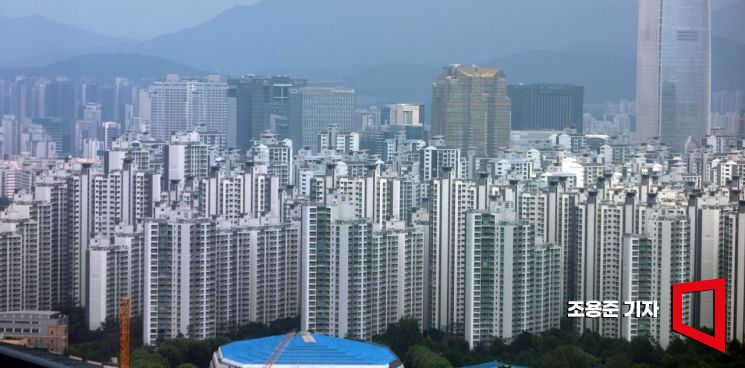
According to the Korea Real Estate Board on October 20, the average monthly rent for apartments in Seoul last month was 1.44 million won, the highest since statistics began. The average monthly rent, which was 1.34 million won in January this year, has continued to rise for nine consecutive months.
This trend is largely influenced by the June 27 lending regulations. By limiting the maximum amount of mortgage loans to 600 million won, it has become more difficult for genuine homebuyers to purchase homes, leading to an increase in tenants renewing their jeonse contracts. In fact, of the 32,838 apartment jeonse contracts in Seoul from July to September this year, 44% were renewals, up 14 percentage points from the same period last year (30%).
As contract renewals continued, the supply of jeonse properties on the market sharply declined. According to the real estate big data platform Asil, the number of apartment jeonse listings in Seoul dropped by 22.9%, from 31,814 in January to 24,442 this month. As a result, tenants unable to find new jeonse homes have been pushed into the monthly rent market.
By district, Gwangjin District saw the largest increase, rising 3.48% to 1.69 million won compared to June. Songpa (3.33%), Gangdong (3.13%), and Yeongdeungpo (2.7%) followed.
Last month, the monthly rent price index for Seoul apartments was 101.97, up 0.30% from the previous month. The monthly rent price index uses March of this year as a baseline of 100 to indicate changes in monthly rent.
A representative from the Korea Real Estate Board stated, "The average price, which serves as a supplementary indicator for the housing price trend survey, responds sensitively depending on the composition of sample price distribution," and added, "To understand market trends over time, it is important to check the index fluctuation rate."
The trend of jeonse contracts converting to monthly rent is expected to become even more pronounced for the time being. The government has designated all of Seoul as a land transaction permit zone, blocking gap investment that would have led to more jeonse listings. Mortgage loan regulations have also been further tightened, with the limit set at 400 million won for homes exceeding 1.5 billion won and 200 million won for homes exceeding 2.5 billion won. As a result, the supply of jeonse is expected to shrink further.
In addition, moves to revise the Lease Protection Act are accelerating the shift to monthly rent. The amendment proposed by Assemblyman Han Changmin of the Social Democratic Party would increase the right to request contract renewal from once to twice and extend the lease period upon renewal from two years to three years. There are concerns that if the bill passes, landlords will have less incentive to offer jeonse contracts.
A real estate industry representative commented, "The structure of decreasing jeonse listings and increasing monthly rent share is likely to continue for some time," adding, "As the conversion from jeonse to monthly rent accelerates, the housing cost burden on tenants will inevitably grow."
© The Asia Business Daily(www.asiae.co.kr). All rights reserved.
![Clutching a Stolen Dior Bag, Saying "I Hate Being Poor but Real"... The Grotesque Con of a "Human Knockoff" [Slate]](https://cwcontent.asiae.co.kr/asiaresize/183/2026021902243444107_1771435474.jpg)











