Some Suggest the Possibility of Chinese Rocket Space Debris
Rare for Spacecraft Debris to Be Found Burning
A large piece of debris was discovered on fire in an Australian desert, prompting local authorities to launch an investigation. The local police have initially announced that it is presumed to be space debris that re-entered Earth's atmosphere. On October 20 (local time), British daily The Guardian and other outlets reported that around 2 p.m. on October 18, miners from the mining town of Newman in Western Australia found a mysterious object burning on a remote road about 30 kilometers from the Pilbara desert.
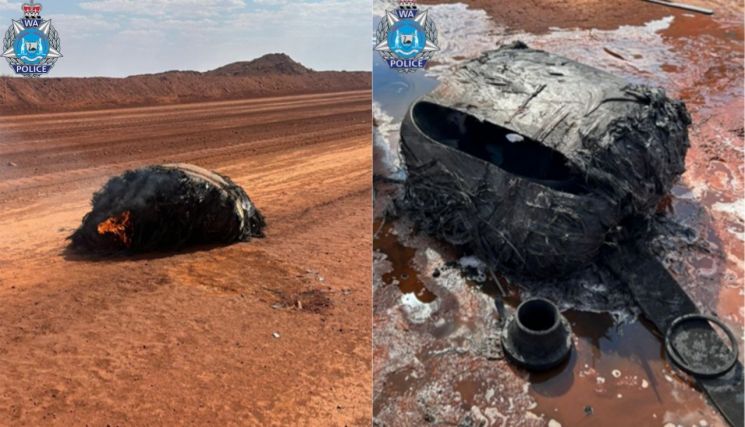 An unidentified object discovered around 2 p.m. on the 18th in the desert near the Newman mining area in Western Australia. Western Australia Police Department Facebook
After discovering the object, the miners immediately reported it to the fire authorities. Currently, the fire department, police, Australian Space Agency, and mining operators are conducting a joint investigation. The Australian Transport Safety Bureau stated that the debris is unrelated to commercial aircraft. Meanwhile, local police announced through social media that "the initial assessment indicates the object is made of carbon fiber and is likely a pressure vessel or rocket tank covered with composite material," adding, "It appears to match previously identified space debris." A pressure vessel covered with composite material is a tank used to store high-pressure fluids on spacecraft.
Alice Gorman, a professor of space archaeology at Flinders University in Australia who mainly studies human-made objects left in outer space, speculated that the object could be the fourth stage of the Jielong-3 rocket launched by China in September. The Jielong rocket is a Chinese solid-fuel rocket mainly used for commercial satellite launch missions. Previously, in September, China launched the Jielong rocket multiple times.
In particular, Professor Gorman stated, "There was a Jielong rocket launched at the end of September, and if this debris is from the rocket launched on September 25, it must have orbited the Earth for a while before suddenly appearing," adding, "It was difficult to anticipate because there were no recent signs of re-entry." She continued, "I checked re-entry prediction systems, but there was nothing. This shows just how sudden this re-entry was."
Increase in Rocket Launches Leads to More Frequent Space Debris Falling to Earth
It is rare for space debris to be found on the ground, as launches are designed from the outset to minimize the possibility of debris falling to Earth. To this end, plans are made to bring aging spacecraft (including rockets) back under controlled re-entry, and they are designed to burn up easily from frictional heat in the atmosphere during re-entry, preventing large fragments from reaching the ground. Furthermore, since most of Earth's surface is water (oceans), space debris is far more likely to fall into the sea.
 As the number of rocket launches has recently increased significantly, incidents of space debris deviating from planned orbits or falling to the ground have become frequent. Professor Gorman emphasized that rocket launch operators must have an "end-of-life plan" for rockets and other objects left in space. The photo shows SpaceX's mega rocket Starship and is not related to the specific content of the article. Photo by AP Yonhap News
For example, the space debris that washed up on a Western Australian beach in 2023 also fell into the ocean. However, as the number of rocket launches has recently increased significantly, incidents of space debris deviating from planned orbits or falling to the ground have become frequent. Professor Gorman emphasized that rocket launch operators must have an "end-of-life plan" for rockets and other objects left in space. She pointed out that even today, as incidents of space debris falling to Earth are increasing, it is still rare for debris to be found while burning, as it usually falls in places out of sight. The Australian Space Agency has cautioned the public never to touch debris if found, as hazardous materials may remain on space debris.
Meanwhile, the previous day, a U.S. aircraft was forced to make an emergency landing after being struck by an unidentified object at an altitude of 36,000 feet (10,972 meters). Fortunately, the passenger plane made a safe emergency landing, but the incident nearly resulted in a major accident, leaving aviation authorities and officials deeply relieved. Notably, it was a harrowing accident in which the pilot was injured by the unidentified object that broke through the front windshield. The object that struck the aircraft is suspected to be space debris.
© The Asia Business Daily(www.asiae.co.kr). All rights reserved.
![Clutching a Stolen Dior Bag, Saying "I Hate Being Poor but Real"... The Grotesque Con of a "Human Knockoff" [Slate]](https://cwcontent.asiae.co.kr/asiaresize/183/2026021902243444107_1771435474.jpg)

















