Stress, Depression, and Suicide Rates Below National Average
'Life-Respect Safe Village' Initiative to Expand to All Neighborhoods by Next Year
Gwangmyeong City in Gyeonggi Province has taken steps to strengthen its support system for citizens' mental health through three major mental safety nets: mental health, suicide prevention, and memory care.
On the 21st, Gwangmyeong City held a policy briefing in the city hall's main conference room to present the achievements and future direction of its 'Gwangmyeong-style Mental Health Policy.'
Hyun-sook Lee, director of the Gwangmyeong City Health Center, stated, "We will further strengthen the emotional and mental support system by expanding the operations of the Mental Health Welfare Center, Suicide Prevention Center, and Dementia Relief Center, and by improving accessibility so that anyone can receive support for their mental well-being at any time."
Mental Health Improved through Institutional and Community Collaboration
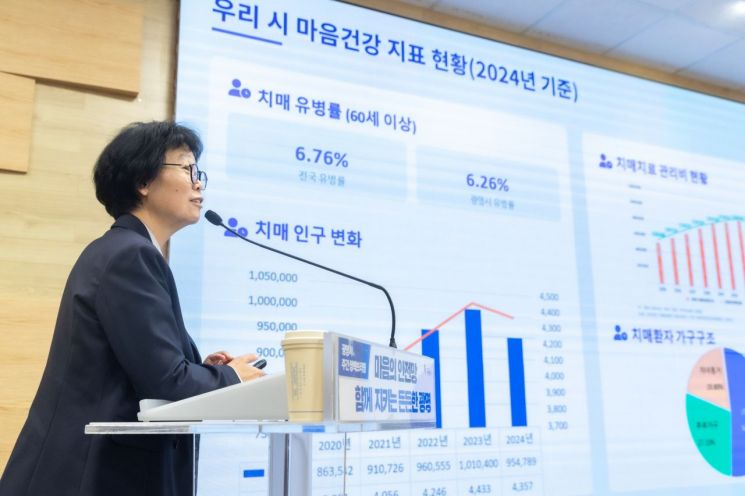 Hyun-Sook Lee, director of the Gwangmyeong City Health Center, is explaining the status of the city's three major mental safety net constructions through a policy briefing on the 21st. Provided by Gwangmyeong City
Gwangmyeong City is building a comprehensive mental safety net centered on the Mental Health Welfare Center, Suicide Prevention Center, and Dementia Relief Center, covering prevention, counseling, treatment, and awareness improvement.
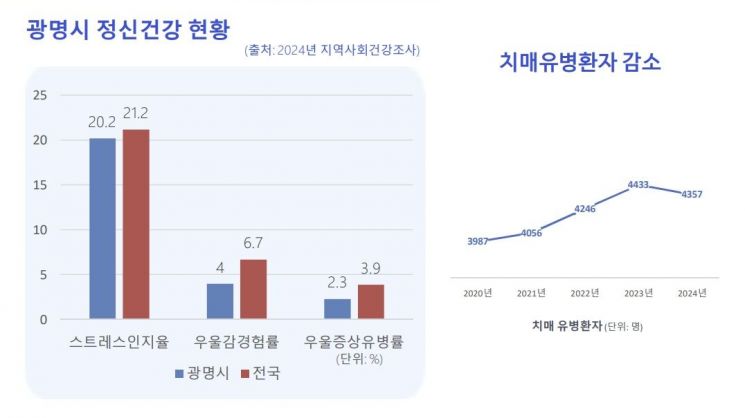
As a result, the city maintains mental health indicators above the national average. According to the Korea Disease Control and Prevention Agency's '2024 Community Health Survey,' the stress awareness rate in Gwangmyeong City was 20.2%, lower than the national average of 21.2%. The rates of experiencing depression and the prevalence of depressive symptoms were also significantly lower at 4% and 2.3%, respectively, compared to the national averages.
The suicide mortality rate was 22.7 per 100,000 people, which is noticeably lower than the national average of 29.1 and the Gyeonggi Province average of 28.1. The prevalence of dementia among those aged 60 and older was 6.26%, also lower than the national average of 6.76%.
Strengthening Tailored Mental Health Services for Children, Adolescents, and Those with Severe Mental Illness
The city's Mental Health Welfare Center has been carrying out a wide range of programs, from promoting mental health in children and adolescents to managing severe mental illnesses. In particular, the city has established a 'Mental Health Crisis Response Council' through collaboration among the health center, police station, fire station, and medical institutions, enabling a rapid and practical crisis response system.
From the beginning of this year to the end of September, the council intervened in 325 crisis situations involving 42 individuals. Through these efforts, the city is able to identify citizens in crisis early and provide active support.
To efficiently manage the main risk and protective factors for the increasing mental health challenges among adolescents, the city is also enhancing its mental health surveys for this group. Based on survey results targeting middle and high school students as well as out-of-school youth within the city, Gwangmyeong plans to establish youth-specific mental health policy directions and build a support system tailored to their needs.
For individuals with severe mental illnesses, the city provides not only financial support for treatment but also customized recovery programs such as employment connections, communication groups, and vocational rehabilitation. As a result, satisfaction with case management services for those with severe mental illnesses rose from 85% in 2023 to 88% last year.
The number of counseling sessions at the Mental Health Welfare Center also increased by 26.5%, from 5,693 in 2023 to 7,200 last year.
'Life-Respect Safe Village' to Expand Citywide Next Year... Spreading a Culture of Life Respect
The city continues to strengthen its community-based mental health policies. By actively utilizing local resources and networks, Gwangmyeong is building a mental health support system at the neighborhood level.
In particular, the city plans to expand the 'Life-Respect Safe Village' initiative, currently involving 11 neighborhoods, to all 19 neighborhoods by next year. This program is a community-based initiative in which the entire village-including residents, institutions, and businesses-takes on the role of life guardians, going beyond a health center-led suicide prevention safety net.
The Life-Respect Safe Village program builds a robust suicide prevention safety net through various activities, such as identifying high-risk groups, conducting awareness campaigns, providing suicide prevention education, and restricting access to means of suicide.
Since last year, the city has also established a 'Mental Health Center' that jointly operates the Suicide Prevention Center and the Mental Health Welfare Center, providing comprehensive mental health services where counseling, treatment, and crisis response are seamlessly integrated.
From Prevention to Awareness Improvement... Becoming a Dementia-Friendly City
To respond to the increasing number of dementia cases due to an aging population, the city has made early detection of dementia and the creation of a dementia-friendly environment its key priorities.
To this end, the city has improved early detection rates by offering on-site dementia screening and high-risk group assessments, as well as allowing all Gwangmyeong citizens to receive dementia screening regardless of age.
To improve dementia awareness and foster community consensus, the city is also creating 'Dementia Relief Villages.' Four locations have been designated as Dementia Relief Villages, where programs such as resident education, dementia partner training, volunteer group operations, and environmental improvements are being expanded. This year, the city is conducting 'Dementia Partner Education' for elementary school students to help improve awareness among future generations.
In addition, the city is implementing various programs, including customized cognitive enhancement home visits for seniors with limited mobility, support for families of dementia patients, and the operation of dementia specialist volunteer groups.
Mayor Park Seungwon of Gwangmyeong stated, "We will strengthen cooperation with the local community and expand tailored mental health programs for each target group," adding, "We aim to create an inclusive and sustainable community where every citizen can confidently care for their mental health."
© The Asia Business Daily(www.asiae.co.kr). All rights reserved.
![Clutching a Stolen Dior Bag, Saying "I Hate Being Poor but Real"... The Grotesque Con of a "Human Knockoff" [Slate]](https://cwcontent.asiae.co.kr/asiaresize/183/2026021902243444107_1771435474.jpg)
















