Exports at $30.1 Billion, Imports at $33.0 Billion
Down 7.8% and 2.3% Respectively
Semiconductor Exports Up 20%
But Automotive Sector Plunges 25%
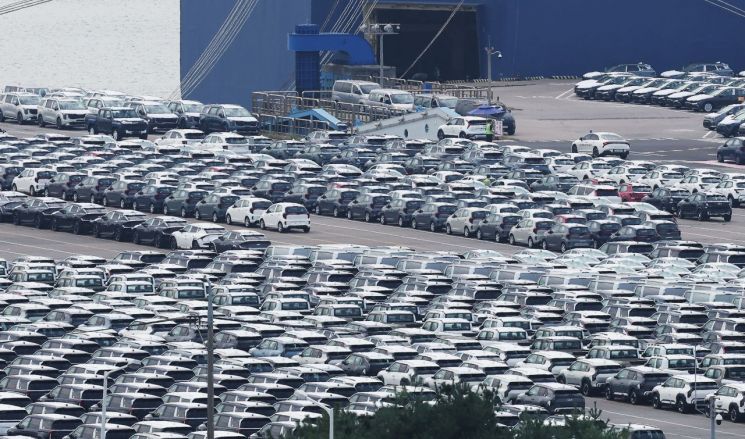
Semiconductors saw gains, but the automotive sector faltered. There is a risk that exports in October may return to negative territory after three months. Despite a more than 20% increase in semiconductors, which are a key export item, exports of non-IT products such as passenger cars, home appliances, and wireless communication devices plummeted across the board, leading to an overall export decline of over 7%. Exports to the United States dropped by 25%, and sluggish exports to China and Vietnam resulted in a trade deficit.
According to the "Export and Import Trends for October 1-20, 2025 (Preliminary)" released by the Korea Customs Service on October 21, exports during this period amounted to 30.1 billion dollars, a 7.8% decrease from the same period last year (32.7 billion dollars). Imports totaled 33.0 billion dollars, down 2.3%, resulting in a trade deficit of 2.8 billion dollars. Although the number of working days was two days fewer than the same period last year, the average daily export value increased by 9.7%, indicating that the export base has been partially maintained.
By product, semiconductors (up 20.2%), petroleum products (up 10.9%), and ships (up 11.7%) continued to rise, but passenger cars (down 25.0%), wireless communication devices (down 17.7%), auto parts (down 31.4%), and home appliances (down 26.5%) in the finished car and electronics sectors saw sharp declines.
In particular, semiconductor exports reached 8.5 billion dollars, accounting for 28.3% of total exports, with their share rising by 6.6 percentage points year-on-year. However, this was not enough to offset the slump in durable goods such as automobiles and mobile phones.
By country, exports to Taiwan (up 58.1%), Hong Kong (up 4.9%), and Singapore (up 5.3%) increased, while exports to China (down 9.2%), the United States (down 24.7%), and Vietnam (down 10.0%) decreased.
The sharp drop in exports to the United States is attributed to weakened demand for manufacturing-centered items such as automobiles and batteries. The reduction in electric vehicle subsidies and prolonged high interest rates in the United States have eroded consumer purchasing power, while inventory adjustments by finished car importers have also had an impact.
Exports to China also declined due to reduced orders for semiconductor equipment and machinery. This is the result of a slowdown in China's manufacturing sector combined with a restructuring of IT supply chains. In contrast, demand for Korean semiconductors surged in Taiwan due to increased imports of memory semiconductors and components for artificial intelligence (AI) servers.
The top three export destinations (China, the United States, and Taiwan) accounted for 45.7% of the total, with the expansion of semiconductor-focused exports to Taiwan driving structural changes overall.
During the same period, imports amounted to 33.0 billion dollars, a 2.3% decrease from the previous year. By product, imports of crude oil (up 12.6%), semiconductors (up 0.8%), and passenger cars (up 41.7%) increased, while imports of gas (down 35.0%), machinery (down 2.3%), and coal (down 18.5%) in the energy and equipment sectors declined. Total energy imports (crude oil, gas, coal) fell by 3.8%, reflecting the stabilization of international oil prices and a drop in natural gas prices.
By country, imports from the United States (up 2.3%), Australia (up 30.7%), Taiwan (up 16.2%), and Vietnam (up 9.1%) increased, while imports from China (down 11.6%) and the European Union (down 2.3%) decreased. In particular, imports from China amounted to 6.6 billion dollars, down 11.6% from the same period last year, accounting for only 20% of the total.
An official from the Korea International Trade Association explained the background of the export decline: "The slowdown in consumption in the United States and Europe has had a direct impact on exports of durable goods such as automobiles and home appliances, and the slow recovery of China's manufacturing sector has weakened the virtuous cycle of demand within East Asia."
However, considering the difference in the number of working days, the average daily export value increased by 9.7%, which suggests that, in the short term, export recovery is being maintained. An official from the Korea Customs Service stated, "Despite having two fewer working days than last year, the average daily export value actually increased," adding, "Exports led by semiconductors and petroleum products supported the overall performance."
The trade industry expects that, starting in November, the year-end peak season and expanding demand for AI servers will lead to a full-fledged recovery in semiconductor-driven exports. However, there are concerns that if demand for non-IT products such as automobiles and home appliances continues to recover slowly and the timing of global interest rate cuts is delayed, the recovery could be limited.
© The Asia Business Daily(www.asiae.co.kr). All rights reserved.
![Clutching a Stolen Dior Bag, Saying "I Hate Being Poor but Real"... The Grotesque Con of a "Human Knockoff" [Slate]](https://cwcontent.asiae.co.kr/asiaresize/183/2026021902243444107_1771435474.jpg)















