38 Patients from 5 European Countries Participate, Clinical Trial Succeeds
"Reading and Recognizing Faces"... A New Paradigm in Macular Degeneration Treatment
In Europe, an innovative clinical trial involving the implantation of a chip at the back of the eye has enabled blind patients to partially regain their vision.
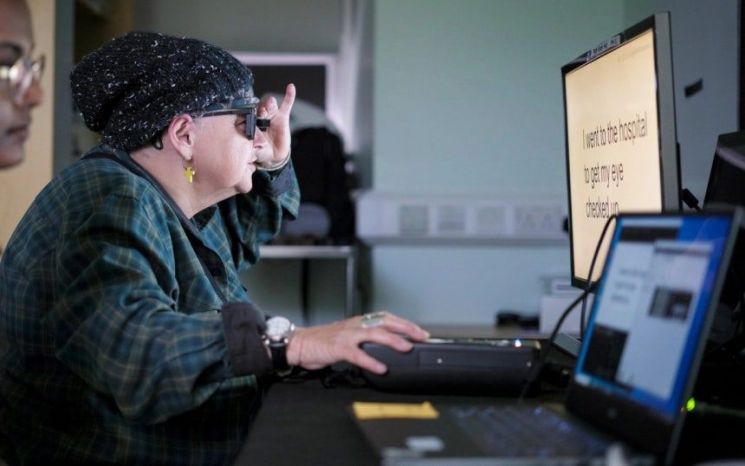 A clinical participant reading text with special glasses after chip implantation. Photo by Moorfields Eye Hospital website
According to the Telegraph on October 20 (local time), 38 blind patients from five countries- the United Kingdom, France, Germany, Italy, and the Netherlands- participated in a clinical trial of the “Prima” implant, developed by the California-based biotech company Science Corporation.
These participants were patients with dry age-related macular degeneration (AMD), specifically a condition called “geographic atrophy (GA).” They received an ultra-small photonic microchip, 2 mm in diameter and about as thick as a human hair, implanted under the retina. After the procedure, the patients wore special glasses equipped with a video camera. The camera converts images into infrared signals, which are transmitted to the chip inside the eye. The signals are then sent to a small portable processor, which restores the visual information.
The signals are refined by the portable processor and then delivered to the brain via the implant and the optic nerve. The patients underwent months of training to interpret this new type of visual information, and as a result, 27 out of the 32 recipients were able to use their central vision to read again.
Mahit Mukit, a specialist at Moorfields Eye Hospital in London who led the UK arm of the clinical trial, stated, “These were elderly people who had lost their ability to read, write, and recognize faces due to vision loss. They have emerged from darkness and regained their sight.” He described the results as “an unprecedented achievement that opens a new era in the history of artificial vision.”
The Medical Community: “A Paradigm Shift in End-Stage AMD Treatment”
The study was published in the New England Journal of Medicine. Frank Holz, a professor at the University of Bonn in Germany and the lead author, said, “For the first time, we have confirmed that it is possible to restore central vision in patients blinded by geographic atrophy,” adding, “This will change the paradigm of end-stage AMD treatment.”
Sheila Irvine, a 70-year-old participant, said, “I was an avid reader and wanted to regain that part of my life. It was truly thrilling when I suddenly started to see the shapes of letters again, which I could not see at all before.” However, she added, “Because I have to keep my head still and wear the special glasses, I do not use the device outdoors.”
Currently, the Prima implant is not yet commercially available and can only be accessed through clinical trials; the cost has not been determined. Dr. Mukit commented, “I hope it will be provided through the National Health Service (NHS) within a few years.” However, the BBC reported that those with congenital visual impairment are unlikely to benefit, as their optic nerves do not function.
© The Asia Business Daily(www.asiae.co.kr). All rights reserved.
![Clutching a Stolen Dior Bag, Saying "I Hate Being Poor but Real"... The Grotesque Con of a "Human Knockoff" [Slate]](https://cwcontent.asiae.co.kr/asiaresize/183/2026021902243444107_1771435474.jpg)















